Important Information
This website is managed by Ultima Markets’ international entities, and it’s important to emphasise that they are not subject to regulation by the FCA in the UK. Therefore, you must understand that you will not have the FCA’s protection when investing through this website – for example:
- You will not be guaranteed Negative Balance Protection
- You will not be protected by FCA’s leverage restrictions
- You will not have the right to settle disputes via the Financial Ombudsman Service (FOS)
- You will not be protected by Financial Services Compensation Scheme (FSCS)
- Any monies deposited will not be afforded the protection required under the FCA Client Assets Sourcebook. The level of protection for your funds will be determined by the regulations of the relevant local regulator.
Note: UK clients are kindly invited to visit https://www.ultima-markets.co.uk/. Ultima Markets UK expects to begin onboarding UK clients in accordance with FCA regulatory requirements in 2026.
If you would like to proceed and visit this website, you acknowledge and confirm the following:
- 1.The website is owned by Ultima Markets’ international entities and not by Ultima Markets UK Ltd, which is regulated by the FCA.
- 2.Ultima Markets Limited, or any of the Ultima Markets international entities, are neither based in the UK nor licensed by the FCA.
- 3.You are accessing the website at your own initiative and have not been solicited by Ultima Markets Limited in any way.
- 4.Investing through this website does not grant you the protections provided by the FCA.
- 5.Should you choose to invest through this website or with any of the international Ultima Markets entities, you will be subject to the rules and regulations of the relevant international regulatory authorities, not the FCA.
Ultima Markets wants to make it clear that we are duly licensed and authorised to offer the services and financial derivative products listed on our website. Individuals accessing this website and registering a trading account do so entirely of their own volition and without prior solicitation.
By confirming your decision to proceed with entering the website, you hereby affirm that this decision was solely initiated by you, and no solicitation has been made by any Ultima Markets entity.
I confirm my intention to proceed and enter this website Please direct me to the website operated by Ultima Markets , regulated by the FCA in the United Kingdom
Ultima Markets App
Trade Anytime, Anywhere





What Is The Rally Base Rally Pattern?
The rally base rally pattern (RBR) is a straightforward way to trade the long side of the market. Instead of buying after price has already exploded higher, the RBR approach focuses on one key idea: buy the base. When the pattern is clean, the base often acts like a demand zone and gives you a logical entry area, an invalidation point for your stop, and a way to plan targets.
The Rally Base Rally (RBR) Pattern
A rally base rally is a three-phase bullish pattern:
- Rally: an impulsive move up
- Base: a short consolidation (price pauses and compresses)
- Rally: another impulsive move up out of the base
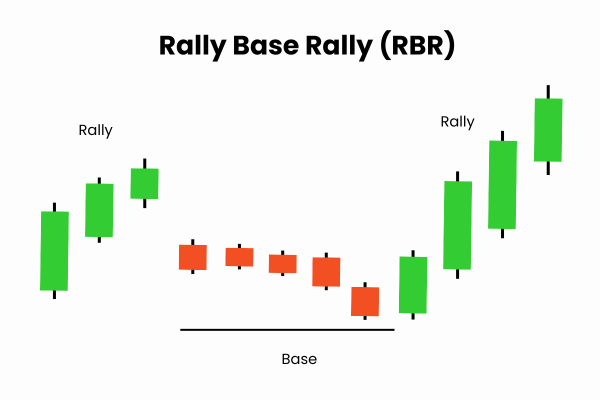
The base is the most important piece. It’s commonly treated as a demand zone, meaning it can serve as both your market entry area and your stop-loss guide. In practical terms, you’re not trying to buy “anywhere”; you’re waiting for price to revisit the basing area that preceded the continuation rally.
How to Identify a High-Quality Rally Base Rally
RBR setups are easy to find, but good RBR setups are not. Quality usually comes down to the clarity of each phase.
1) The first rally should be obvious
Look for a decisive push that stands out from surrounding price action: cleaner candles, less overlap, and a noticeable change in pace. If the “rally” is choppy or slow, the base often becomes just random congestion.
2) The base should be compact
A strong base usually looks like a pause: smaller candles, tighter range, reduced volatility. If the base stretches into a long sideways market with big wicks and wide swings, the zone boundaries get fuzzy and reactions tend to be less reliable.
3) The second rally should leave with strength
The best RBRs look like a breakout. Price exits the base decisively and continues upward, showing that buyers still have control. A weak, drifting departure can still work, but it often provides less edge because there’s no clear imbalance away from the base.
Why RBR Works Better With Confirmation
Many traders treat rally base rally as a pattern plus context. A simple confirmation method is structure: once resistance is broken, it often acts as support on a retest. If price breaks above a prior swing high (or a well-defined level such as a double top), then forms an RBR, the base can be more compelling because the market has already proven it can push through supply.
You can also use other confirmations if they match your style. For example, Fibonacci retracements, momentum tools like RSI/stochastics, or moving averages for trend alignment. The goal isn’t to stack indicators; it’s to avoid taking RBR zones that form in weak locations or against the bigger flow.
How to Draw the Rally Base Rally Demand Zone
To keep your process consistent, draw the zone from the base:
- Identify the base candles between the two rallies.
- Mark the top of the base (often the highest wick within the base).
- Mark the bottom of the base (often the lowest wick within the base).
- Extend the rectangle forward to watch future retests.
Some traders draw wick-to-wick (wider, more forgiving). Others draw body-to-body (tighter, higher reward potential but easier to get wicked out). Choose one method and stick to it so your entries and stops don’t change randomly.
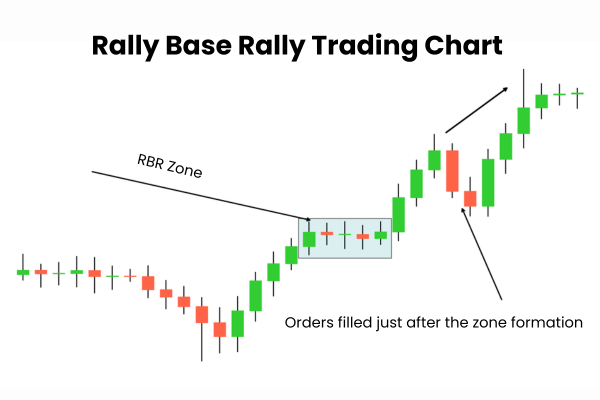
How to Trade the Rally Base Rally
RBR is a buy-side strategy: you profit from bullish price action by buying the base. Most rally base rally trade plans come down to entries, stops, and targets.
Entry options
- Entry 1: buy the top of the base (aggressive)
This aims to catch shallow pullbacks. If price taps the upper portion of the zone and bounces, you’re in. - Entry 2: buy around 50% of the base (more conservative)
This is more patient and can improve entry price, but you may miss trades that only retest the top of the zone.
If you prefer confirmation entries, you can wait for price to touch the zone and then look for a clear bullish response. For example, a strong rejection candle or a short-term break of a micro swing high.
The more confirmation you require, the fewer trades you’ll take. However, the cleaner the ones you do take may feel.
Stop-loss placement
A common RBR stop is placed a small distance beneath the bottom of the base. “a few pips” in forex terms or “a few ticks” in futures terms. The logic is simple: if price breaks cleanly below the base, the demand zone failed and the setup is invalid. Tighter stops can work, but they’re more vulnerable to normal wicks inside the zone.
Targets
- Fixed reward-to-risk targets, such as 1:1, 1:2, or 1:3
- Structure-based targets, such as the prior swing high or the next major resistance/supply area
Whichever method you use, decide the target before you enter. That keeps management logical instead of emotional.
The cardinal rule: reward must justify risk
A simple filter that fits rally base rally well: don’t take the trade unless the potential profit is at least equal to the risk (minimum 1R). If the next resistance level is too close and you can’t realistically reach 1R, the RBR may still be valid, but it’s often not worth the trade.
Notes on the RBR Timeframe
RBR can appear on any timeframe, but consistency improves when you trade a timeframe you can read clearly. Some traders prefer higher timeframes (like 4H in forex) for cleaner structure, while others like intraday charts (such as 30-minute charts) for markets like gold or major indices.
There’s no universal best choice. Pick one timeframe, collect examples, and refine your rules after you have enough data.
Common Mistakes to Avoid
- Marking every pause as a base instead of requiring a decisive rally in and out
- Buying RBR zones directly under nearby resistance (limited upside)
- Putting stops inside the zone where normal wicks happen
- Skipping the reward-to-risk check and taking trades that can’t reach 1R
- Changing zone-drawing or entry rules from trade to trade
Conclusion
The rally base rally pattern is popular because it turns bullish continuation into a structured plan: identify a strong rally, mark the base as your demand zone, and trade the retest with clear risk rules.
Focus on tight bases, strong departures, and simple confirmation, then apply the cardinal rule that reward should be at least equal to risk. With a consistent process, rally base rally becomes less about guessing and more about executing.

FAQs
Rally base rally describes a bullish structure where price rallies, consolidates in a base, then rallies again. Traders often treat the base as a demand zone for future pullbacks.
A rally base rally is commonly treated as a continuation pattern, especially when it forms within an uptrend or during a bullish swing.
Many traders place the stop below the base low (often below the lowest wick of the base). The idea is that a clean break beneath the base invalidates the demand-zone expectation.
Disclaimer: This content is provided for informational purposes only and does not constitute, and should not be construed as, financial, investment, or other professional advice. No statement or opinion contained here in should be considered a recommendation by Ultima Markets or the author regarding any specific investment product, strategy, or transaction. Readers are advised not to rely solely on this material when making investment decisions and should seek independent advice where appropriate.
Latest Articles


FOLLOW US






Ultima Markets is a member of The Financial Commission, an international independent body responsible for resolving disputes in the Forex and CFD markets.

All clients of Ultima Markets are protected under insurance coverage provided by Willis Towers Watson (WTW), a global insurance brokerage established in 1828, with claims eligibility up to US$1,000,000 per account.

Ultima Markets is the first United CFD broker to be part of the United Nations Global Compact.
FOLLOW US
TRADE WITH US
RISK DISCLOSURE
Risk Warning:
Trading leveraged financial products, including Contracts for Difference (CFDs), carries a high level of risk and may result in losses exceeding your initial investment. These products are not suitable for all investors and should only be traded with funds you can afford to lose. You do not own or have any rights to the underlying assets of these derivatives (e.g., entitlement to dividends). Please ensure you fully understand the associated risks. Before trading, consider your level of experience, investment objectives, and seek independent financial advice if necessary. Refer to our legal documents and disclosures before making any trading decisions.
General Advice Warning:
The information provided on this website is general in nature and does not take into account your personal objectives, financial situation, or needs. Before acting on any advice, you should assess its appropriateness in light of your individual circumstances and consult our legal documentation.
Regional Restrictions:
The information and services on this website are not intended for residents of certain jurisdictions, including but not limited to the United States, United Kingdom, Singapore, and any jurisdictions subject to international sanctions. For further information, please contact our customer support team.
Regulatory Information:
Ultima Markets is a trading name shared amongst multiple entities operating in various jurisdictions. These following entities are authorised to operate under the Ultima Markets brand and trademarks.
-
Ultima Markets UK Limited, reference number 470325, is authorised and regulated by the Financial Conduct Authority (FCA). Registered address: 1 Blossom Yard, Fourth Floor, London, E1 6RS, UNITED KINGDOM.
-
Ultima Markets Ltd is authorised and regulated by the Financial Services Commission (FSC) of Mauritius as a Full-Service Investment Dealer (excluding Underwriting), under licence number GB 23201593.
Registered address: 2nd Floor, The Catalyst, 40 Silicon Avenue, Ebene Cybercity, 72201, Mauritius.
-
Ultima Markets EU OÜ, incorporated in Estonia with registry code 17134727. Registered address: Harju maakond, Tallinn, Kristiine linnaosa, Seebi tn 1-1501, 11316. This entity does not offer regulated financial products or provide trading services.

Copyright © 2026 Ultima Markets Ltd. All rights reserved.
-

Messenger


Continue on Messenger
Take the conversation to your Messenger account. You can return anytime.
Scan the QR code and then send the message that appears in your Messenger.
Open Messenger on this device.
-

Instagram

Continue on Instagram
Take the conversation to your Instagram account. You can return anytime.
Scan the QR code to open Instagram. Follow @ultima_markets to send a DM.
Open Instagram on this device.
-

Live Chat
-

