This website is managed by Ultima Markets’ international entities, and it’s important to emphasise that they are not subject to regulation by the FCA in the UK. Therefore, you must understand that you will not have the FCA’s protection when investing through this website – for example:
You will not be guaranteed Negative Balance Protection
You will not be protected by FCA’s leverage restrictions
You will not have the right to settle disputes via the Financial Ombudsman Service (FOS)
You will not be protected by Financial Services Compensation Scheme (FSCS)
Any monies deposited will not be afforded the protection required under the FCA Client Assets Sourcebook. The level of protection for your funds will be determined by the regulations of the relevant local regulator.
Note: UK clients are kindly invited to visit https://www.ultima-markets.co.uk/. Ultima Markets UK expects to begin onboarding UK clients in accordance with FCA regulatory requirements in 2026.
If you would like to proceed and visit this website, you acknowledge and confirm the following:
1.The website is owned by Ultima Markets’ international entities and not by Ultima Markets UK Ltd, which is regulated by the FCA.
2.Ultima Markets Limited, or any of the Ultima Markets international entities, are neither based in the UK nor licensed by the FCA.
3.You are accessing the website at your own initiative and have not been solicited by Ultima Markets Limited in any way.
4.Investing through this website does not grant you the protections provided by the FCA.
5.Should you choose to invest through this website or with any of the international Ultima Markets entities, you will be subject to the rules and regulations of the relevant international regulatory authorities, not the FCA.
Ultima Markets wants to make it clear that we are duly licensed and authorised to offer the services and financial derivative products listed on our website. Individuals accessing this website and registering a trading account do so entirely of their own volition and without prior solicitation.
By confirming your decision to proceed with entering the website, you hereby affirm that this decision was solely initiated by you, and no solicitation has been made by any Ultima Markets entity.
Explore the future of cryptocurrency in 2026 and beyond. Bitcoin forecasts, institutional adoption, stablecoins, DeFi, and AI trading trends explained.
What is the Future of Cryptocurrency 2026 and Beyond
The future of cryptocurrency in 2026 and beyond is shaped by 6 major forces:
Institutional Domination
Bitcoin ETFs, corporate treasury adoption, and Wall Street participation are deepening liquidity and legitimacy. Crypto is no longer retail-only.
Regulatory Clarity
The US GENIUS Act, Europe’s MiCA, and the UK FCA framework are turning crypto from a grey market into a regulated asset class, attracting more capital and trust.
Stablecoins as Financial Infrastructure
With $310B+ in market cap, stablecoins are becoming how the world moves money, faster, cheaper, and borderless. Banks are even building their own.
Real-World Asset Tokenization
Stocks, bonds, real estate, and commodities are moving on-chain. BlackRock and others are turning traditional assets into digital tokens, blurring the line between TradFi and DeFi.
AI-Powered Trading
AI agents are executing trades, managing risk, and analysing markets autonomously. The next generation of crypto trading is faster and smarter than ever.
Bitcoin at New Highs
Forecasts range from $150,000 to $250,000 in 2026, driven by post-Halving supply compression, ETF inflows, and growing scarcity as the 20 millionth BTC is mined.
What Will the Price of Bitcoin Be in 2026?
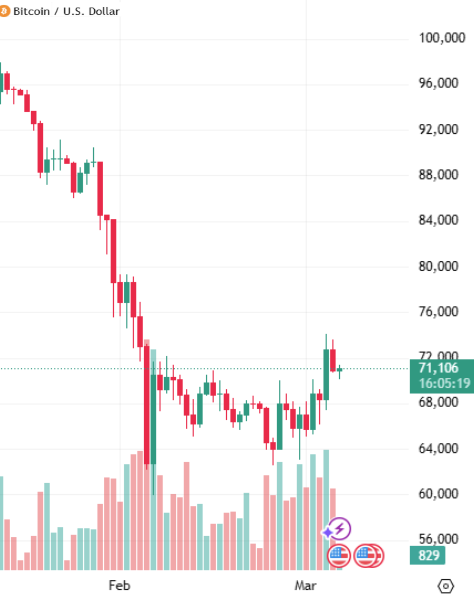
Bitcoin is currently trading around $71,000–$72,000, after a rough stretch that saw it drop to the $60,000–$62,500 support zone twice in February 2026. Bitcoin has posted five consecutive red months starting from October 2025, with February delivering close to 15% in losses.
One of the biggest concerns right now is Bitcoin’s sustained correlation with US equities, with the 30-day rolling correlation between Bitcoin and the S&P 500 sitting at 0.55 as of March 1, 2026. In short, when stocks fall, Bitcoin falls too.
Standard Chartered’s Geoff Kendrick still believes Bitcoin will regain the $100,000 mark in 2026, stating that institutional investors and ETFs will cushion the downside, leading to less extreme total declines compared to previous cycles.
Macroeconomist Henrik Zeberg’s primary scenario targets $110,000–$120,000 for Bitcoin, but his technical analysis warns that if the $60,000–$62,500 support level breaks with conviction, the next target is $50,000, representing approximately 30% further downside.
Prediction markets are now skeptical of the $150,000 target, a significant reversal from three months ago when 44% of bettors believed Bitcoin could reach that level in 2026. Trump’s tariff policies and a pullback in risk appetite are cited as key headwinds.
Is Crypto Going Mainstream?
Yes, and it already has at the institutional level.
Wall Street is all in.
Major financial institutions including BlackRock, Fidelity, BNY Mellon, Goldman Sachs, Morgan Stanley, Citi, and JPMorgan have all opened crypto desks, custody services, or blockchain-based settlement platforms. Over 80% of institutional investors now see a role for crypto in their portfolios.
The US government holds Bitcoin.
The US government announced a plan to include Bitcoin in its strategic reserves, lawmakers passed a clear legislative framework for stablecoins, and US financial regulators adopted a pro-crypto approach, moves that would have been unthinkable five years ago. YouHodler
Crypto ETFs are exploding.
Crypto exchange-traded funds are projected to surpass $400 billion in assets under management in 2026, becoming strategic allocation tools rather than speculative vehicles. Nasdaq
Ownership is climbing.
28% of Americans now own cryptocurrency, and 61% of current crypto owners plan to buy even more in 2026.
What Big Changes Are Coming to Cryptocurrency in 2026?
A Complete Regulatory Overhaul Is Underway
This is the single biggest structural change happening right now. The US Congress is poised to adopt a market infrastructure bill that would set out a comprehensive regulatory regime for digital asset brokers, dealers, and exchanges, bringing greater clarity to when transactions in crypto assets may be regulated as offers or sales of securities.
The GENIUS Act has not only created a federal regulatory framework for stablecoin issuers in the US, but has also created an international benchmark, accelerating global momentum for stablecoin policy development in countries from Korea to the United Kingdom. The proposed US Clarity Act is focused on market structure for digital assets. Greater policy certainty enables responsible innovation and gives businesses the confidence to scale.
TradFi and DeFi Are Merging
The wall between traditional finance and decentralised finance is coming down fast. JP Morgan issued their USD deposit token, JPM Coin, on a public blockchain. Citi integrated Token Services with 24/7 USD clearing for real-time cross-border payments. Financial services companies across the value chain, including asset managers, financial market infrastructures, payment providers, fintechs and investors, are incorporating blockchain-enabled solutions.
Fintechs and traditional financial institutions will likely continue developing new products related to digital assets, including new stablecoins, tokenized deposits, tokenized securities and other real-world assets, new prime brokerage arrangements, and complex derivatives tied to digital assets.
DeFi Gets Regulated for the First Time
The SEC’s innovation exemption will be a time-and-purpose-bound waiver of certain regulatory obligations, giving US institutions certainty that partnering with a DeFi project will not be dismantled through new rules or enforcement. The Market Structure Bill is also expected to provide clear protections for software developers, validators, and self-custody setups.
Regulators across the world, including in the US and EU, are exploring how AML laws may apply to DeFi platforms, which often operate in a grey area. This could mean integrating compliance-friendly mechanisms such as on-chain identity attestations. DeFi firms will likely need to prepare for same-risk-same-rule enforcement across decentralised networks.
Blockchain Interoperability Becomes Critical
As the market moves fast and a growing number of blockchains have entered the ecosystem, there is a growing need for interoperability solutions that interconnect these blockchains. Cross-chain bridges, multichain wallets, and interoperability protocols enabling seamless value transfer will become increasingly important, with a surge in their sophistication and stability expected in 2026.
Privacy and Security Get a Major Upgrade
In 2026, increased innovation in privacy and security protocols is expected, including more robust encryption methods, decentralised identity solutions, and multi-signature authentication. Advancements in quantum computing, artificial intelligence, and zero-knowledge proofs will introduce new layers of security, privacy, and functionality to blockchain systems.
Tokenization of Everything Accelerates
The SEC issued a statement in January 2026 setting out a basic taxonomy of tokenized securities, while the Depository Trust Company (DTC) is targeting a pilot launch in the second half of 2026 to tokenize DTC-custodied assets on supported blockchains. Asset tokenization is moving from proof-of-concept to market use, with more mainstream tokenized asset use expected throughout 2026 across government bonds, real estate, and private equity.
CBDCs Are Getting Closer to Reality
Many major central banks around the world have already advanced pilot programs for central bank digital currencies and tokenized securities. The EU is fast approaching issuing a wholesale CBDC, potentially the missing link for interbank settlement of tokenized deposits.
What Are the Risks of Cryptocurrency in 2026?
Extreme Volatility
Bitcoin dropped over 50% in just four months from its October 2025 peak of $126,000 to below $60,000 in early 2026, one of the steepest declines in its history. Without major new catalysts on the horizon, poor investor sentiment could easily deepen a crypto winter through 2026.
Crypto Winter Is Already Here
A crypto winter describes a prolonged period of declining prices and low trading volume, and 2026 shows early signs of exactly that. Bitcoin’s halving and Trump’s election are already priced in, leaving the market without a clear short-term catalyst to reverse the trend.
Regulatory Risk Cuts Both Ways
While regulation is broadly positive, tighter rules in major jurisdictions may limit market access, increase compliance costs, and reduce liquidity for exchanges and users. Coinbase Implementation gaps and unclear timelines continue to suppress market confidence even as frameworks improve.4. Cybercrime and
AI-Powered Scams
In 2026, AI tools are being used to create highly convincing phishing messages, automated scam agents, and deepfake content that impersonates real people or brands with alarming accuracy. Actors sent approximately $35 billion in cryptocurrency to fraud schemes in 2025 alone.
Systemic Financial Contagion
The majority of investors who bought into spot Bitcoin ETFs are now sitting on substantial losses, as Bitcoin has fallen below the average ETF entry price of $81,600. As crypto becomes embedded in pension funds and corporate balance sheets, a major crash now carries wider economic consequences than ever before.
Macro and Geopolitical Headwinds
Despite escalating US-Iran tensions and geopolitical uncertainty, Bitcoin failed to attract safe-haven flows, crashing alongside risky tech stocks rather than rising like gold, which surged above $5,500 per ounce. Prolonged high interest rates and weak risk appetite remain the biggest macro threats to crypto capital inflows in 2026.
Conclusion
The future of cryptocurrency in 2026 and beyond is one of two competing realities. On one side, institutional adoption is deepening, regulation is clarifying, stablecoins are becoming global financial infrastructure, and real-world asset tokenization is bridging the gap between traditional and digital finance. On the other hand, volatility remains extreme, a potential crypto winter looms, and AI-powered cybercrime is raising the stakes for every market participant.
Ready to trade cryptocurrency? Open your account with Ultima Markets today and access a full range of crypto CFDs, competitive spreads, fast execution, and a platform built for traders at every level.
FAQs
What is the future of cryptocurrency in 2026?
Crypto in 2026 is moving from speculation to infrastructure. Institutional adoption, stablecoin growth, and clearer regulation are driving the next phase of digital asset maturity.
Will Bitcoin reach a new all-time high in 2026?
Most forecasts put Bitcoin between $100,000 and $178,000 in 2026.
Is crypto going mainstream in 2026?
At the institutional level, yes. BlackRock, Fidelity, JPMorgan, and major banks are all in. Everyday consumer adoption is still catching up.
Share Now
Disclaimer:This content is provided for informational purposes only and does not constitute, and should not be construed as, financial, investment, or other professional advice. No statement or opinion contained herein should be considered a recommendation by Ultima Markets or the author regarding any specific investment product, strategy, or transaction. Readers are advised not to rely solely on this material when making investment decisions and should seek independent advice where appropriate.
Thank you for visiting the Ultima Markets website. Please note that this website is intended for individuals residing in jurisdictions where access is permitted by law. Ultima and its affiliated entities do not operate in your home jurisdiction.
By clicking ‘Acknowledge’, you confirm that you are entering this website solely on your own initiative and not as a result of any specific marketing outreach. You wish to obtain information from this website based on reverse solicitation principles, in accordance with the applicable laws of your home jurisdiction.