Important Information
This website is managed by Ultima Markets’ international entities, and it’s important to emphasise that they are not subject to regulation by the FCA in the UK. Therefore, you must understand that you will not have the FCA’s protection when investing through this website – for example:
- You will not be guaranteed Negative Balance Protection
- You will not be protected by FCA’s leverage restrictions
- You will not have the right to settle disputes via the Financial Ombudsman Service (FOS)
- You will not be protected by Financial Services Compensation Scheme (FSCS)
- Any monies deposited will not be afforded the protection required under the FCA Client Assets Sourcebook. The level of protection for your funds will be determined by the regulations of the relevant local regulator.
Note: UK clients are kindly invited to visit https://www.ultima-markets.co.uk/. Ultima Markets UK expects to begin onboarding UK clients in accordance with FCA regulatory requirements in 2026.
If you would like to proceed and visit this website, you acknowledge and confirm the following:
- 1.The website is owned by Ultima Markets’ international entities and not by Ultima Markets UK Ltd, which is regulated by the FCA.
- 2.Ultima Markets Limited, or any of the Ultima Markets international entities, are neither based in the UK nor licensed by the FCA.
- 3.You are accessing the website at your own initiative and have not been solicited by Ultima Markets Limited in any way.
- 4.Investing through this website does not grant you the protections provided by the FCA.
- 5.Should you choose to invest through this website or with any of the international Ultima Markets entities, you will be subject to the rules and regulations of the relevant international regulatory authorities, not the FCA.
Ultima Markets wants to make it clear that we are duly licensed and authorised to offer the services and financial derivative products listed on our website. Individuals accessing this website and registering a trading account do so entirely of their own volition and without prior solicitation.
By confirming your decision to proceed with entering the website, you hereby affirm that this decision was solely initiated by you, and no solicitation has been made by any Ultima Markets entity.
I confirm my intention to proceed and enter this website Please direct me to the website operated by Ultima Markets , regulated by the FCA in the United Kingdom
Ultima Markets App
Trade Anytime, Anywhere





What Is The Currency Of Paraguay?
If you are travelling to Asunción, shopping near the Triple Border, sending money to family, or pricing goods and services locally, understanding Paraguay currency helps more than people expect. Paraguay uses large-number pricing, remains cash friendly in many situations, and continues to modernise how people pay.
So, what is the currency of Paraguay? Paraguay’s official currency is the Paraguayan guaraní, commonly written as Gs. and often shown with the symbol ₲. The international currency code used by banks and FX platforms is PYG. The guaraní is issued by the Banco Central del Paraguay (BCP).
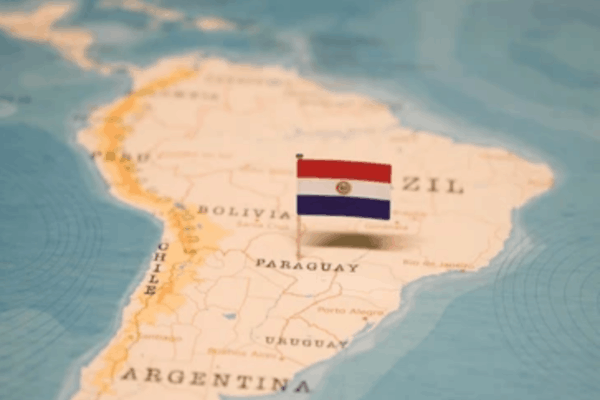
This guide explains the currency of Paraguay, the notes and coins you will actually use, how exchange rates are set, and practical tips for handling currency in Paraguay without confusion.
The Currency Of Paraguay: Paraguayan guaraní
The official currency of Paraguay is the guaraní. According to the BCP, the guaraní was established by Decree Law No. 655 on 5 October 1943, and banknotes entered circulation from 1944. The BCP also describes the currency sign as a crossed “G”, commonly represented as ₲ in modern typography.
In formal terms, the guaraní is defined with a subunit (100 parts). In real life, however, currency in Paraguay is handled in whole numbers, and you are unlikely to see cents used in day-to-day transactions.
For travellers and first-time users, the key point is simple: prices are usually quoted in thousands and even millions of guaraníes, and that is normal for the Paraguay currency system.
Currency Of Paraguay Code And Symbol
When you see the currency of Paraguay in banking apps, exchange platforms, or travel spending tools, these identifiers matter:
- Currency code: PYG
- Currency symbol: ₲ (and commonly “Gs.” in local pricing)
Including these early improves clarity for readers searching for currency in Paraguay because it helps them confirm they are viewing the correct unit before exchanging.
Banknotes And Coins In Circulation In Paraguay
Many online pages list outdated denominations, which can confuse readers the moment they arrive and start using cash. For accuracy, it helps to anchor your article to what the central bank states.
Banknotes (Notes)
The commonly used banknotes in circulation are:
- ₲ 2,000
- ₲ 5,000
- ₲ 10,000
- ₲ 20,000
- ₲ 50,000
- ₲ 100,000
Coins
The common coins in circulation are:
- ₲ 50
- ₲ 100
- ₲ 500
- ₲ 1,000
A Simple Way To Think About Currency In Paraguay
Because Paraguay currency values are large, it helps to build quick reference points. A ₲10,000 note often covers small everyday purchases. ₲50,000 is a frequent mid-range amount for casual spending. ₲100,000 is used for larger payments such as bigger shopping baskets or higher bills.
If you are travelling, a practical mix is several ₲10,000 and ₲20,000 notes for daily use, plus a ₲50,000 or ₲100,000 note for flexibility, with coins for small change. This makes currency in Paraguay much easier to handle in taxis, markets, and smaller shops.
How Prices Are Written In Paraguay Currency
Pricing formats can be a small but important point when dealing with currency of Paraguay. You may see prices written like ₲ 35.000 or Gs. 120.000. In many contexts, the dot is used as a thousands separator, meaning ₲ 35.000 equals ₲35,000, not ₲35.00.
This matters most in markets, transport, and fast-paced retail situations where prices are spoken quickly. If you are unsure, ask the seller to repeat the amount slowly or confirm by typing it into your phone. A quick clarification can save you from a simple but expensive misunderstanding when using Paraguay currency.
Paraguay Currency Exchange Rates
Exchange rates move daily, so a good guide should explain two things clearly: where to check a reliable baseline, and why your actual rate may differ when you exchange money.
How The Central Bank Reference Rate Works
The BCP publishes a daily reference exchange rate. For the U.S. dollar against the guaraní, the reference rate is calculated as a weighted average of interbank spot-market operations. Other currencies are then derived using market quotations and the USD reference rate.
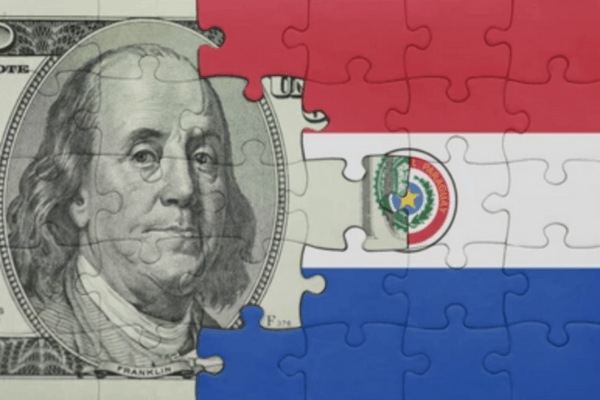
This reference rate is useful because it gives you a neutral benchmark. If you are comparing rates offered by banks, exchange houses, or card payments, the BCP reference is one of the cleanest baselines for judging whether the rate you are getting on Paraguay currency is reasonable.
Example USD To PYG Rate (Dated Snapshot)
To help readers understand the scale of the currency of Paraguay, it is useful to include one dated example. For instance, on 6 February 2026, BCP’s published reference rate shows USD 1 = ₲ 6,593.97.
Keep this clearly labelled as an example because the number will change. A single “as of” date protects the article from looking inaccurate later while still giving readers a realistic sense of how currency in Paraguay compares to the U.S. dollar.
Where To Exchange Currency In Paraguay
If you are converting foreign currency into Paraguay currency, the goal is convenience without paying an unnecessary spread.
Common Options
- ATMs: convenient in major areas, but check your bank’s fees and withdrawal limits.
- Banks: reliable, but sometimes slower with stricter requirements.
- Authorised exchange houses (casas de cambio): often competitive in commercial areas and border cities.
A Practical Card Tip
If a payment terminal offers to charge you in your home currency rather than PYG, choose PYG when possible. Paying in your home currency can involve additional conversion markups, while paying in local currency typically leaves conversion to your card network and issuing bank.
Paying With Currency In Paraguay
Older travel guides sometimes describe Paraguay as cash-only. In reality, it is more accurate to say currency in Paraguay is cash-friendly, while cards are widely used in many urban settings.
- Cash is still common for small purchases, local markets, and everyday transport.
- Cards are widely accepted in hotels, larger shops, and many restaurants in cities.
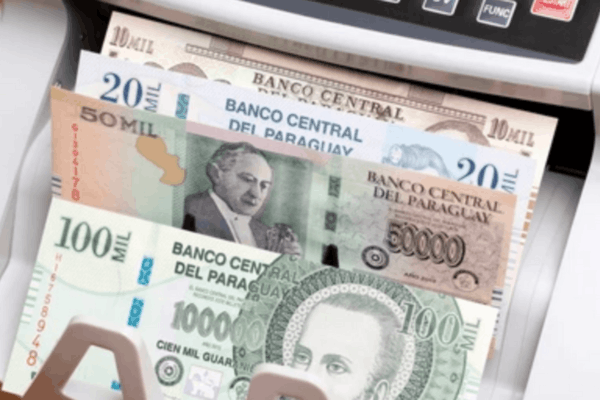
For visitors, the simplest approach is to keep enough Paraguay currency for daily spending and use cards for larger purchases in established businesses.
New Banknotes Of the Paraguay Currency
Paraguay has been working on a new family of banknotes to modernise designs and security features. This is worth mentioning because some readers worry that new banknotes mean a redenomination.
BCP’s project communications make the key point clear: this is not a move to remove zeros or change the value of the currency. It is a design and security update while maintaining the existing denomination structure. If you see headlines about “new banknotes”, interpret it as modernisation of the Paraguay currency system rather than a sudden conversion.
Conclusion
Once you understand the basics, Paraguay currency is straightforward. The currency of Paraguay is the guaraní (PYG), prices are typically written in large whole numbers, and the best way to avoid overpaying is to benchmark against an official reference rate before exchanging.
Keep cash for day-to-day spending, use cards where it makes sense, and remember that banknote updates are focused on security and design, not changing the value of currency in Paraguay.
FAQs
What is the currency of Paraguay? The official Paraguay currency is the Paraguayan guaraní. The currency code is PYG, and the symbol is commonly written as ₲ or “Gs.”.
For currency in Paraguay, banknotes commonly include ₲2,000, ₲5,000, ₲10,000, ₲20,000, ₲50,000, and ₲100,000. Coins commonly include ₲50, ₲100, ₲500, and ₲1,000.
The guaraní is the official currency of Paraguay, but USD may be accepted in some commercial areas, especially in border shopping regions. Even then, it is smart to carry guaraníes for everyday spending and to confirm the exchange rate used by the merchant.
Disclaimer: This content is provided for informational purposes only and does not constitute, and should not be construed as, financial, investment, or other professional advice. No statement or opinion contained here in should be considered a recommendation by Ultima Markets or the author regarding any specific investment product, strategy, or transaction. Readers are advised not to rely solely on this material when making investment decisions and should seek independent advice where appropriate.
Latest Articles
FOLLOW US






Ultima Markets is a member of The Financial Commission, an international independent body responsible for resolving disputes in the Forex and CFD markets.

All clients of Ultima Markets are protected under insurance coverage provided by Willis Towers Watson (WTW), a global insurance brokerage established in 1828, with claims eligibility up to US$1,000,000 per account.

Ultima Markets is the first United CFD broker to be part of the United Nations Global Compact.
FOLLOW US
TRADE WITH US
RISK DISCLOSURE
Risk Warning:
Trading leveraged financial products, including Contracts for Difference (CFDs), carries a high level of risk and may result in losses exceeding your initial investment. These products are not suitable for all investors and should only be traded with funds you can afford to lose. You do not own or have any rights to the underlying assets of these derivatives (e.g., entitlement to dividends). Please ensure you fully understand the associated risks. Before trading, consider your level of experience, investment objectives, and seek independent financial advice if necessary. Refer to our legal documents and disclosures before making any trading decisions.
General Advice Warning:
The information provided on this website is general in nature and does not take into account your personal objectives, financial situation, or needs. Before acting on any advice, you should assess its appropriateness in light of your individual circumstances and consult our legal documentation.
Regional Restrictions:
The information and services on this website are not intended for residents of certain jurisdictions, including but not limited to the United States, United Kingdom, Singapore, and any jurisdictions subject to international sanctions. For further information, please contact our customer support team.
Regulatory Information:
Ultima Markets is a trading name shared amongst multiple entities operating in various jurisdictions. These following entities are authorised to operate under the Ultima Markets brand and trademarks.
-
Ultima Markets UK Limited, reference number 470325, is authorised and regulated by the Financial Conduct Authority (FCA). Registered address: 1 Blossom Yard, Fourth Floor, London, E1 6RS, UNITED KINGDOM.
-
Ultima Markets Ltd is authorised and regulated by the Financial Services Commission (FSC) of Mauritius as a Full-Service Investment Dealer (excluding Underwriting), under licence number GB 23201593.
Registered address: 2nd Floor, The Catalyst, 40 Silicon Avenue, Ebene Cybercity, 72201, Mauritius.
-
Ultima Markets EU OÜ, incorporated in Estonia with registry code 17134727. Registered address: Harju maakond, Tallinn, Kristiine linnaosa, Seebi tn 1-1501, 11316. This entity does not offer regulated financial products or provide trading services.

Copyright © 2026 Ultima Markets Ltd. All rights reserved.
-

Messenger


Continue on Messenger
Take the conversation to your Messenger account. You can return anytime.
Scan the QR code and then send the message that appears in your Messenger.
Open Messenger on this device.
-

Instagram

Continue on Instagram
Take the conversation to your Instagram account. You can return anytime.
Scan the QR code to open Instagram. Follow @ultima_markets to send a DM.
Open Instagram on this device.
-

Live Chat
-

