This website is managed by Ultima Markets’ international entities, and it’s important to emphasise that they are not subject to regulation by the FCA in the UK. Therefore, you must understand that you will not have the FCA’s protection when investing through this website – for example:
You will not be guaranteed Negative Balance Protection
You will not be protected by FCA’s leverage restrictions
You will not have the right to settle disputes via the Financial Ombudsman Service (FOS)
You will not be protected by Financial Services Compensation Scheme (FSCS)
Any monies deposited will not be afforded the protection required under the FCA Client Assets Sourcebook. The level of protection for your funds will be determined by the regulations of the relevant local regulator.
Note: UK clients are kindly invited to visit https://www.ultima-markets.co.uk/. Ultima Markets UK expects to begin onboarding UK clients in accordance with FCA regulatory requirements in 2026.
If you would like to proceed and visit this website, you acknowledge and confirm the following:
1.The website is owned by Ultima Markets’ international entities and not by Ultima Markets UK Ltd, which is regulated by the FCA.
2.Ultima Markets Limited, or any of the Ultima Markets international entities, are neither based in the UK nor licensed by the FCA.
3.You are accessing the website at your own initiative and have not been solicited by Ultima Markets Limited in any way.
4.Investing through this website does not grant you the protections provided by the FCA.
5.Should you choose to invest through this website or with any of the international Ultima Markets entities, you will be subject to the rules and regulations of the relevant international regulatory authorities, not the FCA.
Ultima Markets wants to make it clear that we are duly licensed and authorised to offer the services and financial derivative products listed on our website. Individuals accessing this website and registering a trading account do so entirely of their own volition and without prior solicitation.
By confirming your decision to proceed with entering the website, you hereby affirm that this decision was solely initiated by you, and no solicitation has been made by any Ultima Markets entity.
Ultima Markets does not have an establishment in Singapore and does not operate from Singapore.
Ultima Markets does not provide products or services to citizens or residents of Singapore, and account applications from Singapore citizens or residents will not be accepted.
If you are a citizen or resident of Singapore, please do not open an account or use Ultima Markets’ products or services.
By selecting “Acknowledge and Continue Browsing”, you confirm that you are accessing this website on your own initiative and that your access is not the result of any direct marketing, targeted advertising, solicitation, or promotional activity by Ultima Markets.
Nothing on this website constitutes an offer, solicitation, or promotion of products or services in any jurisdiction where such activity is prohibited. You are responsible for ensuring that your access to and use of this website complies with applicable local laws and regulations.
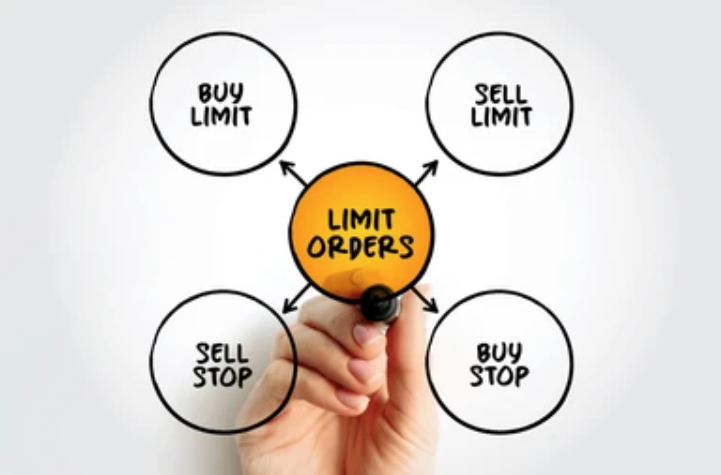
A limit order lets you buy or sell at a set price or better, giving full price control in trading while reducing slippage.
A limit order is a powerful tool that gives traders control over the price they buy or sell an asset. Unlike a market order, which executes instantly at the current price, a limit order allows you to set the maximum or minimum price you’re willing to accept.
If you’re wondering what is a limit order, how it works, and when to use it, this guide will explain everything you need to know including examples, comparisons with market and stop orders, and tips to use it effectively.
What Is a Limit Order?
A limit order is an instruction to your broker or trading platform to buy or sell a financial instrument at a specific price or better.
A buy limit order executes only when the market price falls to or below your chosen price.
A sell limit order executes only when the market price rises to or above your chosen price
This order type helps traders maintain price discipline and avoid overpaying (when buying) or underselling (when selling). However, the trade-off is that the order might not execute if the market never reaches your limit price.
Example: If a stock trades at $50 and you want to buy it at $45, you can place a buy limit order at $45. The order will execute only if the market price drops to $45 or lower.
How Limit Orders Work
Here is a breakdown of how a limit order functions in practice:
You choose the asset, e.g., you want to buy 100 shares of Company X.
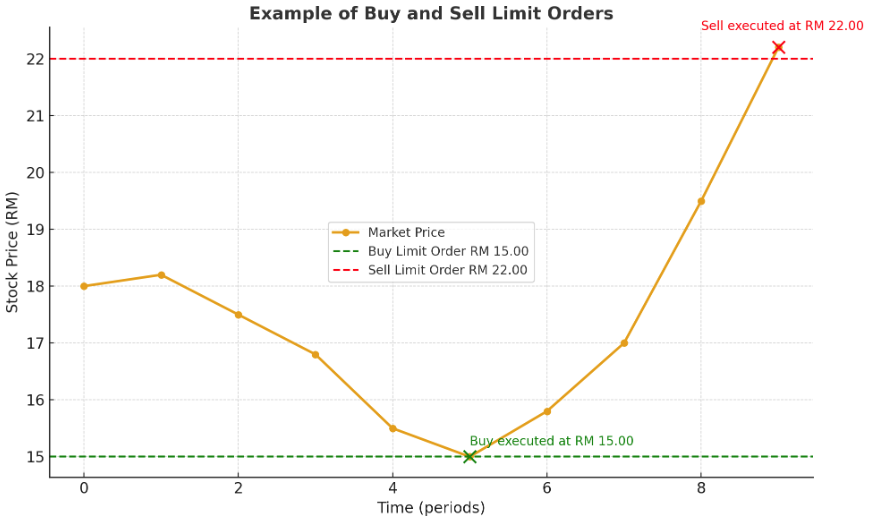
You set the limit price, e.g., you will only buy if the price falls to RM 15.00 or lower (buy limit), or you will only sell if the price rises to RM 20.00 or higher (sell limit).
You enter the limit order with your broker, specifying: buy/sell, asset, quantity, limit price, and often the “time-in-force” (e.g., day order, good-til-canceled).
The market needs to reach your price (or better) for a buy limit, the market price must drop to your limit price or lower; for a sell limit, the price must rise to your limit price or higher.
If the conditions are met, your order executes at your limit price or better (i.e., for a buy you may pay less; for a sell you may receive more, if the market allows).
If conditions aren’t met, your order simply remains unfilled (or partially filled) until you cancel it or it expires based on your time-in-force setting.
Example of how a limit order works
Suppose a stock is currently trading at RM 18.00. You believe it is overvalued and you want to buy only if it drops to RM 15.00. You place a buy limit order at RM 15.00. If the market falls to RM 15.00 (or lower) and shares are available, your order will execute. If the price never falls to RM 15.00, the order stays open or eventually cancels.
Conversely, if you hold shares and want to sell only if the price goes up, you might place a sell limit order at RM 22.00. The order executes only if the market reaches RM 22.00 or higher.
Why use a limit order?
Price certainty: You control the worst price you will pay (buy) or receive (sell).
Automation: You don’t need to constantly watch the market; you set the order and it executes if/when the price condition is met.
Useful in volatile markets: If you fear sudden price swings and want to avoid paying too much (for buys) or receiving too little (for sells), limit orders give a buffer.
Risks and considerations
No guarantee of execution: If the price never reaches your limit, you may miss the trade. This is the trade-off for price control.
Partial fills / liquidity risk: Even if your price is reached, if there aren’t enough shares available at that exact price, you might get a partial fill or none at all.
Market gaps / rapid moves: In fast-moving markets or after hours, price may “jump” and skip your limit price, meaning your order could remain unfilled while the market moves past it.
Limit Order Examples
Buy limit order example
Current market price is RM 50.00. You believe the fair value is RM 45.00, so you place a buy limit order at RM 45.00 for 200 shares. If the price dips to RM 45.00 (or lower) and 200 shares are available, you’ll buy at RM 45.00 or maybe a little less. If the price stays above RM 45.00, no trade happens, you keep waiting or cancel.
Sell limit order example
Suppose you own shares bought at RM 30.00 and the current price is RM 35.00. You want to lock in profit if the price climbs to RM 40.00. You place a sell limit order at RM 40.00 for 100 shares. If the market rises to RM 40.00 (or higher), your 100 shares are sold at RM 40.00 or better. If the price stalls at RM 38.00 and doesn’t reach RM 40.00, your shares remain unsold.
Partial fill scenario
You place a buy limit order for 500 shares at RM 20.00. The market price falls to RM 20.00, but only 300 shares are offered at exactly RM 20.00 at that moment. Your order may get partially filled for 300 shares, and the balance remains open until more shares become available at RM 20.00 or better.
Limit order in volatile or illiquid stock
A small-cap stock trades at RM 5.00 with low volume. You place a buy limit at RM 4.50. But the market price falls quickly to RM 4.20 in a gap move, your limit was at RM 4.50 but the market skipped that price, so you never buy. You miss the opportunity. Risk of non-execution.
These examples help you see both the benefit (price control) and the trade-offs (maybe no execution) of using limit orders.
Limit Order vs Market Order
Many traders compare limit order vs market order when deciding how to execute trades. Here’s the difference:
Market Order
A market order is sent to execute immediately at the best available price in the market at that moment.
The main benefit is speed and certainty of execution, you’ll almost always get filled.
The downside is price uncertainty, you might pay more (on a buy) or receive less (on a sell) than you expected, especially in fast-moving or illiquid markets.
Limit Order
You specify the price (or better) at which you’re willing to trade, giving you price control.
But you sacrifice automatic execution, you might not get filled if the market doesn’t reach your price.
Ideal when your priority is achieving a certain price rather than simply executing as fast as possible.
For example, if you want to buy a stock immediately because you believe a rapid move is starting, a market order can make sense. If instead you believe the price will drop to a certain level and you’re okay waiting, a limit order is preferable.
Limit Order vs Stop Order
Another important comparison is between limit orders and stop orders (sometimes called stop-loss orders).
A stop order is an instruction to buy or sell once the asset reaches a certain trigger (stop) price. At that trigger, the stop order becomes a market order. The purpose is usually risk management, for example, to sell a position if it falls to a certain level, or to buy if the price breaks out.
Key Differences
With a limit order, you specify the price at which you will trade and your order waits until the market hits that price (or better).
With a stop order, once the stop price is reached, you’re converted into a market order (you relinquish price control) and your trade executes at the prevailing market price.
Thus: limit = price control but no fill guarantee; stop = trigger control but less price certainty.
For example, you hold a stock at RM 40 and want to protect against a big drop. You place a sell stop order at RM 35. If the price falls to RM 35, the stop triggers and becomes a market order, you might get out at RM 34 or RM 33 in a fast drop.
Alternatively, you could place a sell limit order at RM 45 if you think the stock might rebound but you want to lock in profit, you only sell if the market goes up to RM 45 or more, and you retain price control.
What Is the Best Way to Use a Limit Order?
To make the most of limit orders and align them with best-practice trading, consider the following strategies and guidelines.
Match Your Limit Order to Your Trading Objective
Entry: If you believe a stock will decline to a support level, you can place a buy limit order at or just below that support.
Exit/Profit-Taking: If you own a position and have identified a target price, you can place a sell limit order to lock in a profit at that target.
Risk Management: While stop orders are more common for risk control, you could use a limit order to sell if price rises to a certain level, then follow with a stop to protect downside.
Consider Time-In-Force and Order Duration
Many brokers allow you to select day orders (valid only for the current trading session) or good-‘til-canceled (GTC) orders. Some may expire after a set period.
If using GTC, revisit the order if market conditions change, your original rationale may no longer hold.
Use Limit Orders for Price Discipline
A major benefit of a limit order is removing emotion from your trading decision. You set the price, walk away, and let the market come to you.
This aligns well with trading plans and risk-management frameworks, you’re not chasing price, you’re setting your conditions.
Monitor, Adjust and Cancel if Necessary
If market conditions change (e.g., news, earnings, macro events), your original limit order might no longer make sense. It’s good practice to revisit and possibly cancel or adjust it.
Also monitor whether your order is partially filled, if only some shares execute, you may need to place another order or adjust your plan.
Conclusion
In forex trading, a limit order can be one of the most effective tools for achieving precision and discipline in your strategy. Because the forex market moves quickly and often around-the-clock, limit orders allow traders to automate entries and exits at predefined prices even while they’re away from the charts.
For example, if EUR/USD is trading at 1.0850 and you want to buy only if the pair dips to 1.0800, you can set a buy limit order at 1.0800. The trade will execute automatically if the price reaches that level, helping you capture opportunities without chasing price movements. Similarly, a sell limit order lets you take profit at a specific target, ensuring you exit the market at your desired rate.
When used correctly, limit orders are more than just a tool for execution, they’re a cornerstone of professional forex risk management and a proven method for maintaining control in a market where precision matters most.
Share Now
Disclaimer:This content is provided for informational purposes only and does not constitute, and should not be construed as, financial, investment, or other professional advice. No statement or opinion contained herein should be considered a recommendation by Ultima Markets or the author regarding any specific investment product, strategy, or transaction. Readers are advised not to rely solely on this material when making investment decisions and should seek independent advice where appropriate.
Thank you for visiting the Ultima Markets website. Please note that this website is intended for individuals residing in jurisdictions where access is permitted by law. Ultima and its affiliated entities do not operate in your home jurisdiction.
By clicking ‘Acknowledge’, you confirm that you are entering this website solely on your own initiative and not as a result of any specific marketing outreach. You wish to obtain information from this website based on reverse solicitation principles, in accordance with the applicable laws of your home jurisdiction.