This website is managed by Ultima Markets’ international entities, and it’s important to emphasise that they are not subject to regulation by the FCA in the UK. Therefore, you must understand that you will not have the FCA’s protection when investing through this website – for example:
You will not be guaranteed Negative Balance Protection
You will not be protected by FCA’s leverage restrictions
You will not have the right to settle disputes via the Financial Ombudsman Service (FOS)
You will not be protected by Financial Services Compensation Scheme (FSCS)
Any monies deposited will not be afforded the protection required under the FCA Client Assets Sourcebook. The level of protection for your funds will be determined by the regulations of the relevant local regulator.
Note: UK clients are kindly invited to visit https://www.ultima-markets.co.uk/. Ultima Markets UK expects to begin onboarding UK clients in accordance with FCA regulatory requirements in 2026.
If you would like to proceed and visit this website, you acknowledge and confirm the following:
1.The website is owned by Ultima Markets’ international entities and not by Ultima Markets UK Ltd, which is regulated by the FCA.
2.Ultima Markets Limited, or any of the Ultima Markets international entities, are neither based in the UK nor licensed by the FCA.
3.You are accessing the website at your own initiative and have not been solicited by Ultima Markets Limited in any way.
4.Investing through this website does not grant you the protections provided by the FCA.
5.Should you choose to invest through this website or with any of the international Ultima Markets entities, you will be subject to the rules and regulations of the relevant international regulatory authorities, not the FCA.
Ultima Markets wants to make it clear that we are duly licensed and authorised to offer the services and financial derivative products listed on our website. Individuals accessing this website and registering a trading account do so entirely of their own volition and without prior solicitation.
By confirming your decision to proceed with entering the website, you hereby affirm that this decision was solely initiated by you, and no solicitation has been made by any Ultima Markets entity.
Ultima Markets does not have an establishment in Singapore and does not operate from Singapore.
Ultima Markets does not provide products or services to citizens or residents of Singapore, and account applications from Singapore citizens or residents will not be accepted.
If you are a citizen or resident of Singapore, please do not open an account or use Ultima Markets’ products or services.
By selecting “Acknowledge and Continue Browsing”, you confirm that you are accessing this website on your own initiative and that your access is not the result of any direct marketing, targeted advertising, solicitation, or promotional activity by Ultima Markets.
Nothing on this website constitutes an offer, solicitation, or promotion of products or services in any jurisdiction where such activity is prohibited. You are responsible for ensuring that your access to and use of this website complies with applicable local laws and regulations.
Discover why the Kuwait currency, the Kuwaiti Dinar (KWD), remains the world’s strongest backed by oil wealth, fiscal stability, and prudent monetary policy.
Few currencies can match the strength and stability of the Kuwaiti Dinar (KWD). With an exchange rate that consistently outperforms global peers, the Kuwait currency is often ranked as the strongest currency in the world. Its high value isn’t just a number, it reflects Kuwait’s robust economy, prudent fiscal policies, and decades of financial discipline.
What Is Kuwait Currency?
The official Kuwait currency is the Kuwaiti Dinar (KWD), which serves as the country’s legal tender for all financial transactions. It is issued and regulated by the Central Bank of Kuwait (CBK) — the nation’s primary monetary authority responsible for maintaining currency stability, managing inflation, and safeguarding the financial system.
Basic Facts
Currency Name: Kuwaiti Dinar
Currency Code: KWD
Symbol: د.ك (Arabic) or KD (English)
Subunit: 1 Kuwaiti Dinar = 1,000 Fils
Issuing Authority: Central Bank of Kuwait
Current Series in Circulation: Sixth Issue (introduced in 2014)
Currency Design and Denominations
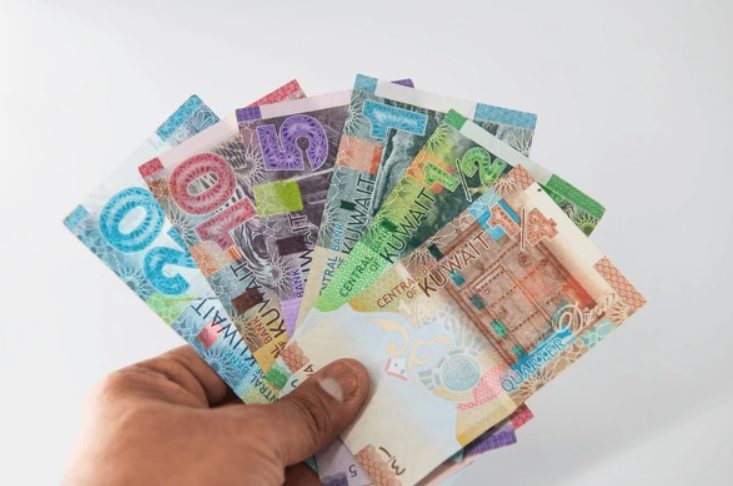
The Kuwaiti Dinar banknotes are designed to reflect the country’s culture, history, and modernization. Denominations in circulation include ¼, ½, 1, 5, 10, and 20 dinars, while coins range from 1 to 100 fils. Security features such as holographic stripes, watermarks, and color-shifting ink ensure authenticity and prevent counterfeiting.
History of the Kuwaiti Dinar
The Kuwaiti Dinar was introduced in 1961, replacing the Gulf Rupee at a rate of 1 KWD = 13⅓ Gulf Rupees, following Kuwait’s independence from Britain. In 1990, during the Iraqi invasion, the dinar was temporarily replaced by the Iraqi dinar, but new notes were issued once Kuwait regained independence in 1991. Since then, the dinar has become one of the world’s most respected and stable currencies.
The Value of the Kuwaiti Dinar
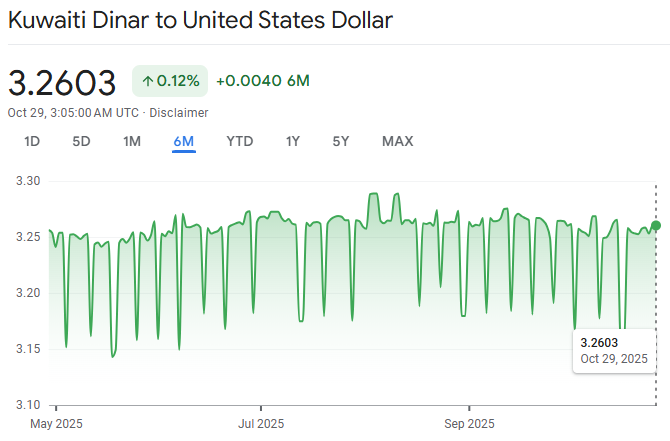
The Kuwaiti Dinar (KWD) holds the distinction of being the strongest currency in the world, a title it has maintained for several decades. As of late 2025, 1 Kuwaiti Dinar equals around 3.26 US dollars, or roughly 0.3067 KWD per USD. This means that one dinar can purchase more in foreign currency terms than any other national currency.
Why Kuwait Currency So Strong
The Kuwaiti Dinar’s value stems from more than just oil exports. Its enduring strength lies in five key pillars:
Oil Wealth and Export Surplus
Kuwait possesses around 6 % of the world’s proven oil reserves, providing consistent export income and large foreign-exchange inflows. The government’s strong fiscal position supports the currency’s credibility and value.
Strong Monetary and Fiscal Policy
Kuwait’s central bank maintains tight monetary control, keeping inflation low and ensuring liquidity stability. The government follows disciplined budgeting and holds one of the lowest debt-to-GDP ratios in the region.
Managed Exchange-Rate System
Since 2007, the Kuwaiti Dinar has been pegged to a basket of major currencies rather than a single one like the US dollar. This reduces exchange-rate volatility and protects Kuwait’s economy from external currency shocks.
Low Inflation and High Purchasing Power
A low inflation rate helps maintain the dinar’s purchasing power, ensuring stability for citizens and investors. It also enhances Kuwait’s reputation as a financially secure nation.
High GDP per Capita and Small Population
Kuwait’s wealth is distributed among a relatively small population, leading to one of the highest GDP per capita levels globally. This supports strong domestic demand and a surplus-based economic model.
How a Strong Currency Impacts the Economy
The strength of the Kuwait currency, represented by the Kuwaiti Dinar (KWD), plays a central role in shaping the country’s economy and trade dynamics. A strong currency brings clear advantages, particularly for consumers and importers. Since the dinar’s value is high relative to other currencies, imported goods from electronics to automobiles, become cheaper for Kuwaiti households and businesses. This boosts purchasing power, helping residents enjoy a higher standard of living and keeping domestic inflation low.
For the government, a strong dinar reduces the cost of importing essential commodities and raw materials, contributing to long-term price stability. It also allows the country to accumulate wealth abroad and maintain purchasing power for international investments, which is crucial for Kuwait’s sovereign wealth fund and foreign-exchange reserves.
However, the benefits of a strong currency are not without trade-offs. A higher currency value can make Kuwaiti exports more expensive in global markets, potentially reducing the competitiveness of non-oil industries. This is one reason Kuwait continues to focus on economic diversification, developing sectors like finance, logistics, and renewable energy to balance its oil dependency.
For foreign investors, the Kuwaiti Dinar’s stability signals reliability and low volatility, making it an attractive destination for long-term capital flows. Yet for forex traders, the same stability can mean fewer short-term trading opportunities due to limited price fluctuations.
Overall, the strong Kuwait currency acts as a double-edged sword, promoting economic stability and global purchasing power while challenging export competitiveness. Maintaining this balance requires prudent fiscal policy, steady oil revenues, and ongoing diversification efforts to ensure that Kuwait’s economy continues to thrive in both regional and global markets.
Current Outlook for 2025
The Kuwait currency remains stable at around 0.306 KWD per USD, according to 2025 forex data. Analysts expect the dinar to remain firm through the year as oil prices stabilize and government reforms continue.
Kuwait is also investing in renewable energy, financial services, and logistics, aiming to diversify its economy beyond oil, a move that could strengthen the dinar’s foundation for decades to come.
Risks to Watch
Even the world’s strongest currency faces risks. Key challenges include:
Oil Price Volatility: Falling oil prices can pressure government revenue.
Global Economic Slowdowns: Reduced demand for oil could affect trade balances.
Regional Geopolitical Uncertainty: Middle East tensions may influence investor sentiment.
Economic Diversification Pace: Over-reliance on oil remains a long-term risk.
Still, Kuwait’s sovereign wealth fund, one of the largest in the world, acts as a powerful safeguard during downturns.
Conclusion
The Kuwaiti Dinar (KWD) remains the world’s most valuable currency, a reflection of Kuwait’s strong fiscal foundations, disciplined monetary policy, and vast oil wealth. Its stability is not merely symbolic; it demonstrates the country’s ability to manage its resources prudently and maintain investor confidence even amid global uncertainty.
For forex traders, the Kuwait currency presents a unique case study in how macroeconomic strength, currency pegs, and geopolitical stability can sustain long-term value. Unlike high-volatility currencies such as the US dollar or Japanese yen, the Kuwaiti Dinar trades within a tightly managed range, offering minimal price swings. This makes it less suitable for speculative trading but ideal for understanding how central banks preserve currency strength through strategic management.
Share Now
Disclaimer:This content is provided for informational purposes only and does not constitute, and should not be construed as, financial, investment, or other professional advice. No statement or opinion contained herein should be considered a recommendation by Ultima Markets or the author regarding any specific investment product, strategy, or transaction. Readers are advised not to rely solely on this material when making investment decisions and should seek independent advice where appropriate.
Thank you for visiting the Ultima Markets website. Please note that this website is intended for individuals residing in jurisdictions where access is permitted by law. Ultima and its affiliated entities do not operate in your home jurisdiction.
By clicking ‘Acknowledge’, you confirm that you are entering this website solely on your own initiative and not as a result of any specific marketing outreach. You wish to obtain information from this website based on reverse solicitation principles, in accordance with the applicable laws of your home jurisdiction.