This website is managed by Ultima Markets’ international entities, and it’s important to emphasise that they are not subject to regulation by the FCA in the UK. Therefore, you must understand that you will not have the FCA’s protection when investing through this website – for example:
You will not be guaranteed Negative Balance Protection
You will not be protected by FCA’s leverage restrictions
You will not have the right to settle disputes via the Financial Ombudsman Service (FOS)
You will not be protected by Financial Services Compensation Scheme (FSCS)
Any monies deposited will not be afforded the protection required under the FCA Client Assets Sourcebook. The level of protection for your funds will be determined by the regulations of the relevant local regulator.
Note: UK clients are kindly invited to visit https://www.ultima-markets.co.uk/. Ultima Markets UK expects to begin onboarding UK clients in accordance with FCA regulatory requirements in 2026.
If you would like to proceed and visit this website, you acknowledge and confirm the following:
1.The website is owned by Ultima Markets’ international entities and not by Ultima Markets UK Ltd, which is regulated by the FCA.
2.Ultima Markets Limited, or any of the Ultima Markets international entities, are neither based in the UK nor licensed by the FCA.
3.You are accessing the website at your own initiative and have not been solicited by Ultima Markets Limited in any way.
4.Investing through this website does not grant you the protections provided by the FCA.
5.Should you choose to invest through this website or with any of the international Ultima Markets entities, you will be subject to the rules and regulations of the relevant international regulatory authorities, not the FCA.
Ultima Markets wants to make it clear that we are duly licensed and authorised to offer the services and financial derivative products listed on our website. Individuals accessing this website and registering a trading account do so entirely of their own volition and without prior solicitation.
By confirming your decision to proceed with entering the website, you hereby affirm that this decision was solely initiated by you, and no solicitation has been made by any Ultima Markets entity.
Ultima Markets does not have an establishment in Singapore and does not operate from Singapore.
Ultima Markets does not provide products or services to citizens or residents of Singapore, and account applications from Singapore citizens or residents will not be accepted.
If you are a citizen or resident of Singapore, please do not open an account or use Ultima Markets’ products or services.
By selecting “Acknowledge and Continue Browsing”, you confirm that you are accessing this website on your own initiative and that your access is not the result of any direct marketing, targeted advertising, solicitation, or promotional activity by Ultima Markets.
Nothing on this website constitutes an offer, solicitation, or promotion of products or services in any jurisdiction where such activity is prohibited. You are responsible for ensuring that your access to and use of this website complies with applicable local laws and regulations.
What is Institutional Trading Platforms for Beginners? Learn types, examples, tools used by hedge funds, and how they differ from retail traders.
What is Institutional Trading Platform?
An institutional trading platform is a professional-grade system built for executing large and complex financial transactions across global markets. These platforms offer features such as Direct Market Access (DMA), FIX API integrations, Smart Order Routing, Advanced risk management tools and Access to Level 2 and 3 market data.
Unlike retail trading platforms, institutional systems connect directly to liquidity providers and offer powerful infrastructure that minimizes slippage, enhances speed, and ensures regulatory compliance.
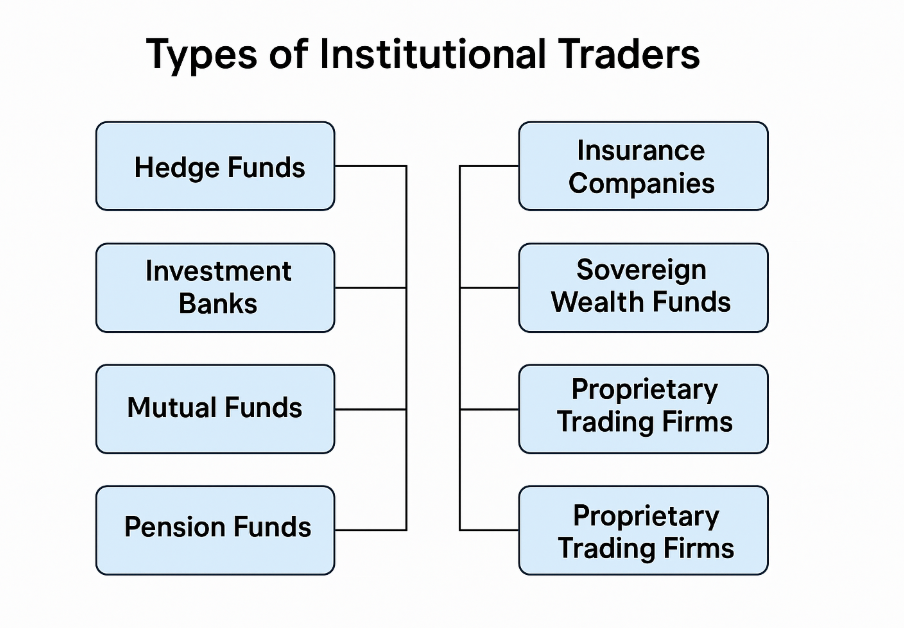
Types of Institutional Traders
Institutional traders are entities that trade large volumes of financial assets, often influencing market direction due to their size and strategy. Each type of institutional trader serves a unique function in the financial ecosystem, governed by specific mandates, risk profiles, and investment horizons.
Hedge Funds
Goal: Maximize absolute returns using aggressive strategies.
How They Trade: Actively trade equities, forex, commodities, and derivatives using leverage, short selling, arbitrage, and high-frequency models.
Hedge funds often cause short-term volatility due to their rapid directional bets and large block orders.
Investment Banks
Goal: Generate profits via proprietary trading and client order flow.
How They Trade: Engage in prop trading, market making, and liquidity provision across equities, bonds, FX, and derivatives.
Investment banks play a key role in setting bid/ask spreads and supplying liquidity, especially in FX and fixed income.
Mutual Funds
Goal: Generate long-term capital growth for investors.
How They Trade: Buy-and-hold strategies focusing on blue-chip stocks, ETFs, and government bonds. Trades are often executed during rebalancing.
Mutual funds are slower-moving but still move markets due to large periodic rebalancing or index-tracking flows.
Pension Funds
Goal: Preserve capital and deliver steady returns to meet future liabilities (e.g., retirement payouts).
How They Trade: Invest conservatively in government bonds, blue-chip equities, and real estate. Use institutional platforms for rebalancing.
While not active traders, pension funds control trillions and impact long-term yield curves and market sentiment.
Insurance Companies
Goal: Match assets with future policy payouts and liabilities.
How They Trade: Invest heavily in long-dated bonds, asset-backed securities, and structured products with minimal turnover.
These firms tend to be conservative, trading to hedge risk rather than chase profit.
Sovereign Wealth Funds (SWFs)
Goal: Grow a country’s reserves and support national economic stability.
How They Trade: Allocate across global asset classes: equities, bonds, real estate, and alternative investments.
SWFs have enormous influence due to their size and often act counter-cyclically, buying during downturns.
Proprietary Trading Firms
Goal: Profit purely from market movements using internal capital.
How They Trade: Employ high-frequency trading (HFT), arbitrage, and statistical models across various markets.
These firms are highly technical, using algorithmic trading to exploit micro-inefficiencies.
Trader Type
Main Objective
Trading Style
Market Impact
Hedge Funds
Maximize alpha
Active, leveraged
High short-term volatility
Investment Banks
Profit via trading and liquidity
Market making, proprietary
Core liquidity providers
Mutual Funds
Long-term capital appreciation
Buy-and-hold
Medium
Pension Funds
Long-term stability and payouts
Conservative
Low to medium
Insurance Companies
Match liabilities
Very conservative
Low
Sovereign Wealth Funds
Grow national reserves
Multi-asset, long-term
Large, strategic
Prop Trading Firms
Short-term profit from inefficiencies
Quant, HFT
High in specific markets
Example of Institutional Trading
Here’s a real-world scenario:
A hedge fund wants to buy $200 million worth of EUR/USD. Instead of placing a single large order which could move the market, it uses an institutional platform. Through algorithmic execution tools such as TWAP (Time-Weighted Average Price), the fund breaks the order into smaller trades over time.
This strategic execution reduces slippage, hides true order intent, and secures better average prices, something retail traders cannot easily replicate.
Difference Between Institutional Traders and Retail Traders
The primary difference between institutional traders and retail traders lies in their scale, resources, and market access. Institutional traders operate on behalf of large organizations such as hedge funds, banks, and pension funds that managing millions or even billions of dollars. They use advanced trading infrastructure like Direct Market Access (DMA), FIX APIs, and smart order routing to execute large trades with minimal slippage.
In contrast, retail traders trade individually using broker platforms, typically with smaller capital and limited access to real-time data or deep liquidity. Institutional traders benefit from tighter spreads, lower fees, and proprietary algorithms, while retail traders often face higher costs and slower execution. This disparity creates a strategic edge for institutions, which can influence market direction through their size and execution precision.
Feature
Institutional Traders
Retail Traders
Capital Size
Millions to billions of dollars
Usually <$100,000
Execution
Via DMA, FIX API, smart routing
Standard broker platforms (e.g., MT4/MT5)
Liquidity Access
Interbank, ECN, or dark pools
Broker-managed liquidity
Market Data
Level 2/3 real-time depth
Delayed or simplified view
Trading Costs
Low spreads, negotiated commissions
Wider spreads, retail markups
Regulation
Strict compliance (MiFID II, Basel III)
Less regulatory complexity
Why Institutions Use Specialized Platforms
Institutional trading requires more than just market access. These platforms provide:
Low latency execution for time-sensitive trades
Access to dark pools to avoid moving the market
Algorithmic trading for slicing orders intelligently
Real-time analytics to monitor slippage and performance
Custom risk controls aligned with internal policies and regulators
Such tools help institutions manage millions or even billions of dollars while minimizing execution risk.
What Can Beginners Learn from Institutional Trading?
Even though most retail traders can’t access these platforms, they can adopt an institutional mindset:
Follow volume: Large orders often leave clues (e.g., order blocks)
Use sentiment data: Institutional positioning (COT reports) helps spot bias
Practice strict risk management: Like institutions, limit risk per trade
Understanding institutional behavior offers retail traders a smarter way to trade, aligning strategies with the true market drivers.
Conclusion
Institutional trading platforms are essential infrastructure for global markets. They allow major financial players to move vast capital with precision, compliance, and cost-efficiency.
For beginners, understanding how these platforms work helps decode price behavior and shows why it’s important to align with institutional flows rather than fight them.
Ultima Markets empowers retail traders with institutional-grade education, helping bridge the gap between professional strategies and everyday execution.
Share Now
Disclaimer:This content is provided for informational purposes only and does not constitute, and should not be construed as, financial, investment, or other professional advice. No statement or opinion contained herein should be considered a recommendation by Ultima Markets or the author regarding any specific investment product, strategy, or transaction. Readers are advised not to rely solely on this material when making investment decisions and should seek independent advice where appropriate.
Thank you for visiting the Ultima Markets website. Please note that this website is intended for individuals residing in jurisdictions where access is permitted by law. Ultima and its affiliated entities do not operate in your home jurisdiction.
By clicking ‘Acknowledge’, you confirm that you are entering this website solely on your own initiative and not as a result of any specific marketing outreach. You wish to obtain information from this website based on reverse solicitation principles, in accordance with the applicable laws of your home jurisdiction.