This website is managed by Ultima Markets’ international entities, and it’s important to emphasise that they are not subject to regulation by the FCA in the UK. Therefore, you must understand that you will not have the FCA’s protection when investing through this website – for example:
You will not be guaranteed Negative Balance Protection
You will not be protected by FCA’s leverage restrictions
You will not have the right to settle disputes via the Financial Ombudsman Service (FOS)
You will not be protected by Financial Services Compensation Scheme (FSCS)
Any monies deposited will not be afforded the protection required under the FCA Client Assets Sourcebook. The level of protection for your funds will be determined by the regulations of the relevant local regulator.
Note: UK clients are kindly invited to visit https://www.ultima-markets.co.uk/. Ultima Markets UK expects to begin onboarding UK clients in accordance with FCA regulatory requirements in 2026.
If you would like to proceed and visit this website, you acknowledge and confirm the following:
1.The website is owned by Ultima Markets’ international entities and not by Ultima Markets UK Ltd, which is regulated by the FCA.
2.Ultima Markets Limited, or any of the Ultima Markets international entities, are neither based in the UK nor licensed by the FCA.
3.You are accessing the website at your own initiative and have not been solicited by Ultima Markets Limited in any way.
4.Investing through this website does not grant you the protections provided by the FCA.
5.Should you choose to invest through this website or with any of the international Ultima Markets entities, you will be subject to the rules and regulations of the relevant international regulatory authorities, not the FCA.
Ultima Markets wants to make it clear that we are duly licensed and authorised to offer the services and financial derivative products listed on our website. Individuals accessing this website and registering a trading account do so entirely of their own volition and without prior solicitation.
By confirming your decision to proceed with entering the website, you hereby affirm that this decision was solely initiated by you, and no solicitation has been made by any Ultima Markets entity.
Discover what a stock screener is, how it works, and real examples of using it. Learn how traders filter stocks and improve their strategies.
If you’ve ever wondered how traders find opportunities in a market filled with thousands of stocks, the answer is often a stock screener. This powerful tool helps traders and investors cut through the noise by filtering stocks based on specific criteria such as price, valuation, sector, or technical signals.
What Is a Stock Screener?
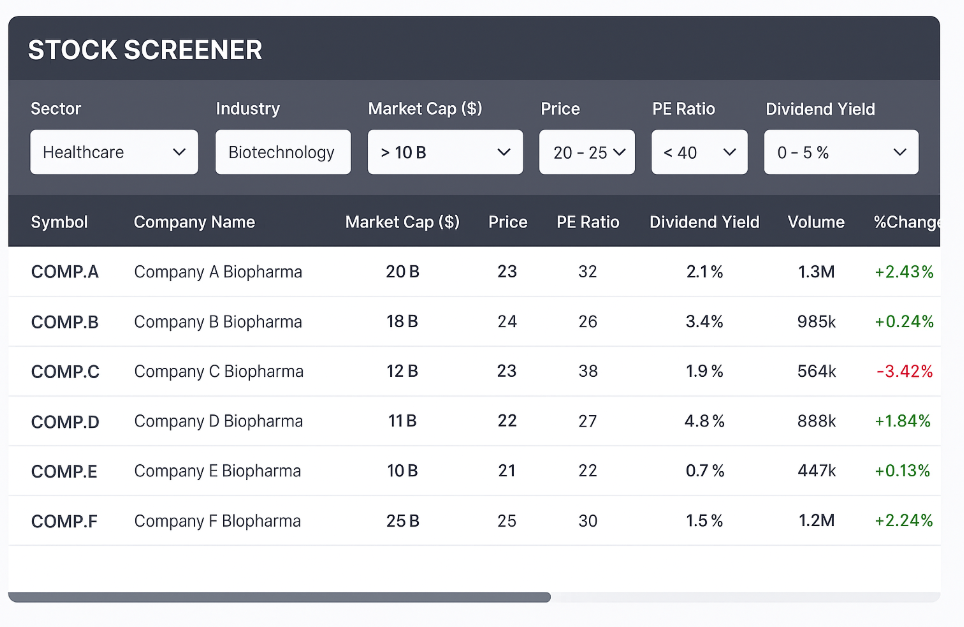
A stock screener is an online or software-based tool that lets traders filter and sort stocks using both fundamental and technical criteria. Instead of manually going through thousands of tickers, you can set rules such as:
Price-to-Earnings (P/E) ratio below 20
Dividend yield above 3%
50-day moving average above the 200-day moving average
Market capitalization above $1 billion
A refined list of potential stocks that match your strategy, saving you hours of research. In short, a stock screener is like a search engine for traders, helping you quickly find stocks that fit your trading or investing style.
Why Are Stock Screeners Important?
Global exchanges list tens of thousands of stocks. Without filters, traders risk information overload. Stock screeners add value in several ways:
Efficiency: Quickly generate a shortlist of stocks that meet your criteria.
Objectivity: Rely on data instead of emotions when choosing trades.
Flexibility: Adapt screening for short-term trading, swing trades, or long-term investing.
Opportunity discovery: Spot hidden gems that manual research might miss.
For example, in the AI boom of 2023–2024, screeners focusing on revenue growth and momentum indicators highlighted NVIDIA (NVDA) and Super Micro Computer (SMCI) before they became mainstream picks.
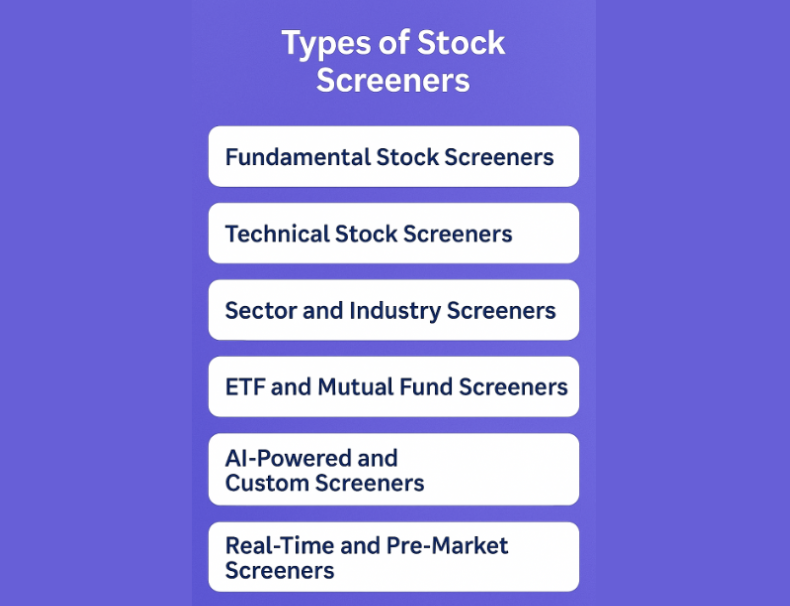
Types of Stock Screeners
Traders use different types of stock screeners depending on whether they focus on fundamentals, technicals, or advanced data analytics. Here are the main categories:
Fundamental Stock Screeners
These are built for investors who prefer fundamental analysis, evaluating a company’s financial health and long-term value.
For example, an income investor might screen for U.S. companies with Dividend Yield > 4%, Market Cap > $10B, and Debt-to-Equity < 0.5. This could bring up companies like Johnson & Johnson (JNJ) or Coca-Cola (KO).
Technical Stock Screeners
These cater to active traders and swing traders who rely on price action and technical signals.
Common filters include:
Moving averages (e.g., 50-day, 200-day)
Relative Strength Index (RSI)
MACD crossovers
Breakouts above resistance or below support
Average daily trading volume
For example, a day trader could set filters for RSI < 30 (oversold), volume > 2M shares, and 50-day MA above 200-day MA to find potential rebound stocks.
Sector and Industry Screeners
Some screeners allow filtering by sector, industry, or theme. This is useful for traders targeting emerging trends such as clean energy, artificial intelligence, or electric vehicles.
For example, a trader bullish on renewable energy might screen for U.S. Clean Energy companies with market cap > $1B and revenue growth > 15%. This could identify stocks like Enphase Energy (ENPH) or First Solar (FSLR).
ETF and Mutual Fund Screeners
Beyond individual stocks, many platforms offer ETF and fund screeners. These allow investors to filter funds by expense ratio, asset class, performance, and sector exposure.
For example, an investor could search for ETFs with expense ratio < 0.2%, exposure to U.S. tech sector, and 5-year return > 10%, which might highlight Invesco QQQ (QQQ) or Vanguard Information Technology ETF (VGT).
AI-Powered and Custom Screeners
The latest evolution in trading tools are AI-powered screeners, which integrate big data, machine learning, and even social sentiment analysis.
Features include:
Natural language queries (“Find undervalued energy stocks with low debt and strong EPS growth”)
Integration with alternative data like Google Trends or Twitter sentiment
AI-based scoring systems ranking stocks by probability of outperforming
Real-Time and Pre-Market Screeners
For day traders, real-time screeners are crucial. These track live price movements, unusual volume spikes, and pre-market movers before the opening bell.
For example, a trader watching for pre-market gainers with news catalysts and high liquidity could spot opportunities in companies announcing earnings beats or major partnerships
Advantages and Limitations of Stock Screeners
Like every trading tool, stock screeners come with both strengths and weaknesses. Understanding these helps you maximize their value while avoiding common pitfalls.
Advantages
Saves research time
Provides unbiased data filtering
Customizable for all trading styles
Helps improve decision-making and risk management
Limitations
Free screeners may lack real-time accuracy
Wrong filters can eliminate good opportunities
Some asset classes (like bonds or international ETFs) may not be supported
Screeners don’t replace deeper due diligence
How Different Traders Use Stock Screeners
Stock screeners aren’t one-size-fits-all. The way you use them depends on your trading style, time horizon, and risk appetite. Here’s how different types of traders put screeners to work:
Day Traders: Scan for volatile, high-volume stocks each morning.
Swing Traders: Search for momentum setups with RSI or MACD confirmation.
Long-Term Investors: Focus on valuation metrics like P/E ratios, book value, and dividend yield.
Quant Traders: Combine screeners with backtesting and automated strategies.
Conclusion
A stock screener is more than a convenience. It’s a powerful tool that transforms raw market data into actionable trade ideas. By filtering thousands of stocks down to a focused watchlist, you gain clarity, save time, and reduce emotional decision-making.
Whether you’re a day trader scanning for breakouts, a swing trader riding short-term momentum, or a long-term investor seeking stable dividend stocks, screeners help align opportunities with your strategy. Of course, the tool itself is only part of the equation, success also depends on trading with a broker that provides reliable data, transparent execution, and strong regulatory oversight.
At Ultima Markets, we combine technology with trust. As an FCA-regulated broker, we provide traders access to advanced platforms, educational resources, and tools designed to help you trade smarter. When you use a stock screener to identify opportunities, you can count on Ultima Markets to deliver the execution and support you need to act with confidence.
Share Now
Disclaimer:This content is provided for informational purposes only and does not constitute, and should not be construed as, financial, investment, or other professional advice. No statement or opinion contained herein should be considered a recommendation by Ultima Markets or the author regarding any specific investment product, strategy, or transaction. Readers are advised not to rely solely on this material when making investment decisions and should seek independent advice where appropriate.
Thank you for visiting the Ultima Markets website. Please note that this website is intended for individuals residing in jurisdictions where access is permitted by law. Ultima and its affiliated entities do not operate in your home jurisdiction.
By clicking ‘Acknowledge’, you confirm that you are entering this website solely on your own initiative and not as a result of any specific marketing outreach. You wish to obtain information from this website based on reverse solicitation principles, in accordance with the applicable laws of your home jurisdiction.