This website is managed by Ultima Markets’ international entities, and it’s important to emphasise that they are not subject to regulation by the FCA in the UK. Therefore, you must understand that you will not have the FCA’s protection when investing through this website – for example:
You will not be guaranteed Negative Balance Protection
You will not be protected by FCA’s leverage restrictions
You will not have the right to settle disputes via the Financial Ombudsman Service (FOS)
You will not be protected by Financial Services Compensation Scheme (FSCS)
Any monies deposited will not be afforded the protection required under the FCA Client Assets Sourcebook. The level of protection for your funds will be determined by the regulations of the relevant local regulator.
Note: UK clients are kindly invited to visit https://www.ultima-markets.co.uk/. Ultima Markets UK expects to begin onboarding UK clients in accordance with FCA regulatory requirements in 2026.
If you would like to proceed and visit this website, you acknowledge and confirm the following:
1.The website is owned by Ultima Markets’ international entities and not by Ultima Markets UK Ltd, which is regulated by the FCA.
2.Ultima Markets Limited, or any of the Ultima Markets international entities, are neither based in the UK nor licensed by the FCA.
3.You are accessing the website at your own initiative and have not been solicited by Ultima Markets Limited in any way.
4.Investing through this website does not grant you the protections provided by the FCA.
5.Should you choose to invest through this website or with any of the international Ultima Markets entities, you will be subject to the rules and regulations of the relevant international regulatory authorities, not the FCA.
Ultima Markets wants to make it clear that we are duly licensed and authorised to offer the services and financial derivative products listed on our website. Individuals accessing this website and registering a trading account do so entirely of their own volition and without prior solicitation.
By confirming your decision to proceed with entering the website, you hereby affirm that this decision was solely initiated by you, and no solicitation has been made by any Ultima Markets entity.
What is a Penny Stock? Guide to Low-Priced Securities
Summary:
Learn what penny stocks are, how they trade, the risks involved, and safer alternatives. A complete guide for investors considering penny stock trading.
In U.S. regulation, a penny stock is any equity security trading below 5 dollars per share. This modern definition expanded from the original under-1 dollar idea and now focuses on the combination of low share price and small market cap, both of which tend to increase risk for most investors.
Microcap stocks often overlap with penny stocks. The SEC commonly refers to micro caps as companies with market capitalization below 250 to 300 million dollars. The smallest public companies under roughly 50 million dollars are sometimes called nanocaps.
A stock price alone does not tell you a company’s market value. A 2 dollar stock with 100 million shares outstanding equals a 200 million dollar market cap, while a 50 dollar stock with 1 million shares equals 50 million dollars.
Where Penny Stocks Trade And Why It Matters
Many penny stocks do not meet the financial, governance, liquidity, or minimum bid price standards for major stock exchanges like Nasdaq and the NYSE. For example, Nasdaq’s rules require a 1 dollar minimum bid price and additional holder, float, and market value criteria. Companies that fail the 1 dollar threshold for a sustained period face deficiency notices and possible delisting if they do not regain compliance.
When companies cannot meet exchange standards, their stocks are traded OTC using broker dealer networks such as those operated by OTC Markets Group. OTC Markets organizes securities into OTCQX the highest disclosure tier, OTCQB for venture stage issuers, and Pink for limited or minimal disclosure. Issuers can move among tiers based on their reporting status and verification. Pink Limited and Pink Current tiers have specific, lighter requirements than OTCQX and OTCQB.
What this means for investors
Liquidity is often thin, so it can be hard to buy or sell penny stocks at your preferred price.
Bid ask spreads are wider than on major markets.
Information quality varies. Many issuers on Pink provide limited financial statements, which makes due diligence harder.
Why Some Investors Buy Penny Stocks
The primary attraction of trading penny stocks lies in their low barrier to entry and the potential for substantial percentage gains. With just $1,000, an investor can purchase 2,000 shares of a $0.50 stock, compared to perhaps 5-10 shares of a typical blue-chip stock. This mathematical advantage creates the appealing possibility of significant returns if the stock price rises even modestly.
Consider a practical example: if that $0.50 penny stock rises to $2.00 per share, the investor would see a 300% return on their initial investment. The same percentage gain would require a $200 stock to rise to $800 – a much less likely scenario for established companies. This potential for outsized returns attracts speculative investors seeking to maximize their gains from small initial investments.
Day traders and swing traders are particularly drawn to penny stocks because of their high volatility. These securities can experience dramatic price swings within short periods, sometimes moving 20% or more in a single trading session. For traders skilled at timing these movements, the volatility represents opportunity for quick gains through rapid buying and selling.
Reality check. Academic and practitioner research generally finds many penny stocks underperform over time and have a high likelihood of extreme losses, even when institutions participate. Treat them as high risk and highly speculative.
Major Risks And Classic Red Flags
Investing in penny stocks exposes investors to significantly higher risks compared to securities traded on major exchanges. The most fundamental risk is the high failure rate among penny stock companies – many eventually become worthless through bankruptcy, business failure, or delisting that leaves shareholders with no viable exit strategy.
The limited financial disclosure required for many penny stocks creates substantial information risk. Unlike companies listed on major exchanges, which must file regular, audited financial statements, many penny stock companies provide minimal or unreliable financial information. This lack of transparency makes it extremely difficult for investors to perform proper due diligence or assess a company’s true financial condition.
Low trading volume presents another significant challenge for penny stock investors. Many penny stocks trade only a few thousand shares per day, creating liquidity problems when investors want to sell their positions. This thinly traded nature means that even modest buy or sell orders can dramatically impact the stock price, and investors may find themselves unable to exit positions at desired prices.
The extreme price volatility that attracts some investors to penny stocks also represents a major risk factor. While prices can rise quickly, they can fall just as rapidly, sometimes losing 50% or more of their value in a single trading session. This volatility often stems from the low liquidity and small float of shares available for trading.
Penny stocks are particularly susceptible to market manipulation due to their low liquidity and limited regulatory oversight. The Securities and Exchange Commission has documented numerous cases where unscrupulous promoters have artificially inflated penny stock prices before selling their holdings to unsuspecting investors.
Regulatory Framework and Investor Protections
To address manipulation in the penny stock market, Congress passed the Penny Stock Reform Act of 1990. The SEC then adopted rules that define penny stocks and require heightened broker disclosures, risk documents, suitability reviews, and a cooling off period before initial transactions. Brokers also must obtain customer consent for subsequent trades in many scenarios. FINRA enforces compliance among member firms and publishes investor alerts.
What you should receive before trading penny stocks
A standardized Penny Stock Risk Disclosure Document explaining risks and spreads
Information on broker compensation and the specific security
Suitability steps confirming the investment matches your investment objectives and risk tolerance
In many cases, signed or recorded customer agreements for penny stock transactions
Penny Stocks vs. Traditional Investments
Understanding the fundamental differences between penny stocks and traditional investments helps investors make informed decisions about portfolio allocation and risk management. These differences extend far beyond simple price points to encompass regulation, transparency, liquidity, and overall investment risk.
Characteristic
Penny stocks
Traditional stocks
Share price
Under 5 dollars
Varies widely
Market cap
Often micro cap under 300 million dollars
Small to mega cap
Trading venue
Traded OTC on OTC Markets tiers
Major exchanges like NYSE and Nasdaq
Liquidity
Often low liquidity and wide spreads
Generally higher
Volatility
High volatility
Usually lower
Disclosure
Limited or unaudited for many issuers
Extensive audited financial statements
Fraud risk
Elevated, including pump and dump
Lower but not zero
Blue-chip stocks, representing large, established companies, offer several advantages that penny stocks typically cannot match. These companies usually pay regular dividends, have stable earnings histories, and operate in multiple markets or geographic regions. Their established business models and experienced management teams provide greater predictability for investors.
Large-cap stocks benefit from extensive analyst coverage, with professional researchers regularly publishing detailed reports on company performance, industry trends, and investment recommendations. This coverage helps ensure that material information is widely available and that stock prices generally reflect the company’s fundamental value.
The liquidity differences between penny stocks and established companies can be dramatic. A major company like Apple or Microsoft can trade millions of shares daily without significant price impact, while a penny stock might see its price swing wildly on a few thousand shares of trading volume. This liquidity difference affects both entry and exit strategies for investors.
Volatility metrics also show stark differences between these investment categories. While blue-chip stocks might experience daily price changes of 1-3% during normal market conditions, penny stocks regularly see daily movements of 20% or more. This increased volatility can work for or against investors, but it consistently increases risk and unpredictability.
Due diligence requirements vary significantly between penny stocks and traditional investments. Researching established companies involves analyzing audited financial statements, SEC filings, analyst reports, and industry data. For penny stocks, investors often must work with limited, unverified information and may need to conduct primary research to understand the company’s actual business operations.
How to Research Penny Stock Companies
Successful penny stock research requires a different approach than traditional stock analysis due to the limited availability of reliable information. Investors must become detective-like in their investigation methods, using multiple sources to piece together an accurate picture of a company’s prospects and risks.
The SEC’s EDGAR database serves as the primary source for official company filings, though many penny stock companies file minimal information. Investors should look for Form 10-K annual reports, Form 10-Q quarterly reports, and Form 8-K reports of material events. The absence of recent filings often signals problems with company management or operations.
When financial statements are available, investors should focus on key metrics including revenue growth trends, debt levels relative to assets, and cash flow patterns. Many penny stock companies show minimal revenue or operating losses, which raises questions about their viability as ongoing business concerns. Consistent losses without a clear path to profitability represent major red flags.
Management team evaluation becomes particularly crucial for penny stock companies, as these small organizations often depend heavily on their leadership. Investors should research management backgrounds, looking for relevant industry experience, track records of success, and any history of involvement with failed companies or regulatory violations. The SEC maintains databases of enforcement actions that can reveal problematic management histories.
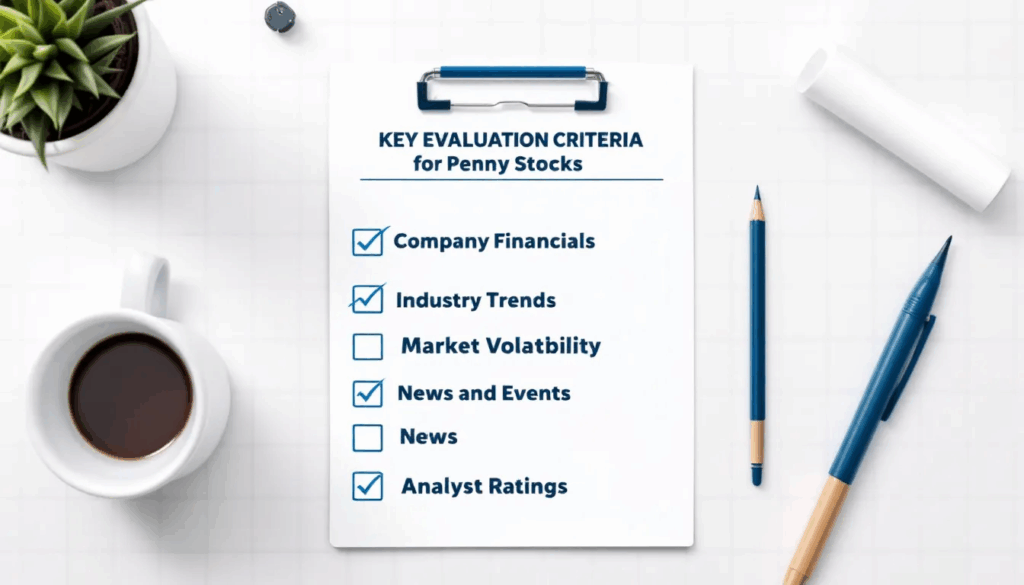
Industry analysis helps investors understand the competitive landscape and growth prospects for penny stock companies. Many penny stocks operate in emerging or niche industries where market dynamics can change rapidly. Understanding industry trends, regulatory changes, and competitive threats helps investors assess whether a company has realistic prospects for growth.
Several red flags should immediately alert investors to potential problems. Frequent company name changes often indicate attempts to distance the company from past failures or regulatory problems. Recent bankruptcy history suggests ongoing financial distress. Uncertified or unaudited financial statements indicate either insufficient resources for proper accounting or potential attempts to hide financial problems.
Promotional activity around a penny stock should also raise suspicions. If a company’s stock is being heavily promoted through newsletters, social media, or cold calls, investors should question who is funding the promotion and why. Legitimate companies rarely need to resort to aggressive promotional tactics to attract investors.
The lack of institutional ownership often signals problems with penny stock companies. Professional money managers and institutional investors typically avoid penny stocks due to their high risk and limited liquidity. When even professional investors won’t touch a security, individual investors should question whether they possess superior analysis capabilities.
Safer Alternatives If You Have A Small Investment
If you like the low cost entry of penny stocks but want lower risk, consider:
Fractional shares of established companies so your small investment buys part of a quality business
ETFs including diversified small cap funds instead of individual penny stock companies
Mutual funds or target date funds that spread risk across sectors and sizes
These options let you invest small investment amounts while avoiding the most common penny stock scams and liquidity traps.
Conclusion
Penny stocks capture attention because of their low share price, high volatility, and the dream of uncovering the “next big thing.” Yet, for most investors, they come with more unique risks than rewards from low liquidity and unreliable financial statements to the ever-present threat of pump and dump scams.
If you’re considering adding penny stocks to your investment portfolio, remember that they should be treated only as a speculative investment, not a core wealth-building strategy.
At Ultima Markets, we believe informed decisions are the foundation of successful trading. Our platform provides access to a wide range of global markets, transparent pricing, and educational resources designed to help traders navigate opportunities and risks alike. Rather than chasing the uncertainty of penny stock trading, you can explore safer, diversified alternatives from fractional shares and ETFs to established global assets all within a regulated and secure trading environment.
Disclaimer: This content is provided for informational purposes only and does not constitute, and should not be construed as, financial, investment, or other professional advice. No statement or opinion contained here in should be considered a recommendation by Ultima Markets or the author regarding any specific investment product, strategy, or transaction. Readers are advised not to rely solely on this material when making investment decisions and should seek independent advice where appropriate.
Thank you for visiting the Ultima Markets website. Please note that this website is intended for individuals residing in jurisdictions where access is permitted by law. Ultima and its affiliated entities do not operate in your home jurisdiction.
By clicking ‘Acknowledge’, you confirm that you are entering this website solely on your own initiative and not as a result of any specific marketing outreach. You wish to obtain information from this website based on reverse solicitation principles, in accordance with the applicable laws of your home jurisdiction.