This website is managed by Ultima Markets’ international entities, and it’s important to emphasise that they are not subject to regulation by the FCA in the UK. Therefore, you must understand that you will not have the FCA’s protection when investing through this website – for example:
You will not be guaranteed Negative Balance Protection
You will not be protected by FCA’s leverage restrictions
You will not have the right to settle disputes via the Financial Ombudsman Service (FOS)
You will not be protected by Financial Services Compensation Scheme (FSCS)
Any monies deposited will not be afforded the protection required under the FCA Client Assets Sourcebook. The level of protection for your funds will be determined by the regulations of the relevant local regulator.
Note: UK clients are kindly invited to visit https://www.ultima-markets.co.uk/. Ultima Markets UK expects to begin onboarding UK clients in accordance with FCA regulatory requirements in 2026.
If you would like to proceed and visit this website, you acknowledge and confirm the following:
1.The website is owned by Ultima Markets’ international entities and not by Ultima Markets UK Ltd, which is regulated by the FCA.
2.Ultima Markets Limited, or any of the Ultima Markets international entities, are neither based in the UK nor licensed by the FCA.
3.You are accessing the website at your own initiative and have not been solicited by Ultima Markets Limited in any way.
4.Investing through this website does not grant you the protections provided by the FCA.
5.Should you choose to invest through this website or with any of the international Ultima Markets entities, you will be subject to the rules and regulations of the relevant international regulatory authorities, not the FCA.
Ultima Markets wants to make it clear that we are duly licensed and authorised to offer the services and financial derivative products listed on our website. Individuals accessing this website and registering a trading account do so entirely of their own volition and without prior solicitation.
By confirming your decision to proceed with entering the website, you hereby affirm that this decision was solely initiated by you, and no solicitation has been made by any Ultima Markets entity.
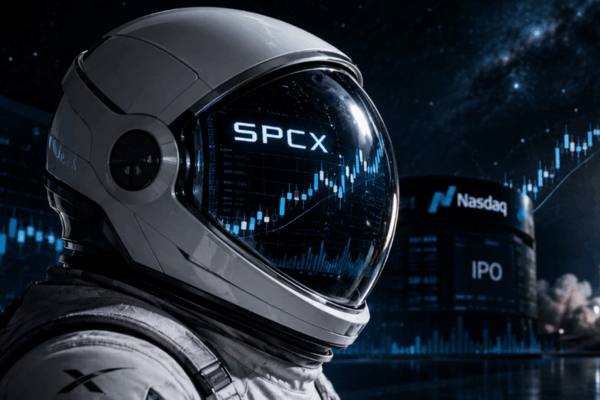
SpaceX files S‑1 for 2026 Nasdaq IPO under SPCX. Learn about its revenue, valuation, and potential growth with investor considerations on the SpaceX IPO.
SpaceX, the rocket, satellite internet, and AI powerhouse led by Elon Musk, has officially filed its Form S‑1 registration statement, confirming plans to go public in June 2026 on the Nasdaq under ticker SPCX.
Analysts project this could be the largest IPO in U.S. history, setting a precedent for how ultra-large, diversified tech and infrastructure companies are valued.
This filing reveals key financials, strategic growth areas, and investor considerations, marking a turning point for public market access to Musk’s ventures.
IPO Filing and Timeline
Pre-IPO Stock Split and Retail Accessibility
Ahead of the IPO, SpaceX executed a 1-for-5 stock split, reducing the fair market value per share from approximately $526.59 to $105.32. The purpose of this move is to lower the investment threshold for retail investors, broadening accessibility ahead of the public listing.
Completion Date: Expected by May 22, 2026
Post-split Private Market Value: ~$100 per share
Anticipated IPO Price: ~$160 per share
This stock split, along with reports of a potential 30% allocation to retail investors, suggests that individual shareholders could play a significant role in the initial trading period, similar to Tesla’s approach in its 2020 and 2022 splits.
IPO Filing Details and Timeline
Ticker Symbol: SPCX (Nasdaq)
Targeted Fundraise: ~$75 billion
Estimated Valuation: $1.5–$2 trillion
Investor Roadshows: Early June 2026
Potential IPO Debut: June 12, 2026
The IPO filing provides investors with insight into SpaceX’s revenue streams, segment performance, and long-term growth potential, establishing a foundation for evaluation before public trading begins.
What Powers SpaceX’s Growth
Investors evaluating SPCX should consider how the broader Musk ecosystem influences market perception and potential valuation. Developments at Tesla, xAI, Grok, and Starlink can affect investor sentiment and indirectly shape SPXC pricing.
Positive performance or breakthroughs at other Musk-led ventures may boost confidence and demand, while setbacks or controversies can introduce short-term volatility. Starlink’s subscriber growth and revenue stability remain key indicators of public market confidence.
Understanding these interactions helps investors anticipate pricing dynamics and market behavior as the IPO unfolds.
Segment Analysis on Revenue Drivers
Starlink: Connectivity Backbone
Starlink satellite internet is SpaceX’s largest revenue driver, serving over 8 million subscribers worldwide. Its subscription-based revenue model provides predictable cash flow, which supports both Starship launches and AI infrastructure. Strong adoption and consistent revenue make Starlink central to investor evaluation and SPXC valuation.
AI, xAI and Technology Platforms
Integration of xAI and Grok reflects SpaceX’s commitment to high-margin, technology-driven initiatives. While these segments generate revenue, they also carry significant operating losses due to upfront capital expenditures.
Analysts view them as long-term growth engines that could amplify shareholder value if successfully deployed.
Space Operations and Starship
Starship heavy-lift rockets underpin large-scale satellite deployment and potential interplanetary projects. Despite high capital requirements, successful operations could unlock substantial revenue opportunities and provide strategic leverage for both Starlink and AI projects.
Valuation and Total Addressable Market
SpaceX anticipates a valuation of $1.5–2 trillion, with a potential fundraise of $75 billion, positioning it as the largest IPO ever. The company estimates a $28.5 trillion total addressable market, including satellite connectivity, AI services, and enterprise technology.
While these figures illustrate the company’s growth potential, investors should approach them cautiously, as they are forward-looking projections rather than guaranteed returns.
Elon Musk’s Compensation and Governance
Elon Musk will remain CEO, CTO, and Chairman, with super-voting shares to maintain control. The S‑1 also highlights a long-term incentive plan:
Musk receives no fixed salary, with compensation tied to ambitious long-term milestones.
Potential awards include up to 260 million SpaceX shares if targets such as a $7.5 trillion valuation, Mars colonization, and orbital AI deployment are achieved.
Full achievement could equate to approximately $500 billion in stock value, underscoring alignment with long-term shareholder interests.
This structure ensures strategic continuity while offering transparency on incentives, a key factor for investors evaluating governance.
Should You Invest in the SpaceX IPO?
The SpaceX IPO represents a rare opportunity to invest in a company at the forefront of aerospace, satellite internet, and artificial intelligence. Analysts note that SPXC is not just a rocket manufacturer but a multi-industry technology leader, with Starlink providing recurring revenue and AI ventures offering high-growth potential.
However, investors should weigh this against significant risks.
Potential Risks Ahead
Key risks include:
Operating losses due to heavy R&D and AI/Starship investments.
High valuation multiples, introducing potential volatility.
Execution risks, particularly for Starship launches and AI infrastructure.
Regulatory hurdles in multiple jurisdictions.
Despite these challenges, SPXC offers exposure to a unique combination of aerospace, satellite internet, and AI sectors, appealing to long-term growth-focused investors.
Market Outlook
While the valuation is unprecedented and execution risks remain, market observers note that SPXC offers a unique opportunity to participate in a high-growth, multi-industry company with substantial long-term potential.
Overall, analysts agree that while the IPO has the potential to deliver long-term growth for patient investors, it is best suited for those who understand the capital-intensive nature of SpaceX’s operations and are comfortable with short-term uncertainty.
For cautious investors, monitoring initial market performance and the company’s execution on key milestones may provide important guidance before taking a position.
FAQs
When will SpaceX IPO happen?
Mid-June 2026, under Nasdaq SPCX.
What is the expected valuation?
Private valuation is around $800 billion though the IPO could target $1.5–2 trillion.
What drives SpaceX’s revenue?
Starlink subscriptions, Falcon rocket launches, xAI, and Grok AI operations.
Will Elon Musk maintain control?
Yes, through CEO, CTO, and Chairman roles with majority voting rights.
What are the main risks?
Operating losses, execution risk on Starship and AI projects, and regulatory or market uncertainties.
Share Now
Disclaimer:This content is provided for informational purposes only and does not constitute, and should not be construed as, financial, investment, or other professional advice. No statement or opinion contained herein should be considered a recommendation by Ultima Markets or the author regarding any specific investment product, strategy, or transaction. Readers are advised not to rely solely on this material when making investment decisions and should seek independent advice where appropriate.
Thank you for visiting the Ultima Markets website. Please note that this website is intended for individuals residing in jurisdictions where access is permitted by law. Ultima and its affiliated entities do not operate in your home jurisdiction.
By clicking ‘Acknowledge’, you confirm that you are entering this website solely on your own initiative and not as a result of any specific marketing outreach. You wish to obtain information from this website based on reverse solicitation principles, in accordance with the applicable laws of your home jurisdiction.