This website is managed by Ultima Markets’ international entities, and it’s important to emphasise that they are not subject to regulation by the FCA in the UK. Therefore, you must understand that you will not have the FCA’s protection when investing through this website – for example:
You will not be guaranteed Negative Balance Protection
You will not be protected by FCA’s leverage restrictions
You will not have the right to settle disputes via the Financial Ombudsman Service (FOS)
You will not be protected by Financial Services Compensation Scheme (FSCS)
Any monies deposited will not be afforded the protection required under the FCA Client Assets Sourcebook. The level of protection for your funds will be determined by the regulations of the relevant local regulator.
Note: UK clients are kindly invited to visit https://www.ultima-markets.co.uk/. Ultima Markets UK expects to begin onboarding UK clients in accordance with FCA regulatory requirements in 2026.
If you would like to proceed and visit this website, you acknowledge and confirm the following:
1.The website is owned by Ultima Markets’ international entities and not by Ultima Markets UK Ltd, which is regulated by the FCA.
2.Ultima Markets Limited, or any of the Ultima Markets international entities, are neither based in the UK nor licensed by the FCA.
3.You are accessing the website at your own initiative and have not been solicited by Ultima Markets Limited in any way.
4.Investing through this website does not grant you the protections provided by the FCA.
5.Should you choose to invest through this website or with any of the international Ultima Markets entities, you will be subject to the rules and regulations of the relevant international regulatory authorities, not the FCA.
Ultima Markets wants to make it clear that we are duly licensed and authorised to offer the services and financial derivative products listed on our website. Individuals accessing this website and registering a trading account do so entirely of their own volition and without prior solicitation.
By confirming your decision to proceed with entering the website, you hereby affirm that this decision was solely initiated by you, and no solicitation has been made by any Ultima Markets entity.
What is ROE? Complete Guide to Key Investment Data
What is ROE? Complete Guide to Key Investment Data
What is ROE? Many newcomers to the stock market may have heard this professional term, but might not fully understand its specific meaning and investment applications.
As a key indicator of a company’s financial performance, ROE (Return on Equity) measures the return on shareholders’ equity. It is an essential tool for analyzing a listed company’s profitability and one of the basic skills every investor should master.
What is ROE and how is it calculated
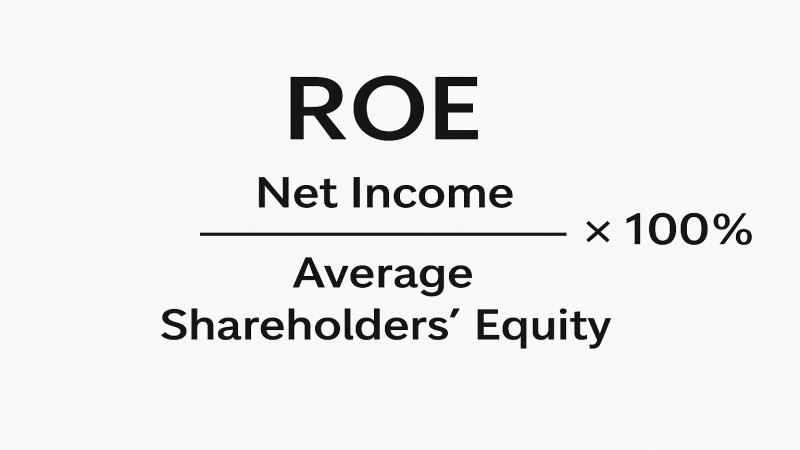
What is ROE? From a professional perspective, ROE refers to a company’s net profit during a specific period divided by its total shareholders’ equity. It is used to assess how efficiently a company uses capital to generate profits. The formula is:
ROE = (Net Profit ÷ Total Shareholders’ Equity) × 100%
For example, if a company has a net profit of USD 5 million and total shareholders’ equity of USD 25 million, then its ROE is 20%.
ROE analysis and its use in investment strategies
In investing, understanding “what is ROE” is often seen as a key filter for identifying quality stocks. Many renowned investors, such as Warren Buffett, have stated that ROE is one of the most important financial indicators they focus on.
Generally, an ROE above 15% is considered high, indicating that the company is using capital efficiently and may have greater investment value.
However, investors should be aware that a high ROE may also result from high leverage. It is important to evaluate it alongside other indicators, such as ROA (Return on Assets) and debt ratio, to avoid blindly chasing high numbers.
For instance, the UM platform offers financial analysis tools to help users comprehensively monitor company financials and market trends to support sound investment decisions.
How the difference between ROE and ROA affects investment decisions
ROE and ROA are often confused, but they actually have different meanings. ROE focuses on shareholders’ equity, while ROA measures the efficiency of total asset utilization.
For example, if a company has a high ROE but a low ROA, it may suggest heavy reliance on debt. Conversely, if both ROE and ROA are high, it indicates stronger and more stable profitability.
What is a good ROE? How to assess stock value
Generally speaking, a company with ROE consistently above 15%, especially if it surpasses the industry average, can be considered a potential growth stock. For example, Taiwanese listed companies such as TSMC and MediaTek have maintained high ROE over the years, making them market favorites.
How should investors use ROE data?
Investors can observe a company’s historical ROE trends. If a company maintains a consistently high ROE that steadily increases year after year, it usually indicates strong and sustainable profitability, making it suitable for long-term investment.
It is recommended to use a demo account to test and observe the interaction between a company’s stock price and its ROE performance.
Practical techniques for screening ROE growth stocks
In practice, investors can use ROE trends to select potential growth stocks. Companies with steadily rising ROE often have greater potential for future stock price appreciation and are worth close attention.
For example, in the Hong Kong market, certain high-tech and biotech stocks such as BYD and WuXi Biologics have shown rapid ROE growth in recent years, with their stock prices climbing accordingly.
Investment insights from comparing ROE and EPS
Combining EPS (Earnings Per Share) with ROE makes investment decisions more effective. For instance, if ROE continues to rise but EPS remains stagnant, it may suggest that profitability is being affected by other factors such as share dilution or increased expenses.
Conversely, when both ROE and EPS increase, it signals strong operations and improved profitability, indicating clear investment value.
How to use ROE together with P/E ratio
Investors can evaluate stock price reasonableness by considering both ROE and the price-to-earnings (P/E) ratio. A company with high ROE but a low P/E may be undervalued and present a good investment opportunity.
FAQ
Q: Is a high ROE always a good thing?
A: A high ROE is generally positive, but it should be analyzed alongside debt ratio to avoid risks from excessive leverage.
Q: Is ROE more suitable for short-term or long-term investment?
A: ROE is more suitable for long-term investment, especially in companies with consistently growing and stable ROE.
Q: How can beginners quickly understand ROE? A: By using a professional platform like Ultima Markets with a trading account, beginners can easily access ROE and corporate financial data.
Conclusion: Understand what ROE is to invest with precision
Through the above explanation, investors should now have a clearer understanding of what ROE is and its significance in investing. It’s essential to evaluate ROE alongside other financial indicators to accurately identify quality companies and achieve stable returns.
Making good use of real-time market analysis and trading tools provided by the UM platform can further enhance the accuracy and efficiency of investment decisions.
Disclaimer: This content is provided for informational purposes only and does not constitute, and should not be construed as, financial, investment, or other professional advice. No statement or opinion contained here in should be considered a recommendation by Ultima Markets or the author regarding any specific investment product, strategy, or transaction. Readers are advised not to rely solely on this material when making investment decisions and should seek independent advice where appropriate.
Thank you for visiting the Ultima Markets website. Please note that this website is intended for individuals residing in jurisdictions where accessing is permitted by law. Ultima and its affiliated entities do not operate in your home jurisdictions.
By clicking on ''Acknowledge'', you confirm that you are entering this website solely based on your initiative and not as a result of any specific marketing outreach. You wish to obtain information from this website based on reverse solicitation principles, in accordance with the applicable laws of your home jurisdiction.