This website is managed by Ultima Markets’ international entities, and it’s important to emphasise that they are not subject to regulation by the FCA in the UK. Therefore, you must understand that you will not have the FCA’s protection when investing through this website – for example:
You will not be guaranteed Negative Balance Protection
You will not be protected by FCA’s leverage restrictions
You will not have the right to settle disputes via the Financial Ombudsman Service (FOS)
You will not be protected by Financial Services Compensation Scheme (FSCS)
Any monies deposited will not be afforded the protection required under the FCA Client Assets Sourcebook. The level of protection for your funds will be determined by the regulations of the relevant local regulator.
Note: UK clients are kindly invited to visit https://www.ultima-markets.co.uk/. Ultima Markets UK expects to begin onboarding UK clients in accordance with FCA regulatory requirements in 2026.
If you would like to proceed and visit this website, you acknowledge and confirm the following:
1.The website is owned by Ultima Markets’ international entities and not by Ultima Markets UK Ltd, which is regulated by the FCA.
2.Ultima Markets Limited, or any of the Ultima Markets international entities, are neither based in the UK nor licensed by the FCA.
3.You are accessing the website at your own initiative and have not been solicited by Ultima Markets Limited in any way.
4.Investing through this website does not grant you the protections provided by the FCA.
5.Should you choose to invest through this website or with any of the international Ultima Markets entities, you will be subject to the rules and regulations of the relevant international regulatory authorities, not the FCA.
Ultima Markets wants to make it clear that we are duly licensed and authorised to offer the services and financial derivative products listed on our website. Individuals accessing this website and registering a trading account do so entirely of their own volition and without prior solicitation.
By confirming your decision to proceed with entering the website, you hereby affirm that this decision was solely initiated by you, and no solicitation has been made by any Ultima Markets entity.
Ultima Markets does not have an establishment in Singapore and does not operate from Singapore.
Ultima Markets does not provide products or services to citizens or residents of Singapore, and account applications from Singapore citizens or residents will not be accepted.
If you are a citizen or resident of Singapore, please do not open an account or use Ultima Markets’ products or services.
By selecting “Acknowledge and Continue Browsing”, you confirm that you are accessing this website on your own initiative and that your access is not the result of any direct marketing, targeted advertising, solicitation, or promotional activity by Ultima Markets.
Nothing on this website constitutes an offer, solicitation, or promotion of products or services in any jurisdiction where such activity is prohibited. You are responsible for ensuring that your access to and use of this website complies with applicable local laws and regulations.
Is Gold a Good Investment? Learn when gold works, how much to own, and the best vehicles, physical, ETFs, miners, futures based on trends.
Yes, gold is a good investment. Gold’s low correlation to stocks and bonds can reduce portfolio risk and preserve purchasing power over long cycles, but it can lag equities for years. Most investors use a small allocation (about 2–10%) alongside core assets.
How Has Gold Actually Performed Recently?
Exceptionally strong. In 2025, gold set a string of all-time highs, fuelled by safe-haven demand, record ETF inflows, and persistent central-bank buying.
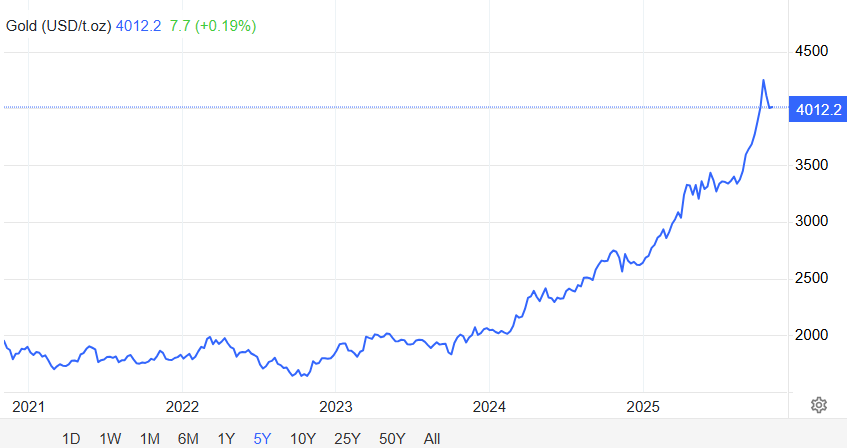
Very strong uptrend with a brief pullback. The 5-year chart shows gold oscillating near US$1,800–2,100/oz (2021–2023), then breaking out in 2024 and accelerating through 2025 to a new peak just under US$4,500/oz, before easing to about US$4,012/oz (shown above). This pattern, higher highs, shallow pullbacks, and a new range above US$3,500 that signals robust momentum supported by safe-haven demand, central-bank buying, and renewed ETF inflows. The recent performance confirms gold’s role as a diversifier and macro hedge during policy and geopolitical uncertainty.
Key Takeaways
Structure: Sideways-to-gradual climb (2021–2023), breakout and trend acceleration (2024–2025).
Momentum: Steeper slope from mid-2024 onward, consistent with trend confirmation rather than a single spike.
Pullback discipline: After a sharp rally toward ~US$4,500/oz, price consolidated near ~US$4,000, a normal retracement inside a primary uptrend.
Support zones: Former resistance around US$3,500–3,700 now acts as first support, with secondary support near US$3,200–3,300 on deeper dips.
Key Reasons Why Gold is a Good Investment
Gold earns its place in a modern portfolio because it behaves differently from stocks and bonds during stress. That difference can lower overall risk and help preserve purchasing power over long cycles. In 2025, strong central bank buying, renewed investor inflows, and persistent macro uncertainty kept gold in focus, but the real case goes beyond any single year.
Powerful Diversifier When You Need It Most
Gold’s correlation to risk assets tends to fall or turn negative during stress, providing ballast when equities wobble. That behavior is uncommon among hedges and is the core reason portfolios often include a gold sleeve
Central-Bank Demand Creates a Durable Floor
Reserve managers have purchased 1,000+ tonnes of gold per year for three straight years, far above the prior decade’s pace. This steady, price-insensitive buyer base supports the long-term investment case.
Investment Flows Have Re-Accelerated
In 2025, global demand hit a quarterly record, driven by bars/coins and a sharp resurgence in physically-backed ETF inflows, indicating broad investor participation, not just speculative spikes.
Proven Safe-Haven During Macro Shocks
Trade-war headlines, policy uncertainty, and rate expectations repeatedly pushed gold to fresh record highs in 2025 (breaking $3,000/oz and beyond), underscoring its “risk-off” appeal.
Long-Cycle Purchasing-Power Preservation
Academic and industry research agree that gold is not a perfect short-run CPI hedge, but over long cycles it helps preserve real wealth and hedge regime/currency risks, one reason central banks keep buying.
Gold Prices Drivers
Gold is driven by real interest rates, the US dollar, investment flows (ETFs/bars & coins), central-bank demand, jewellery/tech demand, mine supply & recycling, and geopolitics/policy risk. Here’s how each piece pushes or pulls price plus what to watch.
Real yields and the US dollar
Lower real (inflation-adjusted) bond yields reduce the opportunity cost of holding a non-yielding asset like gold, typically bullish. A weaker USD makes dollar-priced gold cheaper for non-US buyers, supports demand. Conversely, higher real yields/stronger USD pressure gold.
Investment flows (ETFs, bars & coins)
Physically backed gold ETFs and retail bar/coin buying can quickly swing marginal demand. In 2025, gold saw record ETF inflows (largest on record in September, strongest quarter on record), helping propel prices to all-time highs.
Central-bank buying
Reserve managers have become a structural bid: for the third straight year, central banks purchased 1,000+ tonnes annually, a regime shift that supports prices through cycles. 2025 surveys show many plan to increase gold reserves further.
Jewellery and technology demand
At very high prices, jewellery demand can soften, especially in price-sensitive markets, partially offsetting investment strength. Tech uses (electronics) are smaller but steady. WGC notes this substitution effect during 2025’s surge.
Geopolitics, trade policy, and macro uncertainty
Safe-haven bids rise with geopolitical tension, trade frictions, fiscal concerns, or doubts about central-bank policy paths, all prominent in 2025’s rally.
Positioning & market structure
Futures/options positioning, risk-parity rebalancing, and CTA trend-following can amplify moves. These flows often respond to the macro drivers above and to breakouts through prior highs.
Ways To Invest In Gold
Physical Gold
Bars and coins you can hold. Pricing follows spot gold but includes a purchase premium and a selling discount. You are responsible for secure storage and insurance.
Advantages
Direct ownership with no fund counterparty risk
Long term store of value outside the financial system
Useful for wealth privacy and legacy planning
Disadvantages
Upfront premiums, spreads, storage and insurance costs
Less convenient to trade, harder to fractionalize
Authentication and resale logistics can vary by dealer and location
Why invest in physical gold
You want tangible assets that closely track the gold price
You value holding wealth outside brokerage and banking rails
You plan to hold for the long term with minimal trading
Gold ETFs
Exchange-traded funds that hold bullion or use instruments designed to track the gold price. Bought and sold like a stock in a brokerage account.
Advantages
Simple, liquid, and transparent access to gold
Tight bid-ask spreads for efficient execution
No personal storage or insurance requirements
Disadvantages
Ongoing expense ratio reduces returns slightly over time
You own fund shares rather than specific bars
Must review structure, custody, and tracking quality
Why invest in gold ETFs
You want set-and-forget exposure for a diversified portfolio
You need daily liquidity and easy rebalancing
You prefer operational simplicity over handling physical metal
Gold Mining Stocks
Shares of companies that explore for and produce gold. Returns reflect both the gold price and company fundamentals such as costs, reserves, capital allocation, and jurisdiction risk.
Advantages
Operational leverage to rising gold prices can amplify upside
Potential dividends from quality producers
Broad menu of large caps, mid caps, and juniors for targeted strategies
Disadvantages
Higher volatility than bullion and ETFs
Company-specific risks such as cost inflation, reserve quality, politics, dilution
Can decline even when the gold price is flat or rising
Why invest in gold mining stocks
You want growth potential beyond bullion
You can research operators and accept equity risk
You are building a satellite sleeve around a core gold exposure
Gold Futures and Options
Exchange-traded derivatives referencing the gold price. Futures provide leveraged exposure that requires margin. Options provide defined-risk strategies but are subject to time decay.
Advantages
Capital-efficient exposure and precise hedging
Deep liquidity and nearly around-the-clock pricing on major contracts
Tactics for both bullish and defensive views
Disadvantages
Leverage magnifies losses and can trigger margin calls
Futures positions must be rolled to maintain exposure
Options lose value over time and require active management
Why invest in gold derivatives
You need tactical exposure or hedging precision
You understand margin, options Greeks, and risk controls
You can monitor positions frequently
How Much Gold Should I Own?
For most diversified investors, a 2–10% allocation to gold works well. Stay near 2–4% if you prioritize growth from stocks; move toward 6–10% if you want more drawdown protection or if stock–bond correlations are rising. Treat gold as a diversifier/hedge, not your primary growth engine.
Pick Your Range (by goal & risk)
Conservative diversifier (2–4%) You mainly want stability. Use a low-cost, physically backed gold ETF (or physical bars/coins if you value direct ownership).
Balanced hedge (4–7%) You want meaningful protection without giving up too much equity upside. Core in ETF/physical, optional miners 0–10% of the gold sleeve for some upside.
Hedge-forward (7–10%) You’re focused on tail-risk protection or live in a market with currency/policy uncertainty. Keep most of the sleeve in ETF/physical, limit derivatives to tactical use.
If stocks and bonds start moving together, consider the upper half of your range. If real yields rise and your portfolio is already defensive, use the lower half.
Common Mistakes to Avoid
Allocating too much and then judging gold against stocks (different jobs).
Treating miners as a perfect proxy for bullion.
Ignoring fees, spreads, storage, or futures roll costs.
Using leverage/options without a clear exit and risk budget.
How to Invest/Trade Gold on Ultima Markets
Step 1 — Clarify Your Objective
Investor mindset: add a small diversifier (e.g., 2–6% of portfolio) and rebalance.
Trader mindset: look for tactical entries around news, trend, or mean-reversion setups.
Step 2 — Open and Prepare Your Account
Create an Ultima Markets account and complete KYC.
Start with a demo to test order types, position sizing, and your strategy.
Choose platform: UM Mobile / desktop (MT4/MT5 or UM platform, use what you’re comfortable with).
Set risk defaults: stop-loss enabled by default, max risk per trade (e.g., 0.5%–1% of account), daily loss limit.
Step 3 — Pick Your Gold Instrument on UM
XAUUSD (Spot Gold CFD): most liquid; ideal for trend/mean-reversion/news trading.
XAUEUR / XAU against other majors (if listed): currency diversification.
Gold-related indices/ETFs via CFDs (if available): broader gold ecosystem exposure.
(Instrument availability can vary; check the UM platform’s symbols list.)
Step 4 — Build Your Trade Plan
Setup types:
Trend-following: buy pullbacks above the 50/200-day MAs; trail stops.
Breakout: enter on range breaks; predefine invalidation below range.
Mean-reversion: fade overextensions into prior support/resistance with tight risk.
Catalysts to watch: real yields, USD (DXY), CPI/PPI, FOMC, PMI, geopolitics.
Position sizing (example):
Account $10,000; risk 1% = $100 per trade.
Stop distance $15 on XAUUSD, position size ≈ $100 ÷ $15 ≈ 0.0067 lots (adjust for your platform’s contract size).
Step 5 — Place & Manage the Trade
Use stop-loss at order entry, consider OCO (one-cancels-the-other) for breakouts.
Hold discipline: if price hits your stop, exit; if target reaches R:R ≥ 1.5–2.0, scale or trail.
Step 6 — Costs & Execution Checklist
Spreads/commissions: tighter during liquid sessions (London/NY overlap).
Overnight financing (swaps): know long/short swap on XAUUSD.
News slippage: widen stops or reduce size around high-impact events.
Requotes/partials: use limit orders for precision when appropriate.
Conclusion
Gold earns its keep as the stabilizer in a commodities mix. Pair a core gold allocation with cyclical exposures like oil, copper, and agriculture to balance shocks and smooth returns. Size it sensibly, choose the right vehicle, and judge success by portfolio resilience.
Build your commodities plan with Ultima Markets. Explore spot gold and gold ETFs alongside energy and metals, test ideas on a demo, and follow our Academy guides for risk management and strategy tips. Open an account and start your commodities trading journey with confidence today.
Share Now
Disclaimer:This content is provided for informational purposes only and does not constitute, and should not be construed as, financial, investment, or other professional advice. No statement or opinion contained herein should be considered a recommendation by Ultima Markets or the author regarding any specific investment product, strategy, or transaction. Readers are advised not to rely solely on this material when making investment decisions and should seek independent advice where appropriate.
Thank you for visiting the Ultima Markets website. Please note that this website is intended for individuals residing in jurisdictions where access is permitted by law. Ultima and its affiliated entities do not operate in your home jurisdiction.
By clicking ‘Acknowledge’, you confirm that you are entering this website solely on your own initiative and not as a result of any specific marketing outreach. You wish to obtain information from this website based on reverse solicitation principles, in accordance with the applicable laws of your home jurisdiction.