This website is managed by Ultima Markets’ international entities, and it’s important to emphasise that they are not subject to regulation by the FCA in the UK. Therefore, you must understand that you will not have the FCA’s protection when investing through this website – for example:
You will not be guaranteed Negative Balance Protection
You will not be protected by FCA’s leverage restrictions
You will not have the right to settle disputes via the Financial Ombudsman Service (FOS)
You will not be protected by Financial Services Compensation Scheme (FSCS)
Any monies deposited will not be afforded the protection required under the FCA Client Assets Sourcebook. The level of protection for your funds will be determined by the regulations of the relevant local regulator.
Note: UK clients are kindly invited to visit https://www.ultima-markets.co.uk/. Ultima Markets UK expects to begin onboarding UK clients in accordance with FCA regulatory requirements in 2026.
If you would like to proceed and visit this website, you acknowledge and confirm the following:
1.The website is owned by Ultima Markets’ international entities and not by Ultima Markets UK Ltd, which is regulated by the FCA.
2.Ultima Markets Limited, or any of the Ultima Markets international entities, are neither based in the UK nor licensed by the FCA.
3.You are accessing the website at your own initiative and have not been solicited by Ultima Markets Limited in any way.
4.Investing through this website does not grant you the protections provided by the FCA.
5.Should you choose to invest through this website or with any of the international Ultima Markets entities, you will be subject to the rules and regulations of the relevant international regulatory authorities, not the FCA.
Ultima Markets wants to make it clear that we are duly licensed and authorised to offer the services and financial derivative products listed on our website. Individuals accessing this website and registering a trading account do so entirely of their own volition and without prior solicitation.
By confirming your decision to proceed with entering the website, you hereby affirm that this decision was solely initiated by you, and no solicitation has been made by any Ultima Markets entity.
Yes, copper is a good investment, particularly for those with a long-term outlook. Copper demand is being driven by some of the biggest structural shifts of our time. Electric vehicles, renewable energy, AI infrastructure, and global electrification all rely heavily on copper, and supply is not growing fast enough to meet that demand. BHP estimates the world will need $2.1 trillion in copper investment through 2050, which tells you a lot about where this market is heading.
For short-term traders, timing still matters. Goldman Sachs forecasts a price pullback toward $11,000 per tonne by end of 2026 as the market surplus from 2025 reasserts itself. China’s economic outlook and US tariff policy remain key variables that can move copper prices quickly.
So the short answer is yes, but how you invest or trade copper, and over what time frame, will determine how much of that opportunity you actually capture.
This article walks you through what you need to know. We cover the basics of copper as an asset, what is driving prices, what the risks look like, and how you can actually trade it.
What is Copper?
Copper is a naturally occurring metal that humans have been using for over 10,000 years, making it one of the oldest known metals in history. It has a distinctive reddish-brown colour and is found in the earth’s crust, typically extracted through open-pit or underground mining.
What makes copper so widely used comes down to a few key properties. It conducts electricity and heat better than almost any other metal, it is highly durable, resistant to corrosion, and easy to shape and work with. Those qualities make it useful across a huge range of industries.
You will find copper in the electrical wiring inside your home, the plumbing running through your walls, the circuit boards inside your phone, the motors in electric vehicles, and the cables that carry power across national grids. It is one of those materials that holds modern infrastructure together without most people ever thinking about it.
On the trading side, copper is one of the most actively traded commodities in the world. It is priced and traded on major exchanges. Because copper demand is so closely tied to construction, manufacturing, and energy, its price is widely watched as a real-time indicator of global economic health. That is how it earned the nickname “Dr. Copper” among traders and economists.
Because copper is used in so many parts of the economy, from construction to electronics to energy infrastructure, its price tends to reflect how healthy the global economy actually is. When industry is booming, copper demand rises. When things slow down, copper prices tend to follow.
This is what makes copper stand out from something like gold. Gold moves on fear, uncertainty, and sentiment. Copper moves on real industrial activity. That makes it a very different kind of asset, and for many traders, a very useful one to watch and trade.
The largest copper-producing countries in the world are Chile, Peru, China, the Democratic Republic of Congo, and the United States. Chile alone accounts for roughly 25 to 30% of global supply, which is why any political or operational disruption in the country tends to move copper prices quickly.
What Is Happening in the Copper Market in 2026?
The copper market has seen some significant moves recently. Here is what is behind them.
Prices Have Hit Record Levels
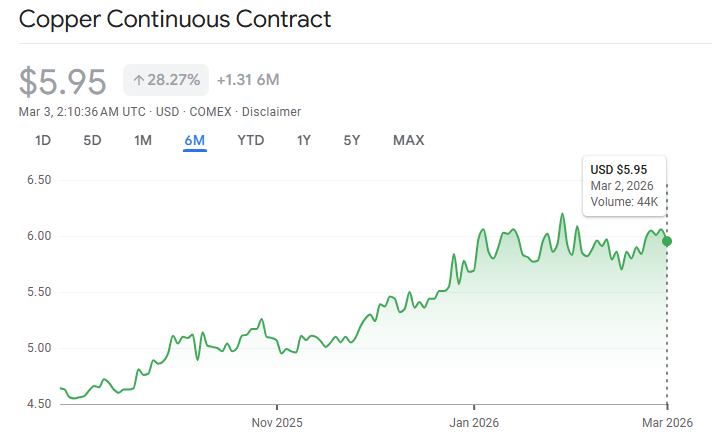
Copper had a strong 2025. It rallied 42% on the London Metal Exchange, making it the best-performing industrial metal on the bourse that year. In January 2026, prices reached a record high of $13,387 per tonne, crossing the $13,000 mark for the first time in history.
Supply Is Not Keeping Up with Demand
Part of what is pushing prices higher is that getting copper out of the ground has become harder and more expensive.
One of the world’s biggest copper mines, Cobre Panama, was shut down by the Panamanian government in late 2023. It has been sitting idle on care and maintenance since. Panama has started environmental and social audits, and there are conversations about a possible restart, but nothing is confirmed. That is a lot of copper still missing from global supply.
Beyond that, the quality of copper ore being mined has been declining for decades. Since 1991, average ore grades have dropped by 40%, which means miners have to process far more rock to get the same amount of copper. Only four significant copper discoveries were made worldwide between 2019 and 2023. And even when a new deposit is found, it takes an average of 17 years to go from discovery to actual production. These are not short-term problems.
Electric Vehicles Are a Major Demand Driver
The shift to electric vehicles is one of the clearest long-term stories in the copper market. A single EV uses three to four times more copper than a traditional petrol or diesel car. As EV sales continue to grow globally and as governments build out charging networks, solar farms, and wind energy infrastructure, demand for copper keeps climbing.
The AI Boom Needs Copper Too
Here is something that does not always make the news. The explosion in AI infrastructure is creating significant new demand for copper. Data centers run on copper. Every server rack, power cable, cooling system, and electrical distribution unit inside a data center requires it.
According to BloombergNEF, cumulative copper demand from data centers is forecast to exceed 4.3 million metric tons by 2035, with annual demand peaking at around 572,000 tonnes in 2028. That is a meaningful new source of demand that barely existed five years ago.
What the Analysts Are Saying
Not everyone agrees on where copper prices are heading, and that is worth understanding before you decide to invest or trade.
The Bullish Case
J.P. Morgan Global Research is forecasting copper at $12,500 per metric ton in the second quarter of 2026, pointing to supply disruptions and tight market conditions as key reasons to be positive on the metal.
BHP, one of the world’s largest mining companies, has put some big numbers on the table. They estimate that roughly $2.1 trillion in investment will be needed to meet global copper demand through 2050, with around a quarter of a trillion dollars required just in the decade from 2025 to 2034. Numbers like that reflect how central copper is expected to be to the global economy going forward.
The Cautious Case
Goldman Sachs takes a more measured view. Their research shows that the global copper market ran a surplus of 600,000 tonnes in 2025, the largest surplus since 2009. Goldman expects prices to hold near $13,000 per tonne in early 2026, but forecasts a decline toward $11,000 per tonne by the end of the year as the market surplus reasserts itself once tariff-related noise settles down.
Both views have merit. Copper has strong long-term fundamentals, but that does not mean prices only go up. Short-term dynamics matter too.
Risk of Copper Investing
Copper is a real opportunity, but it carries real risks. Here are the main ones.
China Drives a Huge Chunk of Demand
China consumes more refined copper than any other country. If Chinese industrial activity slows down, whether from domestic economic issues or trade tensions with the West, copper prices will feel it quickly.
US Tariff Policy Creates Uncertainty
Raw copper is currently exempt from US tariffs, but semi-finished copper products face 50% import tariffs. This creates friction in the supply chain and can affect margins for producers and buyers alike.
Prices Can Move Fast
Copper is sensitive to currency shifts, interest rate changes, geopolitical events, and speculative flows. Even with strong fundamentals, short-term price swings can be sharp.
Substitution Is a Long-Term Wildcard
If copper stays expensive for long enough, industries will look harder for alternatives. Research into substitute materials is ongoing, and over a very long time horizon this could slow demand growth.
Mining Operations Face Real Risks
Floods, labor strikes, and political instability in major copper-producing countries like Chile and Peru can disrupt supply suddenly and with little warning.
4 Ways to Trade and Invest in Copper
There are a few different ways to invest in or trade copper, depending on your goals and risk appetite.
Physical Copper is not practical for most retail investors. Storage and transport costs make it very difficult to manage at a small scale.
Copper Mining Stocks like Freeport-McMoRan, BHP, or Southern Copper give you indirect exposure to copper prices. Keep in mind that share prices are also affected by company management, debt levels, and other factors unrelated to copper itself.
Copper ETFs offer a more diversified way to access the copper theme, whether through funds that track the spot price or those that hold a basket of mining companies.
Copper CFD Trading is what many active traders use to get direct, flexible exposure to copper price movements. CFDs let you trade copper without owning any physical metal. You can take a long position if you think prices will rise, or a short position if you think they will fall. With leverage, you can control larger positions with a smaller upfront capital commitment, though it is important to understand that leverage also increases your risk exposure.
Why Traders Use CFDs for Copper Trading
CFD trading has become one of the most practical ways to get exposure to copper, whether you are just starting out or have been trading for years. Here is why so many traders choose CFDs when it comes to this market.
Trade Both Rising and Falling Markets
With CFDs, you are not limited to buying and hoping prices go up. You can go long if you expect copper to rise, or go short if you think prices are heading lower. That flexibility matters in a commodity market where prices can swing sharply in either direction depending on economic data, supply disruptions, or shifts in demand.
No Physical Ownership or Storage
Buying physical copper means dealing with storage, insurance, and logistics. CFDs cut all of that out. You get direct exposure to copper price movements without ever taking ownership of the metal itself. It is a much cleaner and more accessible way to trade.
Leverage to Maximise Exposure
CFDs allow you to control a larger position with a smaller initial deposit. This means you do not need a large amount of capital to participate in copper price movements. That said, leverage works both ways. It can increase your profits, but it can equally increase your losses, so managing your risk carefully is essential.
Real-Time Pricing on Live Copper Markets
When you trade copper CFDs, you are trading based on live market prices. There is no delay, no guesswork on valuation, and no gap between what you see and what you trade. That kind of transparency is important, especially in a fast-moving commodity market where timing can make a real difference.
Start Trading Copper CFDs Today with Ultima Markets
If copper is on your radar, Ultima Markets gives you everything you need to act on it. Trade copper CFDs alongside forex pairs, indices, and a full range of commodity markets, all from one account on a fast, reliable, and regulated trading platform. Try with a demo account or ready to trade live, getting started takes just a few minutes.
FAQs
Is Copper a Good Investment?
Yes, copper is a good investment. Strong demand from electric vehicles, renewable energy, and AI infrastructure, combined with shrinking global supply, makes copper one of the most strategically important commodities for long-term investors and active traders alike.
What Drives Copper Price?
Copper prices are driven by global industrial demand, China’s economic activity, supply disruptions from major mining countries like Chile and Peru, the growth of electric vehicles and clean energy infrastructure, and broader macroeconomic factors such as interest rates and the US dollar.
Can You Trade Copper on Forex?
Yes, you can trade copper through a forex and CFD broker (Ultima Markets).
Disclaimer: This content is provided for informational purposes only and does not constitute, and should not be construed as, financial, investment, or other professional advice. No statement or opinion contained here in should be considered a recommendation by Ultima Markets or the author regarding any specific investment product, strategy, or transaction. Readers are advised not to rely solely on this material when making investment decisions and should seek independent advice where appropriate.
Thank you for visiting the Ultima Markets website. Please note that this website is intended for individuals residing in jurisdictions where access is permitted by law. Ultima and its affiliated entities do not operate in your home jurisdiction.
By clicking ‘Acknowledge’, you confirm that you are entering this website solely on your own initiative and not as a result of any specific marketing outreach. You wish to obtain information from this website based on reverse solicitation principles, in accordance with the applicable laws of your home jurisdiction.