This website is managed by Ultima Markets’ international entities, and it’s important to emphasise that they are not subject to regulation by the FCA in the UK. Therefore, you must understand that you will not have the FCA’s protection when investing through this website – for example:
You will not be guaranteed Negative Balance Protection
You will not be protected by FCA’s leverage restrictions
You will not have the right to settle disputes via the Financial Ombudsman Service (FOS)
You will not be protected by Financial Services Compensation Scheme (FSCS)
Any monies deposited will not be afforded the protection required under the FCA Client Assets Sourcebook. The level of protection for your funds will be determined by the regulations of the relevant local regulator.
Note: UK clients are kindly invited to visit https://www.ultima-markets.co.uk/. Ultima Markets UK expects to begin onboarding UK clients in accordance with FCA regulatory requirements in 2026.
If you would like to proceed and visit this website, you acknowledge and confirm the following:
1.The website is owned by Ultima Markets’ international entities and not by Ultima Markets UK Ltd, which is regulated by the FCA.
2.Ultima Markets Limited, or any of the Ultima Markets international entities, are neither based in the UK nor licensed by the FCA.
3.You are accessing the website at your own initiative and have not been solicited by Ultima Markets Limited in any way.
4.Investing through this website does not grant you the protections provided by the FCA.
5.Should you choose to invest through this website or with any of the international Ultima Markets entities, you will be subject to the rules and regulations of the relevant international regulatory authorities, not the FCA.
Ultima Markets wants to make it clear that we are duly licensed and authorised to offer the services and financial derivative products listed on our website. Individuals accessing this website and registering a trading account do so entirely of their own volition and without prior solicitation.
By confirming your decision to proceed with entering the website, you hereby affirm that this decision was solely initiated by you, and no solicitation has been made by any Ultima Markets entity.
Ultima Markets does not have an establishment in Singapore and does not operate from Singapore.
Ultima Markets does not provide products or services to citizens or residents of Singapore, and account applications from Singapore citizens or residents will not be accepted.
If you are a citizen or resident of Singapore, please do not open an account or use Ultima Markets’ products or services.
By selecting “Acknowledge and Continue Browsing”, you confirm that you are accessing this website on your own initiative and that your access is not the result of any direct marketing, targeted advertising, solicitation, or promotional activity by Ultima Markets.
Nothing on this website constitutes an offer, solicitation, or promotion of products or services in any jurisdiction where such activity is prohibited. You are responsible for ensuring that your access to and use of this website complies with applicable local laws and regulations.
Gold price predictions for next 5 years show strong upside. Gold price today in USD trends higher as experts forecast $3,000+ by 2025.
Gold Price Predictions for Next 5 Years
Gold has surged to near-record highs in 2024, officially entering a global bull market. With major financial institutions forecasting $3,000+ per ounce by 2025 and potentially $5,000–$7,000 by 2030, investors are wondering, is this the time to buy gold or will the rally lose steam?
Key Takeaways
Most banks predict gold will hit $3,000–$3,265 by 2025
Central banks are buying ~900 tonnes/year, diversifying away from the US dollar
Rate cuts and persistent inflation are key bullish catalysts for gold
Geopolitical tensions and global debt support long-term gold demand
Gold hit record highs in 2024 in many currencies, signaling global bullishness
Gold Market Overview: Why Prices Are Rising
Gold reached over $2,700/oz in 2024 as central banks—led by China and India—boosted reserves. The World Gold Council reports annual purchases near 900 tonnes. Geopolitical uncertainty, inflation, and a weaker US dollar added fuel. Real interest rates also play a role. When inflation outpaces nominal rates, gold becomes more attractive. The Federal Reserve’s potential shift toward rate cuts is a major bullish signal.
Current Gold Price 2025
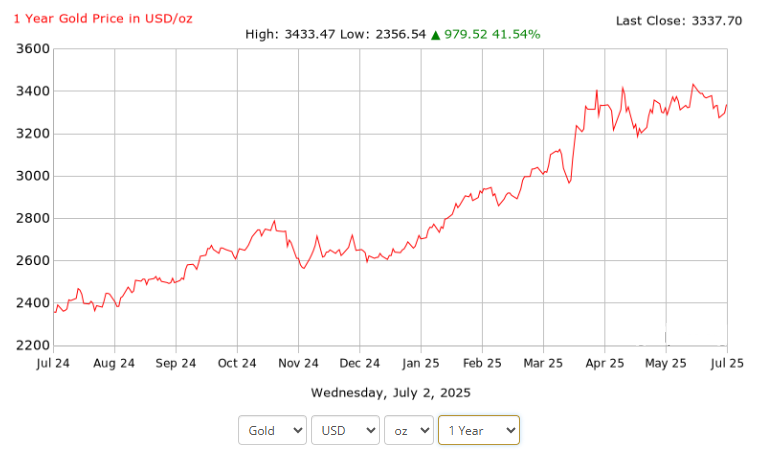
Gold prices have gone up a lot in the past few years. This is because of global conflicts, rising prices, and central banks buying more gold. In 2024, gold went up by 27%. In 2025, it rose another 18%, reaching a new high of over $3,100 per ounce.
Gold Price Forecast (2025–2026)
Most major banks agree that gold prices are likely to continue rising in the short term. Forecasts for 2025 generally fall between $2,800 and $3,300 per ounce, driven by expected Fed rate cuts, ongoing inflation, and strong central bank demand. Here’s a closer look at institutional predictions:
Institution
2025 Forecast
2026 Forecast
Goldman Sachs
$3000
–
JPMorgan
$2900-$3200
–
Bank of America
$3000+
–
Citi Research
$2900-$3300
–
UBS
$2950 (2025)
$3200 (mid-2026)
Catalysts for 2025-2026:
Fed rate cuts expected (75–100bps)
Persistent inflation supports hard assets
Strong central bank demand, especially in emerging markets
Political uncertainty from US elections
Mining supply constraints
Medium-Term Forecast: 2027–2028
Forecasts suggest $3,500–$4,500 per ounce, with potential for higher prices if stagflation or persistent inflation continues. Supply constraints, rising costs, and de-globalization trends could all push gold higher.
Long-Term Forecast: 2029–2030
Long-term gold price forecasts show the most bullish expectations. Analysts believe that if inflation stays high, global debt continues to rise, and central banks maintain accommodative policies, gold could reach $6,000–$7,000 by 2030. These projections are based on structural shifts in the global economy and the metal’s role as a hedge against currency debasement and financial instability.
Analyst/Source
2030 Forecast
Charlie Morris
$7000
Jim Puplava (Financial Sense)
$6000-$7000
David Harper (TA-based)
$6000-$6800
These forecasts are conditional on significant monetary easing, demographic shifts, and high global debt levels.
Structural Drivers Supporting the Gold Bull Market
Global debt at record levels — requiring continued monetary accommodation
Aging populations — increasing demand for safe haven assets
Underinvestment in mining — declining ore grades, environmental limits
Central bank diversification — away from USD into gold
Risks and Headwinds
Aggressive Fed tightening or higher real rates could pressure gold
Resolution of geopolitical conflicts may reduce safe haven demand
Technological mining breakthroughs could increase supply
Sudden central bank gold sales
Unexpected deflation scenarios could hurt gold demand
Regional Price Trends
Euro & GBP gold prices at elevated levels due to currency weakness
Asia (China, India): Strong demand from cultural and inflation-hedging drivers
Emerging markets: Currency crises fueling local demand (e.g., Turkey, Argentina)
Investment Strategies
Vehicle
Pros
Cons
Physical Gold
Tangible, no counterparty risk
Storage & insurance costs
Gold ETFs (eg. GLD)
Liquid, easy access
Management fees
Mining Stocks
Leverage to gold price
Company & geopolitical risk
Gold vs Bitcoin: Diversification Strategy
Gold and Bitcoin offer different types of protection and growth potential, making them valuable tools for diversification. Gold has a long history as a safe-haven asset and store of value during times of economic uncertainty, currency devaluation, and inflation. It is widely used by central banks and institutional investors for wealth preservation.
Bitcoin, on the other hand, is a newer, digital asset known for its high volatility and rapid price movements. It is often viewed as a hedge against fiat currency debasement and has gained popularity among younger investors and tech-savvy traders.
While gold is less volatile and more stable during market stress, Bitcoin has shown stronger returns over short periods, though with much higher risk. Including both assets in a diversified portfolio can offer exposure to traditional and modern hedging strategies.
Investors should consider their risk tolerance and investment goals when choosing between the two. Gold suits conservative, long-term portfolios, while Bitcoin may fit aggressive strategies focused on growth and innovation.
Gold in Election Years and Recession
Gold has historically shown strong performance during times of political and economic uncertainty. In U.S. election years, market volatility tends to increase due to shifting policy expectations, potential leadership changes, and economic reforms—all of which drive demand for safe-haven assets like gold.
During recessions, gold also tends to shine. As economic activity slows and central banks cut interest rates or implement stimulus measures, gold becomes more attractive compared to low-yielding bonds or volatile equities. Investors often turn to gold as a hedge against both inflation and deflation, and as a way to preserve capital during periods of weak growth and market stress.
In both scenarios, gold’s role as a store of value and portfolio stabilizer becomes more important, making it a key consideration for long-term investors looking to manage risk.
Conclusion
Gold’s long-term outlook is supported by strong fundamentals: central bank buying, inflation risk, and global debt. While $3,000+ by 2025 looks likely, investors should prepare for volatility. With careful portfolio allocation, gold remains a powerful diversification and wealth preservation tool.
To stay updated on gold price movements and get actionable market analysis, visit Ultima Markets for real-time insights, forecasts, and trading strategies tailored to gold and other commodities.
FAQ
Will gold reach $3,000 in 2025? Yes, major banks like Goldman Sachs, JPMorgan, and Citi project $2,800–$3,300 in 2025.
Is gold a good investment for the next 5 years? Yes, long-term fundamentals support higher prices, but expect volatility.
How high could gold go by 2030? Mainstream projections range from $5,000 to $7,000, depending on macroeconomic conditions.
What’s the best gold investment? ETFs for liquidity, physical gold for security, miners for leverage.
Share Now
Disclaimer:This content is provided for informational purposes only and does not constitute, and should not be construed as, financial, investment, or other professional advice. No statement or opinion contained herein should be considered a recommendation by Ultima Markets or the author regarding any specific investment product, strategy, or transaction. Readers are advised not to rely solely on this material when making investment decisions and should seek independent advice where appropriate.
Thank you for visiting the Ultima Markets website. Please note that this website is intended for individuals residing in jurisdictions where access is permitted by law. Ultima and its affiliated entities do not operate in your home jurisdiction.
By clicking ‘Acknowledge’, you confirm that you are entering this website solely on your own initiative and not as a result of any specific marketing outreach. You wish to obtain information from this website based on reverse solicitation principles, in accordance with the applicable laws of your home jurisdiction.