This website is managed by Ultima Markets’ international entities, and it’s important to emphasise that they are not subject to regulation by the FCA in the UK. Therefore, you must understand that you will not have the FCA’s protection when investing through this website – for example:
You will not be guaranteed Negative Balance Protection
You will not be protected by FCA’s leverage restrictions
You will not have the right to settle disputes via the Financial Ombudsman Service (FOS)
You will not be protected by Financial Services Compensation Scheme (FSCS)
Any monies deposited will not be afforded the protection required under the FCA Client Assets Sourcebook. The level of protection for your funds will be determined by the regulations of the relevant local regulator.
Note: UK clients are kindly invited to visit https://www.ultima-markets.co.uk/. Ultima Markets UK expects to begin onboarding UK clients in accordance with FCA regulatory requirements in 2026.
If you would like to proceed and visit this website, you acknowledge and confirm the following:
1.The website is owned by Ultima Markets’ international entities and not by Ultima Markets UK Ltd, which is regulated by the FCA.
2.Ultima Markets Limited, or any of the Ultima Markets international entities, are neither based in the UK nor licensed by the FCA.
3.You are accessing the website at your own initiative and have not been solicited by Ultima Markets Limited in any way.
4.Investing through this website does not grant you the protections provided by the FCA.
5.Should you choose to invest through this website or with any of the international Ultima Markets entities, you will be subject to the rules and regulations of the relevant international regulatory authorities, not the FCA.
Ultima Markets wants to make it clear that we are duly licensed and authorised to offer the services and financial derivative products listed on our website. Individuals accessing this website and registering a trading account do so entirely of their own volition and without prior solicitation.
By confirming your decision to proceed with entering the website, you hereby affirm that this decision was solely initiated by you, and no solicitation has been made by any Ultima Markets entity.
Explore the fascinating fun facts about gold and see how these important information can help you make smarter and more confident gold trading decisions.
Gold has always had a certain pull on the human imagination, but 2025 gave the world something genuinely extraordinary. The metal set 53 new all-time highs over the course of the year, staged its strongest rally since 1979, and briefly surpassed $5,500 per ounce in early 2026.
These fun facts about gold go well beyond trivia. They reveal why this 5,000-year-old asset continues to dominate financial headlines, central bank boardrooms and trading platforms the world over.
1. Gold Is Far Rarer Than Most People Imagine
Start with the basics, and the numbers are already staggering.
Every ounce of gold ever mined throughout human history would fit into roughly three and a half Olympic-sized swimming pools, totalling approximately 212,582 tonnes according to the World Gold Council.
Global mine reserves stood at 64,000 metric tonnes in 2024, and initial estimates point to mine production reaching a new record of 3,672 tonnes in 2025.
Why Scarcity Matters for Traders
The Earth’s crust contains only about 0.004 parts per million of gold. The oceans hold an estimated 20 million tonnes of dissolved gold, but it is spread so thinly across such an enormous volume of water that extraction remains entirely uneconomical.
What reaches the market is the product of some of the most capital-intensive mining operations on the planet, and that structural scarcity is a key reason why gold holds its value over the long term.
What Makes Gold Scientifically Unique
Beyond rarity, gold has physical properties that set it apart from virtually every other element.
It carries the chemical symbol Au, derived from the Latin word aurum
One troy ounce can be hammered into a sheet large enough to cover nine square metres
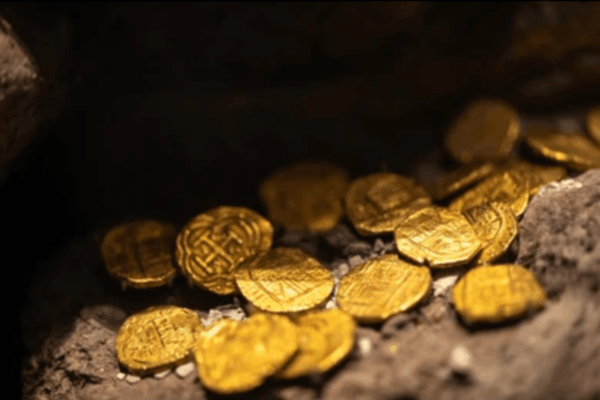
It is one of the least reactive elements on the periodic table, which is why ancient gold coins still emerge from the ground in near-perfect condition
Gold is an exceptional electrical conductor, used in NASA spacecraft, satellites and consumer microchips
It melts at 1,064°C and boils at 2,856°C
24-karat gold leaf (E175) is approved as an edible food additive across the European Union
2. So, Is Gold a Commodity?
This is a question that comes up regularly among new investors, and it deserves a clear answer.
The Official Classification
Yes, gold is officially classified as a commodity. It is traded on major exchanges including COMEX and the London Bullion Market (LBMA), with daily turnover exceeding $130 billion. In that sense, it sits alongside oil, copper and agricultural products as a globally traded raw material.
Why Gold Is Different From Other Commodities
What makes gold unique is that it operates well beyond the boundaries of a typical raw material. It functions simultaneously as a financial safe-haven, a currency hedge and a monetary reserve asset. Central banks hold it alongside foreign currency reserves, sovereign wealth funds use it to manage long-term risk, and retail investors buy it in coins, bars and exchange-traded funds.
The clearest sign of its elevated status came in 2025, when gold surpassed the share of US Treasuries in central bank reserves for the first time since 1996. That is not the behaviour of an ordinary commodity.
3. Gold’s Historic 2025 Price Rally
To call 2025 a strong year for gold would be a significant understatement.
The Numbers Behind the Rally
Metric
Figure
Annual average gold price (2025)
$3,431/oz (+44% year-on-year)
Q4 2025 average price
$4,135/oz (+55% year-on-year)
New all-time highs set in 2025
53
Intraday high (29 Jan 2026)
$5,595/oz
J.P. Morgan Q4 2026 forecast
$5,055/oz
J.P. Morgan end-2027 forecast
$5,400/oz
What Drove the Rally
The surge had its roots in a confluence of powerful drivers: a weakening US dollar, persistent inflation concerns, escalating geopolitical tensions across Eastern Europe and the Middle East, and a sustained wave of institutional buying.
Gold’s 2025 performance was widely compared to its historic surge during the 1979 Iranian Revolution, one of the most dramatic commodity rallies in modern financial history.
Going into 2026, the momentum has continued. Gold surged past $5,000 per ounce and touched an intraday high of $5,595 on 29 January 2026, driven by renewed uncertainty around US trade tariffs and relentless central bank accumulation.
4. Central Banks and Record Global Demand
The scale of institutional demand for gold in 2025 is one of the most significant facts about the market that often goes underreported.
Central Bank Buying at Historic Levels
Central bank purchases reached 863 tonnes in 2025, remaining at historically elevated levels and drawing participation from a geographically diverse range of countries. Globally, central bank gold holdings now total nearly 36,200 tonnes, accounting for approximately 20 per cent of official reserves, up from around 15 per cent at the end of 2023.
Top 3 central bank gold holders:
Country
Gold Reserves
United States
8,133 tonnes
Germany
3,352 tonnes
Italy
2,452 tonnes
Total Demand Crosses a Historic Milestone
Total gold demand in 2025, including over-the-counter transactions, exceeded 5,000 tonnes for the first time in recorded history. Combined with the record-breaking price environment, this translated into a total market value of $555 billion, up 45 per cent year-on-year.
Global gold ETF holdings grew by 801 tonnes, the second strongest annual inflow on record
Bar and coin demand accelerated to a 12-year high
Investment demand and central bank buying were the primary engines of growth
5. Ancient Origins About Gold
One of the most compelling fun facts about gold is just how far back its story goes, and how little its appeal has changed.
Gold artefacts dating to 4,000 BCE have been uncovered in Eastern Europe, making it one of the earliest metals worked by human hands. When archaeologists opened Tutankhamun’s tomb in 1922, they found more than 110 kilograms of gold objects, from burial masks to furniture fittings.
The first gold coins were minted around 550 BCE in Lydia, a kingdom in what is now modern Turkey, under King Croesus. His legendary wealth gave rise to the expression “rich as Croesus”, a phrase still in use today. From ancient trade routes to real-time CFD platforms, gold’s enduring appeal is one of the most consistent threads in human history.
6. How Traders Access Gold Today
For those looking to participate in the gold market, there are several instruments available, each suited to different trading styles and objectives.
Instrument
Description
Best For
Spot Gold (XAU/USD)
Live exposure to real-time gold price
Active traders
Gold Futures (COMEX)
Standardised contracts for hedging or speculation
Institutional and advanced traders
Gold ETFs (e.g. SPDR GLD)
Fund-based exposure, assets exceeding $60bn
Buy-and-hold investors
Gold CFDs (Ultima Markets)
Long or short positions without physical ownership
Flexible, leveraged trading
Over the past two years, gold has been the best-performing major asset class, nearly doubling the returns of the S&P 500 over the trailing 12-month period. With J.P. Morgan targeting $5,055 per ounce by Q4 2026, the structural case for continued engagement with the gold market remains compelling.
Conclusion
From its extraordinary geological rarity to its record-shattering performance across 2025 and into 2026, the fun facts about gold tell the story of an asset unlike any other. It is a commodity, a currency, a store of value and a crisis hedge all rolled into one.
Understanding its history, its physical properties and its market dynamics gives any trader a sharper, more informed perspective on one of the world’s most enduring financial instruments.
At Ultima Markets, you can trade Gold (XAU/USD) with competitive spreads, real-time data and professional-grade tools, putting you at the centre of one of the most closely watched markets in the world.
FAQs
What are some surprising fun facts about gold?
Gold set 53 all-time highs in 2025 and hit $5,595 per ounce intraday in January 2026. All the gold ever mined would fit into just three and a half Olympic swimming pools.
Is gold a commodity or a currency?
Gold is classified as a commodity but also acts as a global reserve asset. In 2025, it overtook US Treasuries in central bank reserves for the first time since 1996.
Why is gold demand so high in 2025?
Total demand surpassed 5,000 tonnes for the first time, driven by record ETF inflows, strong central bank buying and surging retail investment amid global uncertainty.
Disclaimer: This content is provided for informational purposes only and does not constitute, and should not be construed as, financial, investment, or other professional advice. No statement or opinion contained here in should be considered a recommendation by Ultima Markets or the author regarding any specific investment product, strategy, or transaction. Readers are advised not to rely solely on this material when making investment decisions and should seek independent advice where appropriate.
Thank you for visiting the Ultima Markets website. Please note that this website is intended for individuals residing in jurisdictions where access is permitted by law. Ultima and its affiliated entities do not operate in your home jurisdiction.
By clicking ‘Acknowledge’, you confirm that you are entering this website solely on your own initiative and not as a result of any specific marketing outreach. You wish to obtain information from this website based on reverse solicitation principles, in accordance with the applicable laws of your home jurisdiction.