
Ultima Markets App
Trade Anytime, Anywhere





Important Information
This website is managed by Ultima Markets’ international entities, and it’s important to emphasise that they are not subject to regulation by the FCA in the UK. Therefore, you must understand that you will not have the FCA’s protection when investing through this website – for example:
- You will not be guaranteed Negative Balance Protection
- You will not be protected by FCA’s leverage restrictions
- You will not have the right to settle disputes via the Financial Ombudsman Service (FOS)
- You will not be protected by Financial Services Compensation Scheme (FSCS)
- Any monies deposited will not be afforded the protection required under the FCA Client Assets Sourcebook. The level of protection for your funds will be determined by the regulations of the relevant local regulator.
Note: Ultima Markets is currently developing a dedicated website for UK clients and expects to onboard UK clients under FCA regulations in 2026.
If you would like to proceed and visit this website, you acknowledge and confirm the following:
- 1.The website is owned by Ultima Markets’ international entities and not by Ultima Markets UK Ltd, which is regulated by the FCA.
- 2.Ultima Markets Limited, or any of the Ultima Markets international entities, are neither based in the UK nor licensed by the FCA.
- 3.You are accessing the website at your own initiative and have not been solicited by Ultima Markets Limited in any way.
- 4.Investing through this website does not grant you the protections provided by the FCA.
- 5.Should you choose to invest through this website or with any of the international Ultima Markets entities, you will be subject to the rules and regulations of the relevant international regulatory authorities, not the FCA.
Ultima Markets wants to make it clear that we are duly licensed and authorised to offer the services and financial derivative products listed on our website. Individuals accessing this website and registering a trading account do so entirely of their own volition and without prior solicitation.
By confirming your decision to proceed with entering the website, you hereby affirm that this decision was solely initiated by you, and no solicitation has been made by any Ultima Markets entity.
I confirm my intention to proceed and enter this website Please direct me to the website operated by Ultima Markets , regulated by the FCA in the United Kingdom

Differences of Alphabet Class A vs Class C
When people talk about investing in Alphabet, the parent company of Google, they often notice two tickers: GOOGL and GOOG. Both represent Alphabet shares, but they are not the same. The difference lies in voting rights, investor influence, and sometimes small price variations. You might be wondering: What’s the difference between Alphabet Class A vs Class C?
In this guide, we’ll explain what sets Class A and Class C apart, why Alphabet has multiple share classes, and which may suit different types of investors.

Why Alphabet Has Multiple Share Classes
Alphabet introduced a multi-class share structure to let its founders and executives keep control of the company while still raising money from public investors. By separating voting rights from economic ownership, the founders maintain decision-making power without diluting it every time new stock is issued.
This setup is common in big tech. Companies like Meta, Snap, and Airbnb also use dual-class shares to preserve founder influence. For Alphabet, the three main classes are:
- Class A (GOOGL): Publicly traded with voting rights.
- Class C (GOOG): Publicly traded with no voting rights.
- Class B: Held by insiders and founders; carries 10 votes per share but is not publicly traded.
Alphabet Class A vs Class C: Key Differences
- Voting Rights: GOOGL has one vote per share; GOOG has none.
- Ownership Influence: GOOGL lets you formally take part in governance, while GOOG doesn’t.
- Economics: Same dividends, buybacks and earnings claim
- Price: Usually very close; GOOGL can trade at a small premium for the vote
- Conversion: You cannot convert A↔C; you must sell one to buy the other
- Liquidity: Both are highly liquid
Historically, prices stay close. Occasionally, GOOGL trades at a small premium due to voting rights.
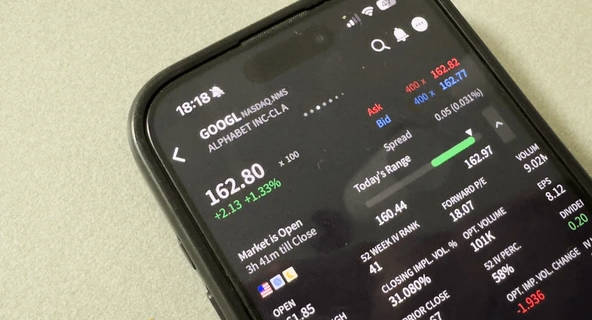
Alphabet Class A Shares (GOOGL)
Class A shares give investors one vote per share. This allows holders to participate in company matters like electing board members and approving major business decisions.
While a single retail investor may not sway outcomes, institutions often prefer Class A for the ability to have a voice. GOOGL typically trades at nearly the same price as GOOG, though sometimes a small premium develops because of the voting rights.
Alphabet Class C Shares (GOOG)
Class C shares carry no voting rights. They were created in 2014 when Alphabet split its stock to preserve control for insiders while still rewarding shareholders with more liquidity.
Because GOOG has no say in governance, these shares often trade very close to GOOGL, sometimes at a slight discount. For most investors focused purely on stock performance rather than influence, the lack of voting rights has little practical effect.
Which Should You Buy?
For most retail investors, the decision between Alphabet Class A vs Class C is less about performance, since both move almost identically, and more about whether voting rights matter to you.
- Choose GOOGL (Class A) if you want voting rights and don’t mind paying a tiny premium.
- Choose GOOG (Class C) if you just want exposure to Alphabet’s financial performance without paying extra for a vote you may never use.
Either way, both share classes give you the same economic interest in Alphabet, so long-term returns are nearly identical.
Conclusion
Alphabet’s dual share system highlights the trade-off between voting power and simplicity. Class A (GOOGL) offers a voice in company decisions, while Class C (GOOG) gives the same economic upside without the vote.
For most everyday investors, the choice often comes down to whichever share is cheaper at the time of purchase.
FAQ
The choice between Alphabet Class A (GOOGL) and Class C (GOOG) depends on whether you value voting rights. If you don’t mind not having voting power, Class C may be more attractive due to its typically lower price.
Alphabet created Class A (GOOGL) and Class C (GOOG) stocks to retain control of the company within a small group of insiders while still allowing public investment. Class A shares offer voting rights, while Class C shares have no voting power.
Yes, you can trade both Alphabet Class A (GOOGL) and Class C (GOOG) stocks on the open market, but they have different ticker symbols. Both are listed on the NASDAQ.
Disclaimer: This content is provided for informational purposes only and does not constitute, and should not be construed as, financial, investment, or other professional advice. No statement or opinion contained here in should be considered a recommendation by Ultima Markets or the author regarding any specific investment product, strategy, or transaction. Readers are advised not to rely solely on this material when making investment decisions and should seek independent advice where appropriate.
Latest Articles



FOLLOW US






Ultima Markets is a member of The Financial Commission, an international independent body responsible for resolving disputes in the Forex and CFD markets.

All clients of Ultima Markets are protected under insurance coverage provided by Willis Towers Watson (WTW), a global insurance brokerage established in 1828, with claims eligibility up to US$1,000,000 per account.

Ultima Markets is the first United CFD broker to be part of the United Nations Global Compact.
FOLLOW US
TRADE WITH US
RISK DISCLOSURE
Risk Warning:
Trading leveraged financial products, including Contracts for Difference (CFDs), carries a high level of risk and may result in losses exceeding your initial investment. These products are not suitable for all investors and should only be traded with funds you can afford to lose. You do not own or have any rights to the underlying assets of these derivatives (e.g., entitlement to dividends). Please ensure you fully understand the associated risks. Before trading, consider your level of experience, investment objectives, and seek independent financial advice if necessary. Refer to our legal documents and disclosures before making any trading decisions.
General Advice Warning:
The information provided on this website is general in nature and does not take into account your personal objectives, financial situation, or needs. Before acting on any advice, you should assess its appropriateness in light of your individual circumstances and consult our legal documentation.
Regional Restrictions:
The information and services on this website are not intended for residents of certain jurisdictions, including but not limited to the United States, United Kingdom, Singapore, and any jurisdictions subject to international sanctions. For further information, please contact our customer support team.
Regulatory Information:
Ultima Markets is a trading name shared amongst multiple entities operating in various jurisdictions. These following entities are authorised to operate under the Ultima Markets brand and trademarks.
-
Ultima Markets UK Limited, reference number 470325, is authorised and regulated by the Financial Conduct Authority (FCA). Registered address: 1 Blossom Yard, Fourth Floor, London, E1 6RS, UNITED KINGDOM.
-
Ultima Markets Ltd is authorised and regulated by the Financial Services Commission (FSC) of Mauritius as a Full-Service Investment Dealer (excluding Underwriting), under licence number GB 23201593.
Registered address: 2nd Floor, The Catalyst, 40 Silicon Avenue, Ebene Cybercity, 72201, Mauritius.

Copyright © 2026 Ultima Markets Ltd. All rights reserved.
-

Messenger


Continue on Messenger
Take the conversation to your Messenger account. You can return anytime.
Scan the QR code and then send the message that appears in your Messenger.
Open Messenger on this device.
-

Instagram

Continue on Instagram
Take the conversation to your Instagram account. You can return anytime.
Scan the QR code to open Instagram. Follow @ultima_markets to send a DM.
Open Instagram on this device.
-

Live Chat
-

