Important Information
This website is managed by Ultima Markets’ international entities, and it’s important to emphasise that they are not subject to regulation by the FCA in the UK. Therefore, you must understand that you will not have the FCA’s protection when investing through this website – for example:
- You will not be guaranteed Negative Balance Protection
- You will not be protected by FCA’s leverage restrictions
- You will not have the right to settle disputes via the Financial Ombudsman Service (FOS)
- You will not be protected by Financial Services Compensation Scheme (FSCS)
- Any monies deposited will not be afforded the protection required under the FCA Client Assets Sourcebook. The level of protection for your funds will be determined by the regulations of the relevant local regulator.
Note: UK clients are kindly invited to visit https://www.ultima-markets.co.uk/. Ultima Markets UK expects to begin onboarding UK clients in accordance with FCA regulatory requirements in 2026.
If you would like to proceed and visit this website, you acknowledge and confirm the following:
- 1.The website is owned by Ultima Markets’ international entities and not by Ultima Markets UK Ltd, which is regulated by the FCA.
- 2.Ultima Markets Limited, or any of the Ultima Markets international entities, are neither based in the UK nor licensed by the FCA.
- 3.You are accessing the website at your own initiative and have not been solicited by Ultima Markets Limited in any way.
- 4.Investing through this website does not grant you the protections provided by the FCA.
- 5.Should you choose to invest through this website or with any of the international Ultima Markets entities, you will be subject to the rules and regulations of the relevant international regulatory authorities, not the FCA.
Ultima Markets wants to make it clear that we are duly licensed and authorised to offer the services and financial derivative products listed on our website. Individuals accessing this website and registering a trading account do so entirely of their own volition and without prior solicitation.
By confirming your decision to proceed with entering the website, you hereby affirm that this decision was solely initiated by you, and no solicitation has been made by any Ultima Markets entity.
I confirm my intention to proceed and enter this website Please direct me to the website operated by Ultima Markets , regulated by the FCA in the United Kingdom
Ultima Markets App
Trade Anytime, Anywhere





Boxabl Stock Price Prediction 2025 to 2030
Boxabl has gone from niche prefab startup to one of the most talked-about housing names in private markets. With its foldable “Casita” units and an ambitious SPAC deal, many investors are now actively searching for a Boxabl stock price prediction to understand the upside and risks.
This Boxabl stock price prediction article explains what the company does, how the BXBL listing is structured, and three possible price scenarios for 2025–2030. It is educational only and not investment advice.
What Is Boxabl?
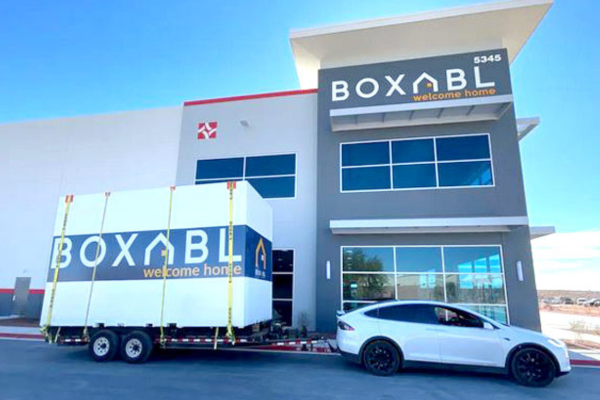
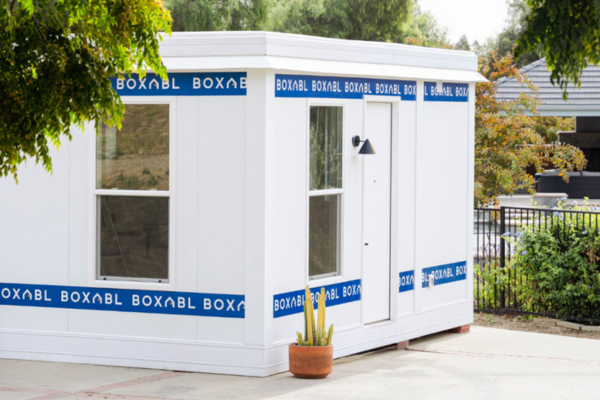
Boxabl is a Las Vegas–based construction-tech company that designs foldable, factory-built modular homes. Its flagship product, the Casita, is a compact pre-finished unit that folds up for transport on a standard trailer and unfolds on site with a built-in kitchen, bathroom and living space. The idea is to move work into a factory, then ship near-complete homes that can be installed in hours rather than months.
Boxabl targets individual buyers, developers, resort operators and public agencies that need fast, repeatable housing solutions in a world of housing shortages and labour constraints. That helps explain why a prefab startup has been able to attract both media attention and large amounts of private capital.
Funding, Valuation And The BXBL SPAC Deal
Boxabl has raised capital through a mix of crowdfunding and private placements, using platforms such as StartEngine and Republic. Across these rounds, its implied valuation climbed into the 3.3–3.5 billion dollar range, based on offering documents and private-market data.
In 2025, Boxabl announced it would go public via a merger with FG Merger II Corp. (FGMC), a US-listed special purpose acquisition company. The proposed transaction values Boxabl at about 3.5 billion dollars, with 350 million shares issued to Boxabl shareholders at a reference price of 10 dollars per share, and the combined company expected to list on Nasdaq under the ticker BXBL.
For anyone looking at a Boxabl stock price prediction, it is important to understand that this 10-dollar level is an accounting reference point, not a guaranteed trading price. Post-merger SPAC stocks often move sharply above or below that notional value, depending on redemptions, sentiment and fundamentals. Until the merger completes and BXBL starts trading, there is no firm public Boxabl share price.
Why Boxabl Attracts Investor Interest
Several features make Boxabl stand out:
- Foldable design that allows Casitas to fit on standard trailers, cutting transport costs compared with many prefab units
- Factory manufacturing aimed at producing thousands of units a year once fully scaled
- Configurable units that can be combined into larger homes or multi-unit structures
- Positioning as both construction-tech and green-tech, tapping into housing affordability and ESG themes
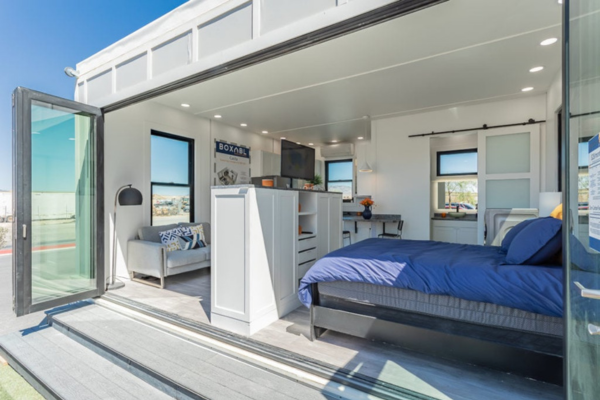
These elements sit on top of a large addressable market and help explain why investors are watching the BXBL listing closely, even though the company is still in an early rollout stage.
Boxabl Stock Price Prediction 2025–2030
Scenario Approach
Because Boxabl is pre-profit and still ramping up production, any Boxabl stock price prediction for 2025–2030 is speculative. A scenario framework is more realistic than a single target.
Base Case: Moderate Progress
In a base case, the SPAC merger completes, BXBL lists on Nasdaq, and Boxabl gradually ramps output. It wins a mix of consumer, resort and public-sector projects, but remains one player among many in the prefab sector.
If Boxabl can reach several hundred million dollars in annual revenue by around 2030, with improving margins but not yet mature profitability, public markets might value it on a price-to-sales (P/S) multiple in the 2x–5x range. At 1 billion dollars of revenue and a 4x P/S, that implies a 4 billion dollar market cap, broadly in line with the current deal value once some dilution is factored in. Long-term holders from the SPAC price might see modest gains or flat returns.
Bullish Case: Strong Adoption
In a bullish case, Boxabl proves its unit economics, scales manufacturing efficiently and wins larger government and corporate contracts, including disaster relief and affordable housing programmes. It also expands internationally, using its system to build multi-unit developments as well as tiny homes.
Under that outcome, Boxabl could potentially reach 2–3 billion dollars in annual revenue by the end of the decade. If markets assign a P/S multiple of 4x–6x for a fast-growing, clearly profitable prefab leader, that would imply an 8–18 billion dollar valuation. Depending on dilution and capital raises along the way, this could translate to BXBL trading well above the 10-dollar SPAC reference price in the longer term.
Cautious Case: Execution Risks
In a cautious case, production scaling proves difficult and expensive, contracts are smaller or slower than expected, and housing market conditions soften. High SPAC redemptions and additional fundraising needs could also dilute existing shareholders.
If revenue remains modest and profitability distant, markets may value Boxabl closer to 1–3 billion dollars, below or only slightly above the SPAC valuation. In that environment, BXBL could trade under 10 dollars for a prolonged period, particularly if investors grow wary of speculative growth and SPAC listings.
Key Factors To Watch
Whatever scenario you lean toward, several drivers will shape Boxabl’s share price after BXBL starts trading:
- Housing demand and interest rates
- Unit economics – total installed costs versus conventional builds and rival prefab suppliers
- Contract wins – size, profitability and diversification across resort, government and developer clients
- Competition from other modular and prefab providers
- Investor sentiment toward speculative growth names and SPAC-origin stocks
Governance And Disclosure
Beyond contracts and revenue, governance will matter for any long term BXBL investor. Boxabl has previously drawn scrutiny from journalists and independent analysts over how its intellectual property and related party arrangements were structured, as well as the limited visibility on detailed financials.
Anyone considering the stock should read the SPAC documents and future SEC filings carefully, paying close attention to IP ownership, related party transactions, dilution risk and how transparently management reports progress over time.
How Can Investors Get Exposure?
Broadly, there are two main paths to Boxabl exposure around the SPAC deal:
- Buy FG Merger II Corp. (FGMC) before the merger, in the expectation that those shares convert into BXBL if and when the transaction closes
- Wait until after BXBL lists on Nasdaq and trade the combined company directly, accepting that the price may already be above or below the 10-dollar reference level
Earlier crowdfunding and private placements are mostly closed to new buyers, and secondary markets for pre-SPAC Boxabl shares tend to be illiquid and limited to certain investors.
Conclusion
Boxabl sits at the intersection of housing affordability, modular construction and industrialised building, and that has helped it reach a multibillion-dollar valuation before BXBL even starts trading. At the same time, the company is early in its commercial life, its long-term unit economics are unproven at scale, and the stock will be exposed to both SPAC sentiment and housing and rate cycles.
For most investors, Boxabl is best viewed as a speculative satellite position rather than a core holding. If you plan to follow the story, it is likely more useful to watch how revenues, margins and contract quality evolve over the next few years than to fixate on a single 2030 price target for BXBL.
FAQs
Boxabl is projected to be worth about $3.5 billion based on its planned SPAC merger with FG Merger II Corp., which values the combined company at roughly $3.5 B when it lists on the Nasdaq under the ticker BXBL.
Currently, Boxabl is not publicly traded. However, it plans to go public through a SPAC merger with FG Merger II Corp. This merger will likely make Boxabl stock available on the Nasdaq under the ticker BXBL once completed. As of now, you cannot buy Boxabl stock on the open market, but private investment opportunities may be available.
Yes, Boxabl is currently not profitable. The company is in its early stages of scaling production and expanding its market presence, which typically leads to losses in the initial years. Boxabl has been focused on increasing its manufacturing capacity and improving its modular home technology, but it has yet to reach profitability. However, it is aiming for significant growth, especially with its upcoming public listing.
Disclaimer: This content is provided for informational purposes only and does not constitute, and should not be construed as, financial, investment, or other professional advice. No statement or opinion contained here in should be considered a recommendation by Ultima Markets or the author regarding any specific investment product, strategy, or transaction. Readers are advised not to rely solely on this material when making investment decisions and should seek independent advice where appropriate.
Latest Articles



FOLLOW US






Ultima Markets is a member of The Financial Commission, an international independent body responsible for resolving disputes in the Forex and CFD markets.

All clients of Ultima Markets are protected under insurance coverage provided by Willis Towers Watson (WTW), a global insurance brokerage established in 1828, with claims eligibility up to US$1,000,000 per account.

Ultima Markets is the first United CFD broker to be part of the United Nations Global Compact.
FOLLOW US
TRADE WITH US
RISK DISCLOSURE
Risk Warning:
Trading leveraged financial products, including Contracts for Difference (CFDs), carries a high level of risk and may result in losses exceeding your initial investment. These products are not suitable for all investors and should only be traded with funds you can afford to lose. You do not own or have any rights to the underlying assets of these derivatives (e.g., entitlement to dividends). Please ensure you fully understand the associated risks. Before trading, consider your level of experience, investment objectives, and seek independent financial advice if necessary. Refer to our legal documents and disclosures before making any trading decisions.
General Advice Warning:
The information provided on this website is general in nature and does not take into account your personal objectives, financial situation, or needs. Before acting on any advice, you should assess its appropriateness in light of your individual circumstances and consult our legal documentation.
Regional Restrictions:
The information and services on this website are not intended for residents of certain jurisdictions, including but not limited to the United States, United Kingdom, Singapore, and any jurisdictions subject to international sanctions. For further information, please contact our customer support team.
Regulatory Information:
Ultima Markets is a trading name shared amongst multiple entities operating in various jurisdictions. These following entities are authorised to operate under the Ultima Markets brand and trademarks.
-
Ultima Markets UK Limited, reference number 470325, is authorised and regulated by the Financial Conduct Authority (FCA). Registered address: 1 Blossom Yard, Fourth Floor, London, E1 6RS, UNITED KINGDOM.
-
Ultima Markets Ltd is authorised and regulated by the Financial Services Commission (FSC) of Mauritius as a Full-Service Investment Dealer (excluding Underwriting), under licence number GB 23201593.
Registered address: 2nd Floor, The Catalyst, 40 Silicon Avenue, Ebene Cybercity, 72201, Mauritius.

Copyright © 2026 Ultima Markets Ltd. All rights reserved.
-

Messenger


Continue on Messenger
Take the conversation to your Messenger account. You can return anytime.
Scan the QR code and then send the message that appears in your Messenger.
Open Messenger on this device.
-

Instagram

Continue on Instagram
Take the conversation to your Instagram account. You can return anytime.
Scan the QR code to open Instagram. Follow @ultima_markets to send a DM.
Open Instagram on this device.
-

Live Chat
-

