This website is managed by Ultima Markets’ international entities, and it’s important to emphasise that they are not subject to regulation by the FCA in the UK. Therefore, you must understand that you will not have the FCA’s protection when investing through this website – for example:
You will not be guaranteed Negative Balance Protection
You will not be protected by FCA’s leverage restrictions
You will not have the right to settle disputes via the Financial Ombudsman Service (FOS)
You will not be protected by Financial Services Compensation Scheme (FSCS)
Any monies deposited will not be afforded the protection required under the FCA Client Assets Sourcebook. The level of protection for your funds will be determined by the regulations of the relevant local regulator.
Note: UK clients are kindly invited to visit https://www.ultima-markets.co.uk/. Ultima Markets UK expects to begin onboarding UK clients in accordance with FCA regulatory requirements in 2026.
If you would like to proceed and visit this website, you acknowledge and confirm the following:
1.The website is owned by Ultima Markets’ international entities and not by Ultima Markets UK Ltd, which is regulated by the FCA.
2.Ultima Markets Limited, or any of the Ultima Markets international entities, are neither based in the UK nor licensed by the FCA.
3.You are accessing the website at your own initiative and have not been solicited by Ultima Markets Limited in any way.
4.Investing through this website does not grant you the protections provided by the FCA.
5.Should you choose to invest through this website or with any of the international Ultima Markets entities, you will be subject to the rules and regulations of the relevant international regulatory authorities, not the FCA.
Ultima Markets wants to make it clear that we are duly licensed and authorised to offer the services and financial derivative products listed on our website. Individuals accessing this website and registering a trading account do so entirely of their own volition and without prior solicitation.
By confirming your decision to proceed with entering the website, you hereby affirm that this decision was solely initiated by you, and no solicitation has been made by any Ultima Markets entity.
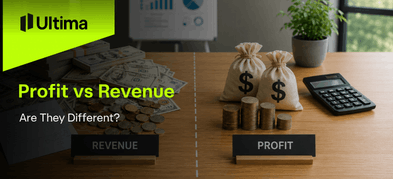
Profit vs revenue explained. Learn how each is calculated, why both matter, and how they affect business growth, cash flow, pricing and financial health.
Understanding profit vs revenue is useful for business owners, investors, and traders. These figures often appear in earnings reports and financial statements, but they do not mean the same thing.
Revenue shows how much money a company brings in from selling goods or services before expenses are deducted. Profit shows how much money remains after the company has paid its costs.
For traders, this difference matters because share prices can react to both sales growth and profitability. A company may report strong revenue but disappoint the market if profit falls, margins shrink, or costs rise too quickly.
By comparing profit vs revenue, traders can see whether a company is simply selling more or becoming more financially efficient.
What Is Revenue?
Revenue is the total income a company earns from its normal business activities. It is often called the “top line” because it appears near the top of an income statement.
For example, if a retailer sells 1,000 products for £20 each, its revenue is £20,000. This shows the value of sales, but not how much money the company keeps.
Gross Revenue vs Net Revenue
Gross revenue is total sales before deductions. Net revenue is what remains after refunds, discounts, returns, and allowances are subtracted.
If a company makes £20,000 in sales but gives £1,000 in refunds and discounts, its net revenue is £19,000. This is still not profit because operating expenses have not yet been deducted.
What Is Profit?
Profit is the money left after expenses are deducted from revenue.
The basic formula is:
Profit = Revenue – Expenses
If a company earns £50,000 in revenue and spends £38,000 on costs, its profit is £12,000.
Profit is often called the “bottom line” because net profit appears near the bottom of an income statement. It gives a clearer view of whether a company is making money after covering its costs.
Common Types of Profit
Gross profit is revenue minus the cost of goods sold, such as stock, raw materials, packaging, or production costs.
Operating profit is what remains after operating expenses are deducted, including wages, rent, utilities, marketing, software, and insurance.
Net profit is the final amount left after all expenses, including interest and taxes. This is often the profit figure traders watch most closely because it shows what the company actually keeps.
The Difference of Profit vs Revenue
The main difference between profit vs revenue is simple. Revenue measures money coming into the business, while profit measures money the business keeps.
Revenue helps show demand. Profit helps show efficiency and financial health.
A company with rising revenue may look strong, but if costs are rising faster than sales, profit may fall. A company with modest revenue growth may still perform well if it improves margins and controls expenses.
Quick Comparison
Category
Revenue
Profit
Meaning
Total income from sales
Money left after expenses
Also called
Top line
Bottom line
Shows
Demand and sales activity
Efficiency and financial health
Formula
Price × units sold
Revenue – expenses
Trading relevance
Growth potential
Earnings strength
Why Profit and Revenue Matter to Traders
Traders often study company earnings to understand how the market may react to new information. Revenue and profit are two of the most important figures in those updates.
Revenue Shows Demand
Revenue growth can suggest that a company is selling more products, gaining customers, raising prices, or expanding into new markets.
This may support a positive market view, especially for growth companies. However, revenue alone does not prove that a company is financially strong.
Profit Shows Efficiency
Profit shows whether the company can turn sales into earnings. If revenue grows but profit falls, the business may be facing higher wages, supplier costs, advertising expenses, debt costs, or weaker pricing power.
Margins Show the Bigger Picture
Profit margin shows what percentage of revenue becomes profit.
Profit Margin = Profit ÷ Revenue × 100
If a company earns £100,000 in revenue and keeps £10,000 as profit, its profit margin is 10%. This means the company keeps 10p from every £1 of revenue.
When margins improve, it may suggest better pricing or stronger cost control. When margins shrink, it may suggest cost pressure or weaker profitability.
Revenue Can Rise While Profit Falls
One important lesson in profit vs revenue analysis is that sales growth does not always lead to higher earnings.
A company may increase revenue by offering discounts, spending heavily on advertising, hiring more staff, or expanding quickly. These actions may lift sales in the short term, but they can reduce profit if costs grow too much.
For example, an online retailer may report record revenue after a major promotion. Yet if discounts, shipping costs, return rates, and advertising expenses are high, net profit may fall.
For traders, this is why earnings reports often include more than revenue. Profit margin, operating expenses, earnings per share, cash flow, and forward guidance can all help build a fuller picture.
Revenue vs Profit vs Cash Flow
Revenue and profit are also different from cash flow.
Cash flow measures the actual movement of money in and out of a business. A company can be profitable on paper but still face cash flow pressure if customers pay late, inventory costs are high, or debt repayments are due.
For trading analysis, cash flow can add useful context. Revenue shows sales activity, profit shows financial performance, and cash flow shows whether the business has money available to operate.
How Traders Can Use Profit vs Revenue
When reading a company update, traders can ask:
Is revenue growing or falling?
Is profit growing at the same pace?
Are profit margins improving or shrinking?
Are costs rising faster than sales?
Is cash flow supporting the reported profit?
What does management say about future guidance?
These questions do not guarantee a trading outcome, but they can help traders understand the story behind the numbers.
Conclusion
Profit vs revenue is more than an accounting comparison. It is a practical way to understand how a company grows, manages costs, and turns sales into earnings.
Revenue shows how much money comes into the business. Profit shows how much remains after expenses. For traders, both figures can influence how the market responds to earnings reports and company updates.
A business with high revenue is not automatically healthy. A business with lower revenue is not automatically weak. What matters is how well the company converts revenue into profit and whether that performance is sustainable.
By understanding profit vs revenue, traders can read financial results with more confidence and make more informed market analysis.
FAQs
Is revenue the same as profit?
No. Revenue is total income from sales. Profit is what remains after expenses are deducted.
Why does profit vs revenue matter to traders?
It shows whether sales growth is turning into actual earnings.
Can revenue rise while profit falls?
Yes. This can happen when costs grow faster than sales.
Which is more important, profit or revenue?
Both matter. Revenue shows demand, while profit shows financial strength.
Share Now
Disclaimer:This content is provided for informational purposes only and does not constitute, and should not be construed as, financial, investment, or other professional advice. No statement or opinion contained herein should be considered a recommendation by Ultima Markets or the author regarding any specific investment product, strategy, or transaction. Readers are advised not to rely solely on this material when making investment decisions and should seek independent advice where appropriate.
Thank you for visiting the Ultima Markets website. Please note that this website is intended for individuals residing in jurisdictions where access is permitted by law. Ultima and its affiliated entities do not operate in your home jurisdiction.
By clicking ‘Acknowledge’, you confirm that you are entering this website solely on your own initiative and not as a result of any specific marketing outreach. You wish to obtain information from this website based on reverse solicitation principles, in accordance with the applicable laws of your home jurisdiction.