This website is managed by Ultima Markets’ international entities, and it’s important to emphasise that they are not subject to regulation by the FCA in the UK. Therefore, you must understand that you will not have the FCA’s protection when investing through this website – for example:
You will not be guaranteed Negative Balance Protection
You will not be protected by FCA’s leverage restrictions
You will not have the right to settle disputes via the Financial Ombudsman Service (FOS)
You will not be protected by Financial Services Compensation Scheme (FSCS)
Any monies deposited will not be afforded the protection required under the FCA Client Assets Sourcebook. The level of protection for your funds will be determined by the regulations of the relevant local regulator.
Note: UK clients are kindly invited to visit https://www.ultima-markets.co.uk/. Ultima Markets UK expects to begin onboarding UK clients in accordance with FCA regulatory requirements in 2026.
If you would like to proceed and visit this website, you acknowledge and confirm the following:
1.The website is owned by Ultima Markets’ international entities and not by Ultima Markets UK Ltd, which is regulated by the FCA.
2.Ultima Markets Limited, or any of the Ultima Markets international entities, are neither based in the UK nor licensed by the FCA.
3.You are accessing the website at your own initiative and have not been solicited by Ultima Markets Limited in any way.
4.Investing through this website does not grant you the protections provided by the FCA.
5.Should you choose to invest through this website or with any of the international Ultima Markets entities, you will be subject to the rules and regulations of the relevant international regulatory authorities, not the FCA.
Ultima Markets wants to make it clear that we are duly licensed and authorised to offer the services and financial derivative products listed on our website. Individuals accessing this website and registering a trading account do so entirely of their own volition and without prior solicitation.
By confirming your decision to proceed with entering the website, you hereby affirm that this decision was solely initiated by you, and no solicitation has been made by any Ultima Markets entity.
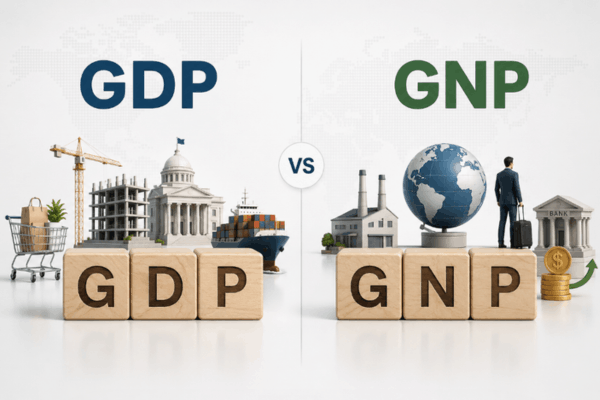
Discover the differences of GDP vs GNP. Learn what GDP and GNP mean. See why it matters for understanding a country’s economic output and national income
When economists and policymakers examine the health of an economy, the terms GDP vs GNP frequently appear. These two indicators are crucial to understanding a country’s output and standard of living, yet they measure different aspects of economic activity.
Knowing the difference between GDP vs GNP can help readers, investors and decision‑makers interpret economic performance more accurately. While both relate to production and income, the key distinction lies in where the activity occurs versus who earns from it.
This article explains GDP vs GNP in clear terms, highlights how they are calculated, gives real‑world examples and explains when each measure is more useful. It also touches on related concepts to help deepen your understanding of economic analysis.
What is GDP (Gross Domestic Product)?
Gross Domestic Product (GDP) is the total monetary value of all final goods and services produced within a country’s borders during a specific period, usually a year or a quarter. GDP tells us how much economic activity happens inside a country, regardless of who owns the businesses or where the owners live.
Think of GDP as a snapshot of domestic production. It includes output from local companies and foreign companies that operate inside the country. For example, a car factory owned by a Japanese company in the UK still counts towards UK GDP because production took place on British soil.
GDP is usually calculated using the expenditure approach:
GDP = Consumption + Investment + Government Spending + (Exports − Imports)
This formula captures demand from households, businesses and the government, adjusted for trade. GDP is considered the primary measure of a country’s economic size and growth rate and is widely used in international comparisons.
What is GNP (Gross National Product)?
Gross National Product (GNP) looks beyond location to focus on nationality. GNP measures the total market value of goods and services produced by the residents of a country, regardless of whether the production occurs within the country’s borders or abroad.
In simple terms:
GNP includes income earned by citizens or companies from overseas.
It excludes income that foreign residents or firms earn inside the country.
For example, if a British software company earns profits from operations in Malaysia, that income contributes to the UK’s GNP but not to Malaysia’s GNP. Conversely, if a French business operates in the UK, its output contributes to the UK’s GDP but not to the UK’s GNP.
Mathematically, the relationship between GDP and GNP involves net factor income from abroad (NFIA):
GNP = GDP + (Income earned by residents abroad − Income earned by foreigners domestically)
This adjustment explains why some countries’ GNP can be significantly higher or lower than their GDP, depending on how much income flows across borders.
GDP vs GNP: Spotting the Difference
When comparing GDP vs GNP, the central distinction is location versus ownership:
Aspect
GDP
GNP
What it measures
Value of goods/services produced within borders
Value produced by residents of a country globally
Includes
Output from foreign companies within the country
Income earned by nationals overseas
Excludes
Income residents earn abroad
Output of foreign nationals within the country
Focus
Domestic production
National income
This distinction matters, particularly for countries with substantial overseas activity, remittances or multinational companies.
Real‑World Examples
United States: For decades, the United States published both GDP and GNP figures, but it now emphasises GDP because it is more relevant for domestic economic policy and international comparisons. Before 1991, GNP was the primary measure, but the shift reflected the global standard and analytical advantages of GDP.
India: India’s nominal GDP has seen significant growth in recent years, reflecting strong domestic production. However, the difference between India’s GDP and GNP highlights the role of income flows from overseas, particularly remittances and investments by Indian citizens abroad. Growing remittance flows can push GNP above GDP in some years.
Why Economists Often Prefer GDP
In the debate of GDP vs GNP, GDP is usually the headline figure because:
It captures real domestic economic output.
It aligns closely with employment, investment, productivity and domestic policy outcomes.
It is standardised for international comparison and widely updated.
GNP, by contrast, requires detailed data on cross‑border income flows, which can be harder to compile accurately, especially for developing economies.
Why GNP Still Matters
While GDP is generally more visible in economic reporting, GNP remains useful because:
It reflects the income earned by a country’s citizens, which can better indicate national welfare in some contexts.
It highlights the effects of multinational operations and remittances.
It is valuable for understanding how economic benefits accrue to residents, not just where production occurs.
For example, a country with a large number of citizens working abroad may have a higher GNP than GDP, meaning nationals benefit from foreign earnings that GDP does not capture.
Limitations of GDP and GNP
Neither GDP nor GNP measures social welfare or quality of life. They focus on production and income but do not capture factors such as health, inequality, environmental quality or informal economic activity.
That is why many analysts also consider indicators such as Gross National Income (GNI), Human Development Index (HDI) or per capita measures to get a fuller picture of economic wellbeing.
FAQs
Why do economists compare GDP vs GNP?
Economists compare them to understand whether economic activity is driven more by domestic production (GDP) or by residents’ global income (GNP).
Does a higher GDP always mean better economic health than a higher GNP?
Not necessarily. Higher GDP shows strong domestic activity, while higher GNP can indicate strong income from abroad. Which is “better” depends on the context.
Can GDP and GNP be the same?
Yes. If income earned by residents abroad exactly equals income earned by foreigners domestically, GDP and GNP values would be identical.
Share Now
Disclaimer:This content is provided for informational purposes only and does not constitute, and should not be construed as, financial, investment, or other professional advice. No statement or opinion contained herein should be considered a recommendation by Ultima Markets or the author regarding any specific investment product, strategy, or transaction. Readers are advised not to rely solely on this material when making investment decisions and should seek independent advice where appropriate.
Thank you for visiting the Ultima Markets website. Please note that this website is intended for individuals residing in jurisdictions where access is permitted by law. Ultima and its affiliated entities do not operate in your home jurisdiction.
By clicking ‘Acknowledge’, you confirm that you are entering this website solely on your own initiative and not as a result of any specific marketing outreach. You wish to obtain information from this website based on reverse solicitation principles, in accordance with the applicable laws of your home jurisdiction.