This website is managed by Ultima Markets’ international entities, and it’s important to emphasise that they are not subject to regulation by the FCA in the UK. Therefore, you must understand that you will not have the FCA’s protection when investing through this website – for example:
You will not be guaranteed Negative Balance Protection
You will not be protected by FCA’s leverage restrictions
You will not have the right to settle disputes via the Financial Ombudsman Service (FOS)
You will not be protected by Financial Services Compensation Scheme (FSCS)
Any monies deposited will not be afforded the protection required under the FCA Client Assets Sourcebook. The level of protection for your funds will be determined by the regulations of the relevant local regulator.
Note: UK clients are kindly invited to visit https://www.ultima-markets.co.uk/. Ultima Markets UK expects to begin onboarding UK clients in accordance with FCA regulatory requirements in 2026.
If you would like to proceed and visit this website, you acknowledge and confirm the following:
1.The website is owned by Ultima Markets’ international entities and not by Ultima Markets UK Ltd, which is regulated by the FCA.
2.Ultima Markets Limited, or any of the Ultima Markets international entities, are neither based in the UK nor licensed by the FCA.
3.You are accessing the website at your own initiative and have not been solicited by Ultima Markets Limited in any way.
4.Investing through this website does not grant you the protections provided by the FCA.
5.Should you choose to invest through this website or with any of the international Ultima Markets entities, you will be subject to the rules and regulations of the relevant international regulatory authorities, not the FCA.
Ultima Markets wants to make it clear that we are duly licensed and authorised to offer the services and financial derivative products listed on our website. Individuals accessing this website and registering a trading account do so entirely of their own volition and without prior solicitation.
By confirming your decision to proceed with entering the website, you hereby affirm that this decision was solely initiated by you, and no solicitation has been made by any Ultima Markets entity.
Learn about the Iron Condor options trading strategy, its profit/loss potential, and how to set up and manage this risk-defined, range-bound strategy.
Iron Condor: Options Trading Strategy
The iron condor is a widely-used options trading strategy that allows traders to potentially profit from range-bound markets. This strategy is perfect for those who believe an asset will remain within a certain price range and offers the benefit of a defined risk.
The appeal of an iron condor lies in its ability to generate profits from time decay while capping potential losses. For traders who don’t want to bet on significant market movement, the iron condor offers a way to trade without the risk of large, unmanageable losses.
In this article, we will explore the mechanics of an iron condor, how it works, the best market conditions for its use, and the key risks and considerations involved.
What Is an Iron Condor?
An iron condor is a neutral options strategy that involves four options contracts, all with the same expiration date. It consists of two credit spreads:
A bull put spread (a short put spread)
A bear call spread (a short call spread)
In simpler terms, you sell an out-of-the-money (OTM) put and buy a further OTM put while simultaneously selling an OTM call and buying a further OTM call.
The goal is for the underlying asset to expire between the two short strikes, allowing all options to expire worthless and leaving you with the premium collected from the trade.
The beauty of the iron condor is that the trader benefits from time decay as the value of the options decreases with the passage of time. This strategy works well when the market is expected to trade sideways without significant movement in either direction.
How Does the Iron Condor Structure Work
To set up an iron condor, you need to choose four options contracts:
1) Put Side (Bull Put Spread):
Sell 1 OTM put (higher strike)
Buy 1 OTM put (lower strike)
2) Call Side (Bear Call Spread):
Sell 1 OTM call (lower strike)
Buy 1 OTM call (higher strike)
The short put and short call define the price range you expect the underlying to trade within. The long options (the protective “wings”) limit your risk by setting a cap on the potential loss. This is why the iron condor is a defined-risk strategy.
Payoff: Max Profit, Max Loss, and Breakevens
The key to understanding the iron condor is the payoff structure, which is how much you can win and lose.
Max Profit:
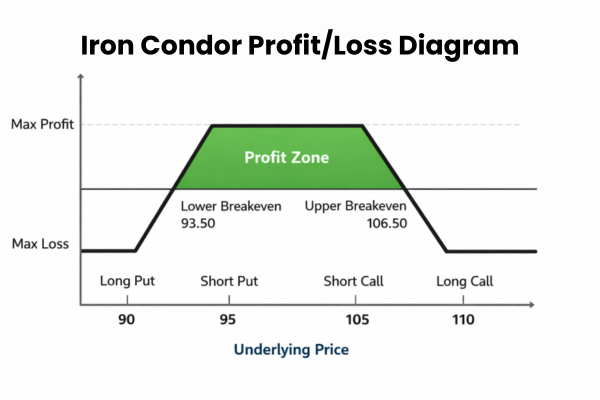
The maximum profit occurs when the underlying asset expires between the two short strikes (the sold put and sold call). This allows all options to expire worthless, and you keep the premium received.
Max profit = Credit received
Max Loss:
The maximum loss is capped and occurs when the price of the underlying moves beyond either of the long options (the bought put or call). The loss is calculated as the difference between the strike prices, minus the credit received.
Max loss = Spread width − Credit received
Breakeven Points:
The breakeven points mark the price levels where you neither make a profit nor incur a loss.
Lower breakeven: Short put strike − Credit received
Upper breakeven: Short call strike + Credit received
An Iron Condor Example
Let’s walk through an example to make this clearer.
Suppose the stock you’re trading is priced at $100, and you want to enter an iron condor trade with the following strikes:
Sell the 95 put, buy the 90 put
Sell the 105 call, buy the 110 call
If you receive a $1.50 credit for this position, here’s how the numbers break down:
Spread width = $5 (difference between strikes)
Max profit = $1.50 × 100 = $150
Max loss = ($5 − $1.50) × 100 = $350
Lower breakeven = 95 − 1.50 = $93.50
Upper breakeven = 105 + 1.50 = $106.50
In this case, the ideal scenario is for the stock to expire between $95 and $105, where you keep the full premium. If the price falls below $90 or rises above $110, you will experience a loss, but the maximum loss is capped at $350.
When Does the Iron Condor Strategy Work Best?
The iron condor is best used when you expect the underlying asset to remain range-bound. This could happen in a number of scenarios, including:
Sideways market conditions: You expect little movement or volatility in the price of the asset.
Low-to-moderate implied volatility: The strategy works best when option premiums are high (but not overly inflated).
No major upcoming catalysts: You’re not expecting a significant event, like an earnings report or an economic announcement, which could cause large price movement.
Many traders prefer this strategy during periods of high implied volatility (IV), as it allows them to collect higher premiums. But this also comes with risk, as an increase in IV can make the position more sensitive to price changes.
Risk Considerations for the Iron Condor Strategy
While the iron condor offers a defined risk, it’s important to understand the risks involved before entering the trade.
1) Directional Risk:
If the price of the underlying moves strongly toward one of your short strikes (either the put or call), you could face significant losses. In these cases, the max loss comes into play.
2) Gamma Risk Near Expiration:
As expiration approaches, the rate of change in the option’s price accelerates. This is known as gamma risk. If the underlying price moves toward your short strikes near expiration, your position can quickly lose value.
3) Volatility Risk:
Changes in volatility can affect the price of options. If implied volatility increases after you’ve entered the trade, the value of your position may also increase, causing a potential loss.
4) Pin Risk:
Pin risk occurs when the price of the underlying is near your short strike at expiration. In this scenario, there’s uncertainty about whether your options will be exercised or assigned, leading to unexpected risks. This is especially a concern for traders who do not manage their positions ahead of expiration.
How to Choose Strikes for an Iron Condor
Choosing the right strikes is key to maximizing the potential profit of an iron condor. Here are a few guidelines to consider:
1) Distance of Short Strikes:
Further out-of-the-money short strikes mean a higher probability of success, but you’ll receive less premium.
Closer short strikes increase the potential premium, but also introduce more risk.
2) Spread Width:
The distance between the strikes on the put and call sides can impact the overall risk and reward. Wider spreads bring in more premium but also increase the maximum potential loss.
3) Expiration Selection:
Most traders prefer an expiration of 30–60 days to give enough time for time decay (theta) to work, without exposing the position to significant gamma risk.
Conclusion
The iron condor is a great options strategy for traders who believe an asset will stay within a particular range. It allows traders to profit from time decay while limiting downside risk. However, it’s important to remember that iron condors come with risks, including directional price movement, volatility, and pin risk near expiration.
If you are looking for a defined-risk strategy that profits from neutral market conditions, the iron condor could be a suitable choice. But like any strategy, it’s essential to understand the tradeoffs and manage the position carefully to optimize results.
FAQs
1. What is the best market condition for an iron condor?
An iron condor works best in a range-bound market where the underlying asset is not expected to make significant moves. It’s ideal when implied volatility is moderate to elevated.
2. How much profit can I make with an iron condor?
The max profit is the net credit you receive when you open the position. It occurs if the price stays between the two short strikes at expiration.
3. Can I lose money with an iron condor?
Yes, you can lose money if the underlying moves beyond one of your long strikes (either the bought put or bought call). However, the maximum loss is capped and known upfront.
Share Now
Disclaimer:This content is provided for informational purposes only and does not constitute, and should not be construed as, financial, investment, or other professional advice. No statement or opinion contained herein should be considered a recommendation by Ultima Markets or the author regarding any specific investment product, strategy, or transaction. Readers are advised not to rely solely on this material when making investment decisions and should seek independent advice where appropriate.
Thank you for visiting the Ultima Markets website. Please note that this website is intended for individuals residing in jurisdictions where access is permitted by law. Ultima and its affiliated entities do not operate in your home jurisdiction.
By clicking ‘Acknowledge’, you confirm that you are entering this website solely on your own initiative and not as a result of any specific marketing outreach. You wish to obtain information from this website based on reverse solicitation principles, in accordance with the applicable laws of your home jurisdiction.