This website is managed by Ultima Markets’ international entities, and it’s important to emphasise that they are not subject to regulation by the FCA in the UK. Therefore, you must understand that you will not have the FCA’s protection when investing through this website – for example:
You will not be guaranteed Negative Balance Protection
You will not be protected by FCA’s leverage restrictions
You will not have the right to settle disputes via the Financial Ombudsman Service (FOS)
You will not be protected by Financial Services Compensation Scheme (FSCS)
Any monies deposited will not be afforded the protection required under the FCA Client Assets Sourcebook. The level of protection for your funds will be determined by the regulations of the relevant local regulator.
Note: UK clients are kindly invited to visit https://www.ultima-markets.co.uk/. Ultima Markets UK expects to begin onboarding UK clients in accordance with FCA regulatory requirements in 2026.
If you would like to proceed and visit this website, you acknowledge and confirm the following:
1.The website is owned by Ultima Markets’ international entities and not by Ultima Markets UK Ltd, which is regulated by the FCA.
2.Ultima Markets Limited, or any of the Ultima Markets international entities, are neither based in the UK nor licensed by the FCA.
3.You are accessing the website at your own initiative and have not been solicited by Ultima Markets Limited in any way.
4.Investing through this website does not grant you the protections provided by the FCA.
5.Should you choose to invest through this website or with any of the international Ultima Markets entities, you will be subject to the rules and regulations of the relevant international regulatory authorities, not the FCA.
Ultima Markets wants to make it clear that we are duly licensed and authorised to offer the services and financial derivative products listed on our website. Individuals accessing this website and registering a trading account do so entirely of their own volition and without prior solicitation.
By confirming your decision to proceed with entering the website, you hereby affirm that this decision was solely initiated by you, and no solicitation has been made by any Ultima Markets entity.
Ultima Markets does not have an establishment in Singapore and does not operate from Singapore.
Ultima Markets does not provide products or services to citizens or residents of Singapore, and account applications from Singapore citizens or residents will not be accepted.
If you are a citizen or resident of Singapore, please do not open an account or use Ultima Markets’ products or services.
By selecting “Acknowledge and Continue Browsing”, you confirm that you are accessing this website on your own initiative and that your access is not the result of any direct marketing, targeted advertising, solicitation, or promotional activity by Ultima Markets.
Nothing on this website constitutes an offer, solicitation, or promotion of products or services in any jurisdiction where such activity is prohibited. You are responsible for ensuring that your access to and use of this website complies with applicable local laws and regulations.
Truflation is a real-time inflation index updated daily using large-scale price data. Learn how it works, how it compares with CPI and where to access it.
What Is Truflation? How Does It Work?
Inflation influences interest rates, household budgets, business pricing, and market sentiment. The challenge is timing. Many widely referenced inflation metrics are published on a schedule, which can feel slow when prices change quickly.
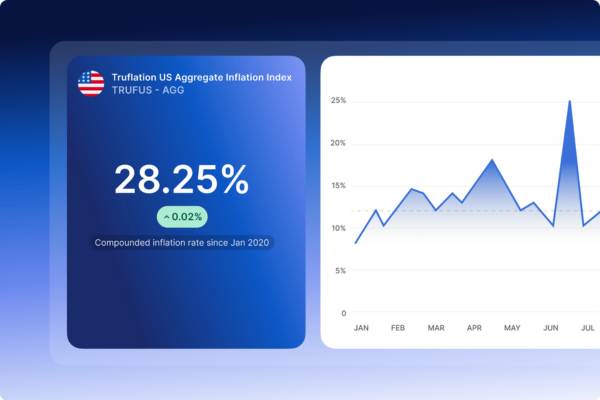
Truflation is an independent economic and financial data platform built to provide daily inflation readings and macro signals using large scale price data and transparent category breakdowns.
This article explains what Truflation is, how it builds its inflation index, how it compares with CPI and PCE, and how TRUF Network and the TRUF token fit into the ecosystem.
What Is Truflation?
Truflation publishes inflation indexes intended to update more frequently than traditional releases. In its US methodology, Truflation states it draws on 30 plus data sources and 15 plus million prices of goods and services to produce independent inflation indexes.
Truflation is also commonly discussed in Web3 because it aims to make economic data usable in on chain applications, with token based incentives for participants in its network.
Why Daily Inflation Data Matters?
Official inflation measures remain essential benchmarks, but they are designed for consistency and broad comparability rather than instant feedback.
For example, the US Consumer Price Index is produced by the Bureau of Labor Statistics using a structured national framework. The BLS describes collecting prices for approximately 80,000 goods and services each month across 75 urban areas, from about 23,000 retail establishments and about 6,000 housing units.
Truflation’s approach targets a different need. By updating daily and showing category drivers, it aims to offer faster signals between official releases.
How Truflation Builds Its Inflation Index
Truflation describes a methodology that starts with defining a basket and weights, then collecting and standardising large amounts of price data into a daily index.
Setting The Basket And Category Weights
Every inflation index depends on two design choices. What is included, and how much each category matters.
Truflation’s methodology includes published category weights for the US example. In that table, Housing is 23.2%, with Owned Dwellings 13.7% and Rented Dwellings 8.1%.
Collecting Prices From Many Sources
Truflation’s US methodology states its index uses 30 plus data sources and 15 plus million prices. It also lists examples of inputs such as NielsenIQ, Amazon, Walmart, Zillow and Trulia, AAA gas prices, CarGurus, and JD Power, among others.
Daily Processing And Quality Checks
Truflation outlines a daily ingestion process in which new data is gathered at 11:00 PM UTC, loaded, then evaluated through quality checks before being used in the index.
Normalisation And Aggregation
Because price feeds come in different formats and frequencies, Truflation describes normalising inputs into index form, then aggregating category indexes into a headline reading using the chosen weights.
Truflation Vs CPI
Truflation and CPI can show different readings because they are built with different data sources and measurement choices. Housing is one of the most important areas where methodologies diverge.
How CPI Measures Shelter
The BLS explains that shelter is one of the largest parts of the CPI market basket. Owners’ Equivalent Rent and Rent of Primary Residence measure most of the change in shelter cost consumers experience.
This matters because shelter carries heavy weight in the CPI structure. When shelter inflation is sticky, it can keep CPI elevated even if other categories cool.
How Truflation Treats Housing
Truflation’s methodology includes housing as a major category and publishes an owned versus rented split in its US weights table.
In addition, Truflation’s site describes that its CPI index includes the cost of home purchases by factoring in mortgage payments, which is a different framing from CPI’s rental equivalence approach.
A Recent Example Truflation Highlighted
In a macro update dated January 13, 2026, Truflation reported its independent US inflation index fell from 1.87% to 1.74%, attributing the move largely to cooling in the Owned Dwellings category.
Truflation Vs PCE
In US macro commentary, PCE is a major benchmark because it is widely referenced in monetary policy discussions.
The Bureau of Economic Analysis describes the Personal Consumption Expenditures price index as a measure of prices that people in the US, or those buying on their behalf, pay for goods and services. It is known for capturing inflation across a wide range of expenses and reflecting changes in consumer behaviour.
The Federal Reserve notes it seeks inflation at 2% over the longer run as measured by the annual change in the PCE price index.
Truflation introduced a Truflation PCE Index and presents it as a real time alternative aligned with the Fed’s benchmark, designed to provide timely and granular inflation data.
Truflation Products And Distribution
Truflation has expanded how its data can be accessed, including distribution into institutional and cloud environments.
Bloomberg Terminal Availability
Truflation announced that its US Inflation and PCE indexes are available on Bloomberg Terminal, positioning this as a step into traditional finance workflows.
AWS Marketplace Streaming
Truflation also announced its macroeconomic data is live on AWS Marketplace through the TRUF Network layer, which it describes as combining PostgreSQL with blockchain infrastructure to simplify integration into cloud environments.
AWS Marketplace lists a TRUF Network Node offering access to 200K plus live economic and market data feeds.
Specialised Index Example
To make high frequency data more tangible, Truflation launched the Breakfast Index, a daily index tracking nine breakfast commodities including coffee, tea, cocoa, orange juice, milk, sugar, oats, wheat, and lean hogs.
TRUF Network And TRUF Token
Truflation’s ecosystem includes a network and token design that supports participation, data delivery, and governance.
TRUF Network documentation outlines token allocations including Investors 25%, Team and Recruitment 13%, and Advisors 2%, with vesting schedules.
Truflation and exchange educational materials also describe staking and governance concepts such as veTRUF for voting rights within the ecosystem.
Conclusion
Truflation is a real time inflation data platform publishing daily inflation indexes and category drivers using large scale price data.
It differs from CPI in key design choices, particularly in how shelter and home ownership costs are represented, and it also offers a PCE aligned index for users who follow the Fed’s benchmark closely.
FAQ
Is Truflation an official inflation statistic
No. Truflation is an independent index provider publishing its own inflation indexes and methodology.
How often does Truflation update
Truflation’s US methodology describes daily collection and daily index updates.
Why can Truflation differ from CPI
CPI and Truflation use different data sources and measurement choices, with housing treatment being a major area of divergence.
Why does PCE matter in macro discussions
The Federal Reserve’s inflation target is framed in terms of PCE inflation over the longer run.
Share Now
Disclaimer:This content is provided for informational purposes only and does not constitute, and should not be construed as, financial, investment, or other professional advice. No statement or opinion contained herein should be considered a recommendation by Ultima Markets or the author regarding any specific investment product, strategy, or transaction. Readers are advised not to rely solely on this material when making investment decisions and should seek independent advice where appropriate.
Thank you for visiting the Ultima Markets website. Please note that this website is intended for individuals residing in jurisdictions where access is permitted by law. Ultima and its affiliated entities do not operate in your home jurisdiction.
By clicking ‘Acknowledge’, you confirm that you are entering this website solely on your own initiative and not as a result of any specific marketing outreach. You wish to obtain information from this website based on reverse solicitation principles, in accordance with the applicable laws of your home jurisdiction.