Important Information
This website is managed by Ultima Markets’ international entities, and it’s important to emphasise that they are not subject to regulation by the FCA in the UK. Therefore, you must understand that you will not have the FCA’s protection when investing through this website – for example:
- You will not be guaranteed Negative Balance Protection
- You will not be protected by FCA’s leverage restrictions
- You will not have the right to settle disputes via the Financial Ombudsman Service (FOS)
- You will not be protected by Financial Services Compensation Scheme (FSCS)
- Any monies deposited will not be afforded the protection required under the FCA Client Assets Sourcebook. The level of protection for your funds will be determined by the regulations of the relevant local regulator.
Note: UK clients are kindly invited to visit https://www.ultima-markets.co.uk/. Ultima Markets UK expects to begin onboarding UK clients in accordance with FCA regulatory requirements in 2026.
If you would like to proceed and visit this website, you acknowledge and confirm the following:
- 1.The website is owned by Ultima Markets’ international entities and not by Ultima Markets UK Ltd, which is regulated by the FCA.
- 2.Ultima Markets Limited, or any of the Ultima Markets international entities, are neither based in the UK nor licensed by the FCA.
- 3.You are accessing the website at your own initiative and have not been solicited by Ultima Markets Limited in any way.
- 4.Investing through this website does not grant you the protections provided by the FCA.
- 5.Should you choose to invest through this website or with any of the international Ultima Markets entities, you will be subject to the rules and regulations of the relevant international regulatory authorities, not the FCA.
Ultima Markets wants to make it clear that we are duly licensed and authorised to offer the services and financial derivative products listed on our website. Individuals accessing this website and registering a trading account do so entirely of their own volition and without prior solicitation.
By confirming your decision to proceed with entering the website, you hereby affirm that this decision was solely initiated by you, and no solicitation has been made by any Ultima Markets entity.
I confirm my intention to proceed and enter this website Please direct me to the website operated by Ultima Markets , regulated by the FCA in the United Kingdom
Ultima Markets App
Trade Anytime, Anywhere





What Currency Does Venezuela Use?
If you’re trying to understand venezuela currency, the simple answer is: Venezuela’s official money is the Venezuelan bolívar (currency code VES, commonly written as Bs.).
But the answer is more nuanced. Because Venezuela has dealt with years of high inflation, currency devaluations, and shifting exchange-rate conditions, people and businesses often operate in a mixed-currency reality where bolívars, U.S. dollars, and even dollar‑pegged crypto (stablecoins) can all play a role, depending on the situation.
In this article, we’ll explore what currency does Venezuela use, how venezuela currency works today, why the bolívar has changed so much over time, and what the forex outlook looks like heading into 2026.
What Is the Official Venezuela Currency?
The bolívar has been Venezuela’s official currency for over a century. Introduced in 1879, it was named after Simón Bolívar, a key figure in Latin America’s independence movement. For most of the 20th century, the bolívar was relatively stable, pegged to the US dollar and backed by gold.
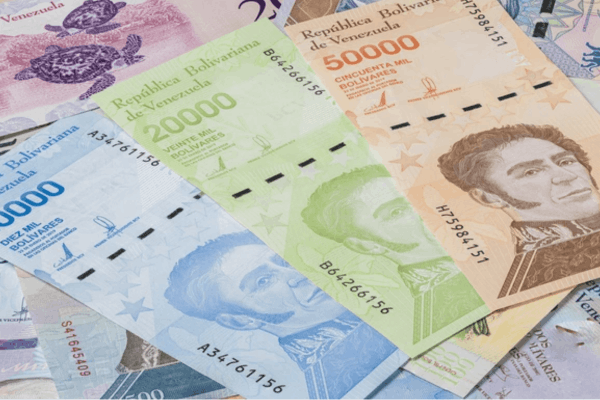
However, the 21st century brought economic turmoil, particularly after the early 1980s. This led to numerous devaluations and even redenominations of the bolívar, culminating in what we know today as the bolívar soberano (VES), introduced in 2018.
Despite these attempts to stabilise the currency, Venezuela has experienced a prolonged period of hyperinflation. Inflation reached unprecedented levels, and the bolívar’s purchasing power was decimated.
In fact, by 2018, the country was facing inflation rates of more than 1 million percent annually. This reality forced the government to issue new bolívars in attempts to keep up with the ever-decreasing value.
To cope with the economic chaos, Venezuela reintroduced the bolívar soberano in a series of redenominations, cutting five zeros off the currency’s value.
Why the Bolívar Lost So Much Value
The bolívar’s long-running challenges are mostly tied to inflation and the availability of hard currency (especially U.S. dollars). When inflation is very high, a local currency tends to lose purchasing power quickly, which then pushes more people to seek safer alternatives for saving and pricing.
A useful “big picture” indicator comes from the IMF’s country data for Venezuela, which shows extremely high projected inflation: 2026 projected consumer price inflation is 682.1%, alongside 2026 projected real GDP change of -3.0%.
Even without diving into technical economics, this matters for ordinary life because high inflation typically means:
- prices change frequently,
- the exchange rate becomes volatile,
- people prefer holding value in something more stable than cash bolívars.
What Currency Does Venezuela Use in Daily Life?
While the bolívar is still the official currency in Venezuela, it is far from the most commonly used one. The US dollar has become the de facto currency for many transactions, particularly in larger cities and for big-ticket items.
Due to the persistent devaluation of the bolívar, many Venezuelans prefer to keep their savings in US dollars, which hold much more stability in comparison.
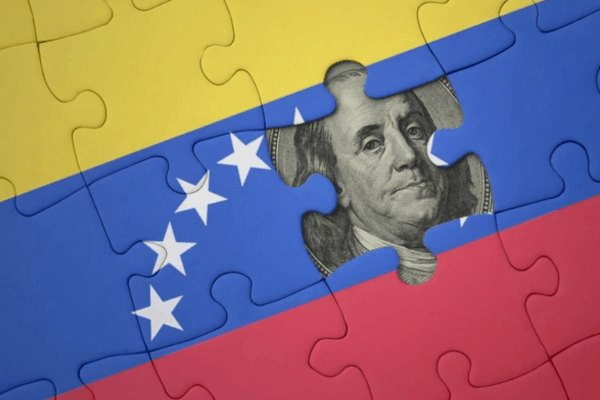
The government itself has even shifted towards using dollars for certain financial transactions, particularly in the formal economy. It’s not uncommon for businesses, especially larger ones, to price goods in dollars. Additionally, stablecoins, such as USDT (Tether) and USDC, have seen increasing use for digital transactions.
These cryptocurrencies, which are pegged to the US dollar, offer a viable alternative to the bolívar, providing Venezuelans with a way to protect their money from inflation while also having access to international financial systems.
Official vs Parallel Exchange Rates
One of the key features of Venezuela’s economic landscape is the parallel exchange rate, also known as the black market rate. The official exchange rate, set by the Central Bank of Venezuela, is often far from the actual value of the bolívar in the market.
The parallel market is where most Venezuelans exchange bolívars for dollars. It operates in a different style, often showing a significantly higher rate than the official one.
For example, the official rate of the bolívar to the US dollar in January 2026 was around 301.37 VES per USD. However, in the informal market, this rate could be significantly higher. This discrepancy has made it incredibly difficult for most Venezuelans to access dollars through official channels, pushing them to rely on the parallel market, where rates fluctuate and can be difficult to predict.
The Rise of the Dollar and Digital Currencies
Because of the bolívar’s constant devaluation, many Venezuelans have turned to foreign currencies, primarily US dollars, for everyday transactions. In fact, as of 2026, many businesses in Venezuela price their goods and services in dollars, especially in more urban areas.
Some estimates suggest that over 60% of all retail transactions in Venezuela are now conducted in US dollars. The dollarisation of the economy is not just limited to cash payments. Credit card transactions in dollars are also widely accepted.
Beyond the dollar, cryptocurrencies such as Bitcoin and stablecoins have gained popularity. These digital assets provide Venezuelans with a way to safeguard their wealth without being subject to the bolívar’s extreme inflation. In response to restrictions on foreign exchange and remittances, stablecoins like USDT (Tether) have seen a huge rise in usage, as they offer a way to hold value in a more stable form.
Venezuela Currency in Forex
When people ask about venezuela currency in forex, they’re usually asking one of two things:
- What is the USD/VES exchange rate right now?
- Is the bolívar actively tradeable like major forex pairs?
Current USD/VES level
According to Trading Economics, the USD/VES exchange rate was about 377.9851 on February 6, 2026, and the site notes the bolívar weakened significantly over the prior month. Investing.com also listed the USD/VES around the same level.
Is VES a normal “forex trading” currency?
In many countries, retail forex traders can buy and sell currency pairs freely through deep, liquid markets. With Venezuela, things are typically more complicated because:
- access to foreign currency can be policy-driven,
- exchange mechanisms may change,
- and the rate people actually get can vary by channel (official vs informal vs bank programs).
So while you can track USD/VES like a forex pair, the lived reality of converting bolívars to dollars can be shaped heavily by availability and rules, more than by pure market liquidity.
Conclusion
To fully understand venezuela currency, you have to understand that the bolívar (VES) is the official currency, yet the daily economy often relies on dollar pricing and, in some channels, stablecoin “digital dollars.”
Looking ahead, the bolívar’s forex direction in 2026 will likely be driven by the same fundamentals it has been for years of inflation, dollar inflows, and access to exchange mechanisms.
FAQ
The official Venezuela currency is the Venezuelan bolívar (VES), but US dollars are widely used for pricing and everyday payments in many areas.
Yes. While the official Venezuela currency is the bolívar (VES), US dollars are widely used in daily life for pricing and payments in many places.
It’s usually better as a market indicator than a mainstream trading pair. USD/VES can be volatile and less “standard” due to limited convertibility and differences between official and market pricing.
Disclaimer: This content is provided for informational purposes only and does not constitute, and should not be construed as, financial, investment, or other professional advice. No statement or opinion contained here in should be considered a recommendation by Ultima Markets or the author regarding any specific investment product, strategy, or transaction. Readers are advised not to rely solely on this material when making investment decisions and should seek independent advice where appropriate.
Latest Articles

FOLLOW US






Ultima Markets is a member of The Financial Commission, an international independent body responsible for resolving disputes in the Forex and CFD markets.

All clients of Ultima Markets are protected under insurance coverage provided by Willis Towers Watson (WTW), a global insurance brokerage established in 1828, with claims eligibility up to US$1,000,000 per account.

Ultima Markets is the first United CFD broker to be part of the United Nations Global Compact.
FOLLOW US
TRADE WITH US
RISK DISCLOSURE
Risk Warning:
Trading leveraged financial products, including Contracts for Difference (CFDs), carries a high level of risk and may result in losses exceeding your initial investment. These products are not suitable for all investors and should only be traded with funds you can afford to lose. You do not own or have any rights to the underlying assets of these derivatives (e.g., entitlement to dividends). Please ensure you fully understand the associated risks. Before trading, consider your level of experience, investment objectives, and seek independent financial advice if necessary. Refer to our legal documents and disclosures before making any trading decisions.
General Advice Warning:
The information provided on this website is general in nature and does not take into account your personal objectives, financial situation, or needs. Before acting on any advice, you should assess its appropriateness in light of your individual circumstances and consult our legal documentation.
Regional Restrictions:
The information and services on this website are not intended for residents of certain jurisdictions, including but not limited to the United States, United Kingdom, Singapore, and any jurisdictions subject to international sanctions. For further information, please contact our customer support team.
Regulatory Information:
Ultima Markets is a trading name shared amongst multiple entities operating in various jurisdictions. These following entities are authorised to operate under the Ultima Markets brand and trademarks.
-
Ultima Markets UK Limited, reference number 470325, is authorised and regulated by the Financial Conduct Authority (FCA). Registered address: 1 Blossom Yard, Fourth Floor, London, E1 6RS, UNITED KINGDOM.
-
Ultima Markets Ltd is authorised and regulated by the Financial Services Commission (FSC) of Mauritius as a Full-Service Investment Dealer (excluding Underwriting), under licence number GB 23201593.
Registered address: 2nd Floor, The Catalyst, 40 Silicon Avenue, Ebene Cybercity, 72201, Mauritius.
-
Ultima Markets EU OÜ, incorporated in Estonia with registry code 17134727. Registered address: Harju maakond, Tallinn, Kristiine linnaosa, Seebi tn 1-1501, 11316. This entity does not offer regulated financial products or provide trading services.

Copyright © 2026 Ultima Markets Ltd. All rights reserved.
-

Messenger


Continue on Messenger
Take the conversation to your Messenger account. You can return anytime.
Scan the QR code and then send the message that appears in your Messenger.
Open Messenger on this device.
-

Instagram

Continue on Instagram
Take the conversation to your Instagram account. You can return anytime.
Scan the QR code to open Instagram. Follow @ultima_markets to send a DM.
Open Instagram on this device.
-

Live Chat
-

