Important Information
This website is managed by Ultima Markets’ international entities, and it’s important to emphasise that they are not subject to regulation by the FCA in the UK. Therefore, you must understand that you will not have the FCA’s protection when investing through this website – for example:
- You will not be guaranteed Negative Balance Protection
- You will not be protected by FCA’s leverage restrictions
- You will not have the right to settle disputes via the Financial Ombudsman Service (FOS)
- You will not be protected by Financial Services Compensation Scheme (FSCS)
- Any monies deposited will not be afforded the protection required under the FCA Client Assets Sourcebook. The level of protection for your funds will be determined by the regulations of the relevant local regulator.
Note: UK clients are kindly invited to visit https://www.ultima-markets.co.uk/. Ultima Markets UK expects to begin onboarding UK clients in accordance with FCA regulatory requirements in 2026.
If you would like to proceed and visit this website, you acknowledge and confirm the following:
- 1.The website is owned by Ultima Markets’ international entities and not by Ultima Markets UK Ltd, which is regulated by the FCA.
- 2.Ultima Markets Limited, or any of the Ultima Markets international entities, are neither based in the UK nor licensed by the FCA.
- 3.You are accessing the website at your own initiative and have not been solicited by Ultima Markets Limited in any way.
- 4.Investing through this website does not grant you the protections provided by the FCA.
- 5.Should you choose to invest through this website or with any of the international Ultima Markets entities, you will be subject to the rules and regulations of the relevant international regulatory authorities, not the FCA.
Ultima Markets wants to make it clear that we are duly licensed and authorised to offer the services and financial derivative products listed on our website. Individuals accessing this website and registering a trading account do so entirely of their own volition and without prior solicitation.
By confirming your decision to proceed with entering the website, you hereby affirm that this decision was solely initiated by you, and no solicitation has been made by any Ultima Markets entity.
I confirm my intention to proceed and enter this website Please direct me to the website operated by Ultima Markets , regulated by the FCA in the United Kingdom
Ultima Markets App
Trade Anytime, Anywhere





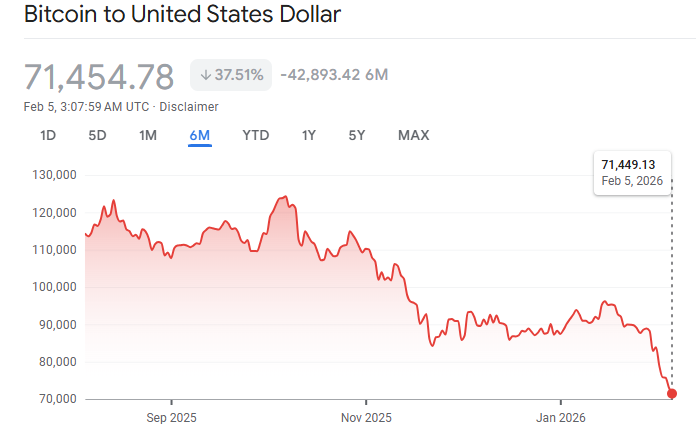
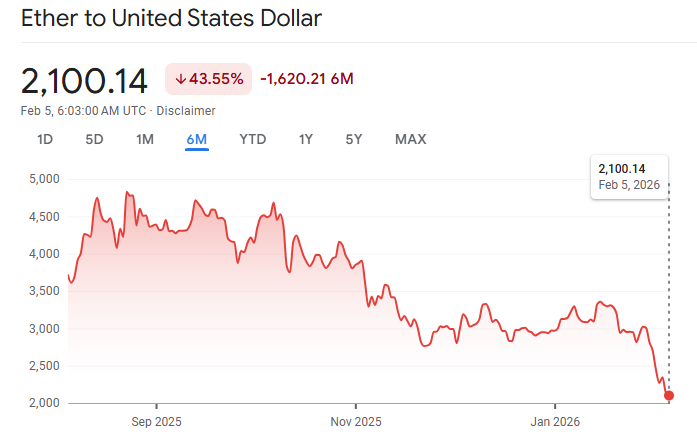
Cryptocurrency markets are facing significant declines today. Since February 4, 2026, Bitcoin has dropped from around $76,000 to $72,000, while Ethereum slid from $3,200 to $3,050. XRP and other major altcoins are also experiencing steep losses, with some coins down by more than 4% in the last 24 hours.
5 Reasons Why Is Crypto Down
This decline is largely driven by several key factors:
Broad Sell-Off & Risk-Off Sentiment
The crypto market is currently experiencing a broad sell-off across major assets. This downturn is part of a risk-off sentiment, where investors are pulling back from assets perceived as high-risk, like cryptocurrencies, in favor of safer investments such as government bonds, gold, or even cash holdings.
Global equity markets are also facing downward pressure, with many major indices (like the S&P 500) showing weakness. The U.S. dollar has strengthened, signaling a flight to safety, which further pressures riskier assets like crypto.
According to CoinMarketCap, Bitcoin’s market dominance has fallen from 43% to 41% in the past week, showing that investors are fleeing to other assets in a general market retreat. Gold has seen an uptick, with the price rising by over 1.5% recently, indicating a shift in investor preference.
As global financial conditions tighten, traders and investors become more cautious, which hits speculative assets like cryptocurrencies the hardest.
Mass Liquidations of Leveraged Positions
A wave of forced liquidations has been one of the most immediate drivers of today’s crypto drop. Leveraged traders, those who borrow funds to increase their exposure—have been hit particularly hard, as their positions are automatically closed when prices fall beyond a certain point, causing further sell-offs.
A blockchain data provider reported that over $600 million worth of leveraged positions were liquidated on February 4, 2026, across Bitcoin and Ethereum alone. This adds to the downward pressure as liquidations trigger further sell-offs.
This has created a self-perpetuating cycle, where leveraged traders are forced to sell as prices fall, triggering additional sell-offs by other leveraged traders and retail investors.
Monetary Policy Uncertainty
The U.S. Federal Reserve’s stance on interest rates and monetary policy has been a significant source of market uncertainty. With inflationary pressures still looming, the Fed’s decision to potentially keep interest rates high for an extended period is making riskier assets like crypto less attractive.
The U.S. Federal Reserve’s recent interest rate hike in January 2026 has made traditional safe assets, such as U.S. Treasury Bonds and high-quality corporate bonds, more appealing compared to cryptocurrencies. As bond yields rise, crypto’s appeal weakens, especially for institutional investors.
Cryptocurrencies like Bitcoin and Ethereum are often viewed as speculative assets with higher volatility, and high interest rates reduce their attractiveness in favor of more stable investments offering guaranteed returns, such as bonds.
Market participants are now bracing for higher-for-longer rates, and this uncertainty is causing risk aversion in the market.
Reduced Institutional Demand
There has been a noticeable reduction in institutional demand for cryptocurrencies, which has contributed to today’s decline. Big players who had previously shown strong interest in the market are now pulling back, primarily due to regulatory uncertainty and market volatility.
Crypto ETFs have experienced significant outflows, with data from ETFDB showing $400 million in outflows from major crypto ETFs in January 2026 alone. The uncertainty surrounding upcoming crypto regulations in both the U.S. and EU has led many institutions to reevaluate their positions, contributing to reduced market confidence and the drop in demand.
Without institutional buyers stepping in, the market is more susceptible to price manipulation, lower liquidity, and higher volatility.
Broader Economic Concerns
Global economic instability continues to play a major role in the downturn. Political and economic concerns, especially in the U.S., are causing investors to flee to safer assets, adding to the pressure on cryptocurrencies.
The U.S. debt ceiling and geopolitical risks are creating additional uncertainties. As markets face rising concerns about a potential U.S. debt default, investor sentiment is turning negative. This uncertainty is bleeding into the crypto markets as traders look to protect their assets.
Traditional safe havens, such as gold and Swiss Francs, are gaining ground as global markets become increasingly volatile. In fact, gold prices surged 2% over the last week, highlighting the shift away from riskier assets like cryptocurrencies.
In times of uncertainty, crypto is often the first asset to be sold off as investors seek out perceived safer alternatives.
Crypto Bearish or Bullish in the Future?
Currently, the short-term outlook for crypto is bearish. The combination of liquidations, institutional pullbacks, regulatory uncertainty, and economic fears is causing downward pressure on prices. However, crypto markets have historically recovered from such downturns, and with long-term adoption continuing, bullish potential remains but it may take some time to materialize.
- Short-Term Bearish Outlook: Expect continued volatility as traders digest these economic and market conditions.
- Long-Term Bullish Potential: As adoption continues and regulatory clarity improves, cryptocurrencies still have significant growth potential in the long run, despite the short-term struggles.
What Traders Need to Know
With the current downturn in the crypto market, it’s essential for traders to approach this period with caution, clear strategy, and adaptability.
- Manage Risk Carefully: With the market’s volatility, risk management is key. Use stop-loss orders and avoid excessive leverage to protect your portfolio from deeper losses.
- Stay Informed: Monitor key economic data, such as U.S. inflation figures and interest rate announcements, as these can influence market sentiment.
- Look for Entry Points: While the market is bearish now, experienced traders might view this as an opportunity to buy the dip but patience is essential.
- Expect Volatility: Crypto is inherently volatile, so be prepared for short-term fluctuations even as long-term prospects remain promising.
In summary, today’s market downturn is the result of mass liquidations, weak institutional demand, and broader economic uncertainties. While the short-term outlook is bearish, crypto’s long-term potential remains, and those who manage risk effectively may find opportunities down the line.
Conclusion
The current bearish sentiment in the crypto market presents both risks and opportunities. Traders should focus on risk management, stay updated on macroeconomic trends, and be patient during this period of volatility. Volatility is a given in the crypto world, and while the short-term outlook may be down, those who approach the market strategically could capitalize on future gains when conditions improve.
At Ultima Markets, we understand the importance of making informed, strategic decisions. Whether you’re looking to trade forex, or other assets, we offer advanced trading tools, real-time data, and professional support to help you navigate the markets with confidence.
Open a live account with Ultima Markets today and start trading with purpose. Stay ahead of the market, manage your risks effectively, and explore new opportunities even during uncertain times.
FAQs
The crypto market is down due to factors like market correction, negative news, or regulatory concerns impacting investor sentiment.
Crypto prices are volatile, and while they may rise again, future performance depends on market conditions, investor sentiment, and global trends.
It depends on your risk tolerance and investment strategy. Consider your long-term goals, the current market trend, and potential risks before deciding.
Disclaimer: This content is provided for informational purposes only and does not constitute, and should not be construed as, financial, investment, or other professional advice. No statement or opinion contained here in should be considered a recommendation by Ultima Markets or the author regarding any specific investment product, strategy, or transaction. Readers are advised not to rely solely on this material when making investment decisions and should seek independent advice where appropriate.
Latest Articles


FOLLOW US






Ultima Markets is a member of The Financial Commission, an international independent body responsible for resolving disputes in the Forex and CFD markets.

All clients of Ultima Markets are protected under insurance coverage provided by Willis Towers Watson (WTW), a global insurance brokerage established in 1828, with claims eligibility up to US$1,000,000 per account.

Ultima Markets is the first United CFD broker to be part of the United Nations Global Compact.
FOLLOW US
TRADE WITH US
RISK DISCLOSURE
Risk Warning:
Trading leveraged financial products, including Contracts for Difference (CFDs), carries a high level of risk and may result in losses exceeding your initial investment. These products are not suitable for all investors and should only be traded with funds you can afford to lose. You do not own or have any rights to the underlying assets of these derivatives (e.g., entitlement to dividends). Please ensure you fully understand the associated risks. Before trading, consider your level of experience, investment objectives, and seek independent financial advice if necessary. Refer to our legal documents and disclosures before making any trading decisions.
General Advice Warning:
The information provided on this website is general in nature and does not take into account your personal objectives, financial situation, or needs. Before acting on any advice, you should assess its appropriateness in light of your individual circumstances and consult our legal documentation.
Regional Restrictions:
The information and services on this website are not intended for residents of certain jurisdictions, including but not limited to the United States, United Kingdom, Singapore, and any jurisdictions subject to international sanctions. For further information, please contact our customer support team.
Regulatory Information:
Ultima Markets is a trading name shared amongst multiple entities operating in various jurisdictions. These following entities are authorised to operate under the Ultima Markets brand and trademarks.
-
Ultima Markets UK Limited, reference number 470325, is authorised and regulated by the Financial Conduct Authority (FCA). Registered address: 1 Blossom Yard, Fourth Floor, London, E1 6RS, UNITED KINGDOM.
-
Ultima Markets Ltd is authorised and regulated by the Financial Services Commission (FSC) of Mauritius as a Full-Service Investment Dealer (excluding Underwriting), under licence number GB 23201593.
Registered address: 2nd Floor, The Catalyst, 40 Silicon Avenue, Ebene Cybercity, 72201, Mauritius.
-
Ultima Markets EU OÜ, incorporated in Estonia with registry code 17134727. Registered address: Harju maakond, Tallinn, Kristiine linnaosa, Seebi tn 1-1501, 11316. This entity does not offer regulated financial products or provide trading services.

Copyright © 2026 Ultima Markets Ltd. All rights reserved.
-

Messenger


Continue on Messenger
Take the conversation to your Messenger account. You can return anytime.
Scan the QR code and then send the message that appears in your Messenger.
Open Messenger on this device.
-

Instagram

Continue on Instagram
Take the conversation to your Instagram account. You can return anytime.
Scan the QR code to open Instagram. Follow @ultima_markets to send a DM.
Open Instagram on this device.
-

Live Chat
-

