This website is managed by Ultima Markets’ international entities, and it’s important to emphasise that they are not subject to regulation by the FCA in the UK. Therefore, you must understand that you will not have the FCA’s protection when investing through this website – for example:
You will not be guaranteed Negative Balance Protection
You will not be protected by FCA’s leverage restrictions
You will not have the right to settle disputes via the Financial Ombudsman Service (FOS)
You will not be protected by Financial Services Compensation Scheme (FSCS)
Any monies deposited will not be afforded the protection required under the FCA Client Assets Sourcebook. The level of protection for your funds will be determined by the regulations of the relevant local regulator.
Note: UK clients are kindly invited to visit https://www.ultima-markets.co.uk/. Ultima Markets UK expects to begin onboarding UK clients in accordance with FCA regulatory requirements in 2026.
If you would like to proceed and visit this website, you acknowledge and confirm the following:
1.The website is owned by Ultima Markets’ international entities and not by Ultima Markets UK Ltd, which is regulated by the FCA.
2.Ultima Markets Limited, or any of the Ultima Markets international entities, are neither based in the UK nor licensed by the FCA.
3.You are accessing the website at your own initiative and have not been solicited by Ultima Markets Limited in any way.
4.Investing through this website does not grant you the protections provided by the FCA.
5.Should you choose to invest through this website or with any of the international Ultima Markets entities, you will be subject to the rules and regulations of the relevant international regulatory authorities, not the FCA.
Ultima Markets wants to make it clear that we are duly licensed and authorised to offer the services and financial derivative products listed on our website. Individuals accessing this website and registering a trading account do so entirely of their own volition and without prior solicitation.
By confirming your decision to proceed with entering the website, you hereby affirm that this decision was solely initiated by you, and no solicitation has been made by any Ultima Markets entity.
Ultima Markets does not have an establishment in Singapore and does not operate from Singapore.
Ultima Markets does not provide products or services to citizens or residents of Singapore, and account applications from Singapore citizens or residents will not be accepted.
If you are a citizen or resident of Singapore, please do not open an account or use Ultima Markets’ products or services.
By selecting “Acknowledge and Continue Browsing”, you confirm that you are accessing this website on your own initiative and that your access is not the result of any direct marketing, targeted advertising, solicitation, or promotional activity by Ultima Markets.
Nothing on this website constitutes an offer, solicitation, or promotion of products or services in any jurisdiction where such activity is prohibited. You are responsible for ensuring that your access to and use of this website complies with applicable local laws and regulations.
Will gold price increase after its recent sharp fall? Discover the key factors of the price drop, forecasts, and the outlook for gold in the months ahead.
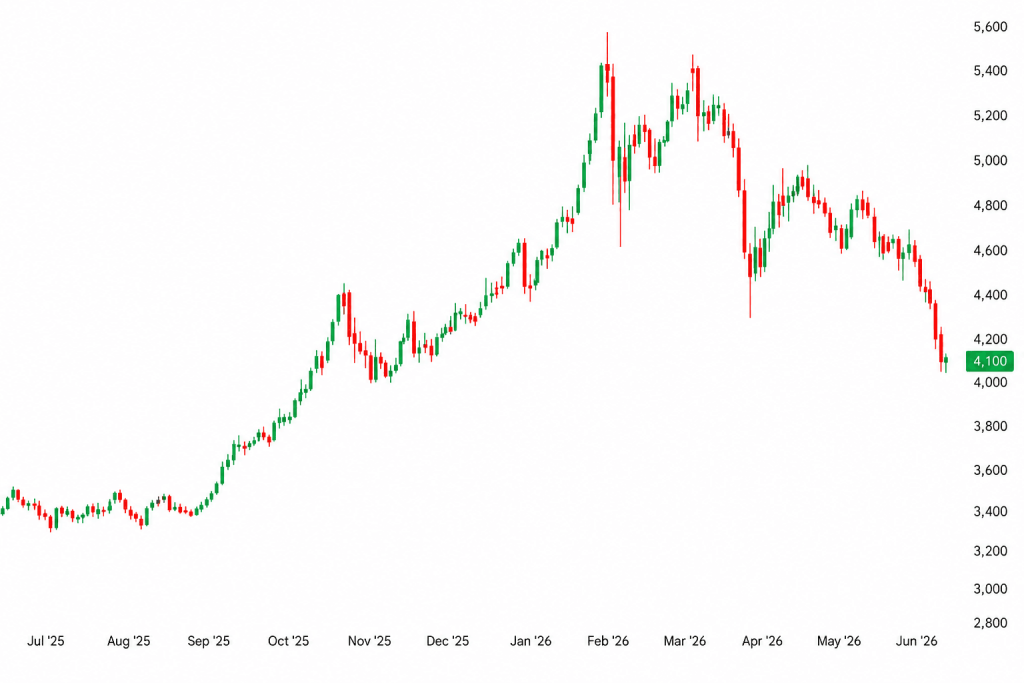
Gold has recently come under significant pressure, breaking below the $4,300 per ounce mark and slipping past its 200-day moving average (DMA), a widely watched technical benchmark.
This sharp decline, paired with volatile geopolitical developments and robust economic data from the United States, has reignited debates among investors and traders: will gold price increase in the near or medium term?
This article explores the drivers behind the drop, examines technical and macro factors, and assesses whether gold remains a reliable asset.
Recent Gold Price Drop and Technical Breakdown
On 11 June 2026, during Asian trading hours, spot gold fell to an intraday low of $4,268.42, erasing all year-to-date gains. The break below the 200-DMA is particularly noteworthy. According to Ole Hansen, Commodity Strategist at Saxo Bank, short-term technical focus now lies between $4,100 and $4,075 per ounce. Should this zone fail to hold, the downward momentum could intensify.
The 200-DMA acts as a critical reference point for momentum and trend-following strategies. Many CTAs, algorithmic traders, and medium-to-long-term allocation models use the 200-DMA as a risk filter: prices remaining below this level often trigger deleveraging, reduced exposure, or delayed long positions, creating a negative feedback loop that can amplify price declines.
Additionally, the $4,100–$4,075 zone coincides with:
The March 2026 lows, offering a psychological support
38.2% Fibonacci retracement from gold’s 2022–2026 primary rally, attracting algorithmic and target-driven buying
This combination makes it a critical short-term observation zone for traders and analysts alike.
Macroeconomic Factors Driving the Decline
Gold’s recent fall is not purely technical; it is heavily influenced by macroeconomic conditions:
Strong U.S. Employment Data: May nonfarm payrolls increased by 172,000, more than double the 85,000 estimate, while unemployment remained low at 4.3% for the third consecutive month.
Inflation Expectations: The U.S. Consumer Price Index (CPI) for May is expected at 4.2%, up from 3.8% in April, reflecting rising energy prices and ongoing inflationary pressures.
Federal Reserve Rate Outlook: With robust employment and sticky inflation, market expectations for a rate hike this year rose to 74.8%, up from 53.5% a week ago, reducing the likelihood of rate cuts.
Higher real yields and a stronger U.S. dollar increase the opportunity cost of holding non-yielding gold, putting further pressure on prices.
This dynamic explains why even escalating Middle East tensions, which would normally boost safe-haven demand, failed to support gold in the short term.
Geopolitical Context
Escalating tensions in the Middle East have produced a counter-intuitive effect on gold:
On 7 June, Iran attacked an Israeli airbase, prompting retaliation from Israel.
Typically, geopolitical risk increases safe-haven demand, but in this instance, the market interpreted the shock as a driver of higher energy prices, contributing to inflation expectations and pushing USD and long-term yields higher.
This has created a rare scenario of “rising geopolitical risk + falling gold”, highlighting how macroeconomic factors can override traditional safe-haven behaviour in the short term.
Investment Bank Forecasts and Market Sentiment
Recent bank forecasts illustrate mixed sentiment:
Commerzbank: lowered end-2026 forecast from $5,000 to $4,800
Citi: 0–3 month target $4,300, cautioning further downside if risk-off events intensify
JPMorgan: 2026 average forecast reduced from $5,708 to $5,243
Goldman Sachs: remains bullish, targeting $5,400 by year-end, citing sustained central bank demand
Investor sentiment is reflected in ETF and futures data:
Bloomberg-tracked gold ETF holdings declined by 88 tons to 3,048 tons, yet remain 282 tons above last year’s level, showing a long-term base persists.
COMEX speculative net long positions are at 171,000 contracts, above the two-year low of 149,000 but below the one-year average of 194,000, indicating a neutral stance: traders are neither aggressively selling nor buying.
Ole Hansen notes that “the missing factor is momentum, not money.” Once volatility normalises and margin pressure eases, gold could attract renewed inflows. This is provided the trend itself reverses.
Central Bank Demand
Structural demand from central banks continues to provide a strong floor for gold prices:
April 2026 net purchases: ~17 tons, reversing March’s net sales of 30 tons
National Bank of Poland: 45 tons year-to-date
People’s Bank of China: reserves increased by 9.95 tons in May, marking the 19th consecutive month of additions
Goldman Sachs projects average monthly central bank purchases could reach 60 tons, above historical averages
This persistent accumulation demonstrates that central banks continue to view gold as a strategic asset, supporting its long-term price floor.
Short-Term vs. Long-Term Outlook
Short-Term Risks:
Breach of $4,075 could accelerate the decline
Short-term sentiment remains cautious due to strong USD, rising yields, and sticky inflation
Medium-to-Long-Term Support:
Structural factors such as central bank purchases, debt concerns, de-dollarization, and geopolitical uncertainty underpin gold’s appeal
Relief rallies may occur if inflation stabilises or geopolitical tensions ease, giving gold a platform to increase
Trigger for Recovery: Analysts suggest gold’s trend will only resume upwards if:
Prices reclaim the 200-DMA and form higher lows
Inflation concerns ease significantly
Energy markets stabilise and geopolitical risks reduce
Will Gold Price Increase In the Months Ahead?
Analysts indicate that while gold faces short-term pressure due to strong U.S. employment data, rising yields, and a recent break below the 200-day moving average, the medium- to long-term outlook remains positive.
In the near term, prices may fluctuate between $4,075 and $4,300, as the market tests critical support levels and investors digest economic signals. Over the next 6–12 months, institutional forecasts suggest gold could rise by 15–30%, potentially reaching $5,000 to $6,000 per ounce, supported by ongoing central bank purchases, persistent inflation, and geopolitical uncertainty.
While short-term volatility may continue, these structural factors indicate that gold price is likely to increase over the medium term, making it an attractive hedge and strategic asset for patient investors.
FAQs
Will gold price increase in the next week?
Short-term movements are uncertain; gold may bounce near $4,100, but sustained increases require supportive macro factors.
Why did gold drop below $4,300?
Strong U.S. employment data, high inflation expectations, and the break below the 200-day moving average triggered the decline.
Is gold a safe investment now?
Yes. Despite short-term volatility, gold remains a reliable long-term hedge against inflation, geopolitical risk, and currency depreciation.
Share Now
Disclaimer:This content is provided for informational purposes only and does not constitute, and should not be construed as, financial, investment, or other professional advice. No statement or opinion contained herein should be considered a recommendation by Ultima Markets or the author regarding any specific investment product, strategy, or transaction. Readers are advised not to rely solely on this material when making investment decisions and should seek independent advice where appropriate.
Thank you for visiting the Ultima Markets website. Please note that this website is intended for individuals residing in jurisdictions where access is permitted by law. Ultima and its affiliated entities do not operate in your home jurisdiction.
By clicking ‘Acknowledge’, you confirm that you are entering this website solely on your own initiative and not as a result of any specific marketing outreach. You wish to obtain information from this website based on reverse solicitation principles, in accordance with the applicable laws of your home jurisdiction.