This website is managed by Ultima Markets’ international entities, and it’s important to emphasise that they are not subject to regulation by the FCA in the UK. Therefore, you must understand that you will not have the FCA’s protection when investing through this website – for example:
You will not be guaranteed Negative Balance Protection
You will not be protected by FCA’s leverage restrictions
You will not have the right to settle disputes via the Financial Ombudsman Service (FOS)
You will not be protected by Financial Services Compensation Scheme (FSCS)
Any monies deposited will not be afforded the protection required under the FCA Client Assets Sourcebook. The level of protection for your funds will be determined by the regulations of the relevant local regulator.
Note: UK clients are kindly invited to visit https://www.ultima-markets.co.uk/. Ultima Markets UK expects to begin onboarding UK clients in accordance with FCA regulatory requirements in 2026.
If you would like to proceed and visit this website, you acknowledge and confirm the following:
1.The website is owned by Ultima Markets’ international entities and not by Ultima Markets UK Ltd, which is regulated by the FCA.
2.Ultima Markets Limited, or any of the Ultima Markets international entities, are neither based in the UK nor licensed by the FCA.
3.You are accessing the website at your own initiative and have not been solicited by Ultima Markets Limited in any way.
4.Investing through this website does not grant you the protections provided by the FCA.
5.Should you choose to invest through this website or with any of the international Ultima Markets entities, you will be subject to the rules and regulations of the relevant international regulatory authorities, not the FCA.
Ultima Markets wants to make it clear that we are duly licensed and authorised to offer the services and financial derivative products listed on our website. Individuals accessing this website and registering a trading account do so entirely of their own volition and without prior solicitation.
By confirming your decision to proceed with entering the website, you hereby affirm that this decision was solely initiated by you, and no solicitation has been made by any Ultima Markets entity.
Ultima Markets does not have an establishment in Singapore and does not operate from Singapore.
Ultima Markets does not provide products or services to citizens or residents of Singapore, and account applications from Singapore citizens or residents will not be accepted.
If you are a citizen or resident of Singapore, please do not open an account or use Ultima Markets’ products or services.
By selecting “Acknowledge and Continue Browsing”, you confirm that you are accessing this website on your own initiative and that your access is not the result of any direct marketing, targeted advertising, solicitation, or promotional activity by Ultima Markets.
Nothing on this website constitutes an offer, solicitation, or promotion of products or services in any jurisdiction where such activity is prohibited. You are responsible for ensuring that your access to and use of this website complies with applicable local laws and regulations.
Learn what currency does Luxembourg use, get travel payment tips, and see how EUR moves forex pairs like EUR/USD for traders and travelers today in 2026.
What Currency Does Luxembourg Use Now?
Luxembourg uses the euro (€) as its official currency. If you are visiting, moving, or doing business in the country, prices, salaries, taxes, and everyday payments are handled in EUR, the euro’s international currency code.
In this blog guide, you will get a clear answer to what currency does Luxembourg use, plus a practical note on why the euro matters in forex trading and exchange rates.
What Currency Does Luxembourg Use Today?
What currency does Luxembourg use? Luxembourg uses the euro (€) as its official and everyday currency. Prices are displayed in EUR, and both cash and card payments are made in euros.
Luxembourg is part of the euro area, so the currency works the same way as it does in many other European countries that use the euro.
Quick Currency Facts for Luxembourg
Here are the key details of Luxembourg’s Currency laid out:
Official currency: Euro
Symbol: €
Currency code: EUR
Subdivision: 100 cents
Used for: shopping, salaries, taxes, bills, and banking
Why Luxembourg Uses The Euro
Luxembourg adopted the euro through the European Economic and Monetary Union.
The euro was introduced first as an accounting and electronic currency for a transitional period.
Euro banknotes and coins arrived on January 1, 2002.
Luxembourg had a short period where both the old currency and the euro were legal tender, and that dual circulation ended on February 28, 2002.
That is why, today, Luxembourg is fully a euro country in both daily spending and financial systems.
What Currency Did Luxembourg Use Before The Euro
Before the euro, Luxembourg used the Luxembourg franc, commonly abbreviated as LUF.
When euro cash entered circulation in January 2002, the Luxembourg franc was phased out during the dual circulation window and then stopped being legal tender after the end date noted above.
Coins And Banknotes In Luxembourg
Luxembourg uses the same euro banknotes as the rest of the euro area, and they are accepted throughout euro countries.
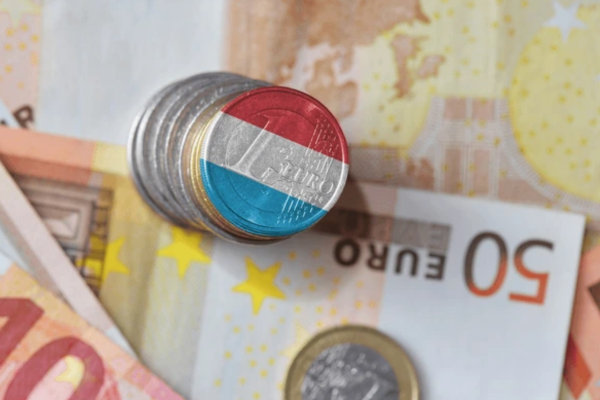
Luxembourg also issues euro coins with a Luxembourg national design on one side. These coins are still valid everywhere in the euro area, meaning a coin minted in Luxembourg can be spent in other euro countries and vice versa.
How Do You Pay In Luxembourg?
Luxembourg is modern and card friendly, so card payments are widely accepted in many places. Still, it helps to keep some cash for small purchases, local markets, or situations where card minimums exist.
If you are arriving from outside the euro area, you will usually get euros via ATM withdrawal or currency exchange. Either way, your goal is simple. You want to hold EUR for daily use since it is the country’s legal tender.
How Luxembourg’s Currency Impacts Forex Markets
The euro connects Luxembourg to one of the biggest currency markets in the world.
The Euro Is A Major Forex Currency
Luxembourg uses the euro, and the euro is one of the most traded currencies in the world. The Bank for International Settlements reported that global FX trading reached $9.6 trillion per day in April 2025, with the euro among the most traded currencies in that market.
This matters because the Euro is linked to a deep global market. That affects exchange rates, hedging costs, and the way international businesses and investors manage exposure.
EUR USD Is The Reference Pair Many People Watch
In forex, currencies are quoted in pairs. One of the most watched pairs globally is EUR USD, which reflects how many US dollars one euro can buy.
If EUR USD rises, it means the euro is stronger versus the dollar
If EUR USD falls, it means the euro is weaker versus the dollar
For people in Luxembourg, this can matter when paying for dollar priced goods or services, traveling outside the euro area, investing in US assets, or running a business with USD revenue or costs.
A Quick Safety Note For Retail Forex
Regulators regularly warn that forex and leveraged products can carry significant risks, especially when dealing with unauthorised firms or scams.
Luxembourg’s financial regulator, the CSSF, maintains a public warnings section and also publishes investor warnings related to forex and similar high risk products.
The CSSF has also published warnings about specific entities it says are not authorised to provide investment services in or from Luxembourg.
Conclusion
To wrap it up clearly, what currency does Luxembourg use? Luxembourg uses the euro (€), currency code EUR.
If you are looking at this from a trading perspective, the fact that Luxembourg uses EUR also means its currency is deeply linked to the global forex market, where EUR pairs like EUR/USD are closely watched by traders worldwide.
FAQ
Can you use US dollars or British pounds in Luxembourg?
Generally, day to day pricing and payments are in euros. Some places may accept another currency informally, but it is not standard and the rate may be unfavorable. The practical answer is to carry or access EUR.
Is Luxembourg in the eurozone?
Yes. Luxembourg is part of the euro area and uses the euro as its official currency.
When did Luxembourg start using the euro
Euro banknotes and coins were introduced on January 1, 2002, and the dual circulation period ended on February 28, 2002.
Share Now
Disclaimer:This content is provided for informational purposes only and does not constitute, and should not be construed as, financial, investment, or other professional advice. No statement or opinion contained herein should be considered a recommendation by Ultima Markets or the author regarding any specific investment product, strategy, or transaction. Readers are advised not to rely solely on this material when making investment decisions and should seek independent advice where appropriate.
Thank you for visiting the Ultima Markets website. Please note that this website is intended for individuals residing in jurisdictions where access is permitted by law. Ultima and its affiliated entities do not operate in your home jurisdiction.
By clicking ‘Acknowledge’, you confirm that you are entering this website solely on your own initiative and not as a result of any specific marketing outreach. You wish to obtain information from this website based on reverse solicitation principles, in accordance with the applicable laws of your home jurisdiction.