This website is managed by Ultima Markets’ international entities, and it’s important to emphasise that they are not subject to regulation by the FCA in the UK. Therefore, you must understand that you will not have the FCA’s protection when investing through this website – for example:
You will not be guaranteed Negative Balance Protection
You will not be protected by FCA’s leverage restrictions
You will not have the right to settle disputes via the Financial Ombudsman Service (FOS)
You will not be protected by Financial Services Compensation Scheme (FSCS)
Any monies deposited will not be afforded the protection required under the FCA Client Assets Sourcebook. The level of protection for your funds will be determined by the regulations of the relevant local regulator.
Note: UK clients are kindly invited to visit https://www.ultima-markets.co.uk/. Ultima Markets UK expects to begin onboarding UK clients in accordance with FCA regulatory requirements in 2026.
If you would like to proceed and visit this website, you acknowledge and confirm the following:
1.The website is owned by Ultima Markets’ international entities and not by Ultima Markets UK Ltd, which is regulated by the FCA.
2.Ultima Markets Limited, or any of the Ultima Markets international entities, are neither based in the UK nor licensed by the FCA.
3.You are accessing the website at your own initiative and have not been solicited by Ultima Markets Limited in any way.
4.Investing through this website does not grant you the protections provided by the FCA.
5.Should you choose to invest through this website or with any of the international Ultima Markets entities, you will be subject to the rules and regulations of the relevant international regulatory authorities, not the FCA.
Ultima Markets wants to make it clear that we are duly licensed and authorised to offer the services and financial derivative products listed on our website. Individuals accessing this website and registering a trading account do so entirely of their own volition and without prior solicitation.
By confirming your decision to proceed with entering the website, you hereby affirm that this decision was solely initiated by you, and no solicitation has been made by any Ultima Markets entity.
Ultima Markets does not have an establishment in Singapore and does not operate from Singapore.
Ultima Markets does not provide products or services to citizens or residents of Singapore, and account applications from Singapore citizens or residents will not be accepted.
If you are a citizen or resident of Singapore, please do not open an account or use Ultima Markets’ products or services.
By selecting “Acknowledge and Continue Browsing”, you confirm that you are accessing this website on your own initiative and that your access is not the result of any direct marketing, targeted advertising, solicitation, or promotional activity by Ultima Markets.
Nothing on this website constitutes an offer, solicitation, or promotion of products or services in any jurisdiction where such activity is prohibited. You are responsible for ensuring that your access to and use of this website complies with applicable local laws and regulations.
Is Disney a good stock to buy? Read about its performance, growth potential, and its risks to help you decide if Disney is the right investment for 2026.
Is Disney A Good Stock to Buy Or Not?
If you’re wondering is Disney a good stock to buy, then the answer is yes. Particularly, Disney is a good stock to buy for long-term investors. Despite recent challenges in its streaming division, Disney has a diversified portfolio, including its theme parks, movies, and media networks, which provide stability and growth potential.
In 2026, Disney’s ongoing investment in streaming services, content production, and international expansion could drive future growth. However, competition in streaming and global economic risks should be considered before buying. Always assess your risk tolerance and consult a financial advisor before making any investment decisions.
What Does the Company Disney Do?
We’ve all heard of Disney. Before deciding whether is Disney a good stock to buy, it’s important to first understand the bigger picture of what the company does. The Walt Disney Company is a global entertainment conglomerate with operations across various sectors:
Media Networks
Disney owns and operates popular media networks like ABC, ESPN, and Disney Channel. It also owns streaming services like Disney+, ESPN+, and Hulu.
Entertainment and Film Production
Disney is known for producing blockbuster films, including franchises like Marvel Studios, Star Wars, Pixar, and Disney Animation. The company has a strong presence in both animated and live-action film production.
Theme Parks and Resorts
Disney operates iconic theme parks, including Disneyland and Disney World, along with resorts and hotels. These parks offer immersive experiences based on Disney’s films, characters, and franchises.
Consumer Products
Disney produces a wide range of merchandise, from toys to apparel, based on its characters and intellectual properties. The company also generates revenue through licensing deals.
Interactive Media and Video Games
Disney develops video games and interactive media based on its films, characters, and franchises. This includes mobile apps and online games for consumers of all ages.
Overall, Disney is a diversified entertainment company that creates, distributes, and licenses content across a variety of platforms, including TV, film, theme parks, and consumer products.
Recent Walt Disney Co Stock Price Performance
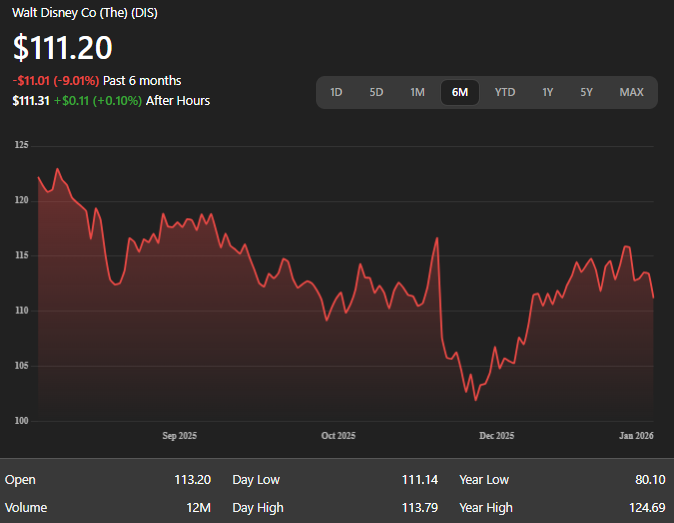
Based on Disney’s recent stock performance, the company has shown moderate volatility in early 2026, with its stock fluctuating between approximately $110 and $116 in mid-January.
Despite these fluctuations, Disney has maintained a relatively stable position within a broader range of $80 to $124 over the past year.
As of mid-January 2026, Disney’s stock price is hovering around $113, reflecting a slight upward movement, but the overall trend appears flat when compared to the broader market’s performance.
Analysts remain cautiously optimistic, with a consensus 12-month price target of around $135, suggesting a potential 20% upside from its current level.
This potential growth is attributed to Disney’s diversified revenue streams, including its media networks, streaming platforms like Disney+, and theme parks, which are expected to continue contributing to long-term growth. However, the stock still faces challenges, such as heightened competition in the streaming space and economic risks, which could weigh on its short-term performance.
Overall, Disney’s stock presents a solid long-term investment opportunity, especially for those looking for a company with diversified revenue sources, though investors should be mindful of the risks that could impact its stock in the near future.
Disney’s Financial Health and Market Performance
Q4 2025 Earnings (Fiscal Year 2025):
Revenue: Disney reported $23.3 billion in revenue for Q4 2025, a 9% increase year-over-year. This growth was primarily driven by the strong performance in its media networks and theme parks.
Net Income: Disney’s net income for Q4 was $2.2 billion, an increase from the previous quarter, mainly due to the recovery of its theme park segment and growth in its streaming business.
EPS (Earnings Per Share): Disney posted an EPS of $1.18, above analyst expectations.
Disney’s stock has been volatile, dropping significantly from its highs in 2021. As of January 2026, Disney is trading around $113, reflecting the market’s mixed outlook on its streaming and media segments. The stock has underperformed the broader market in recent months due to investor concerns about its ability to compete in the highly competitive streaming space and the broader economic pressures.
In conclusion, Disney is seeing positive growth in its theme parks and media networks, but its streaming services continue to face headwinds in terms of both competition and profitability. As Disney invests heavily in new content and international expansion, the company’s ability to execute its strategies will determine its financial health and stock performance moving forward.
Why Has Disney Stock Dropped So Much
Disney’s stock has experienced significant drops in recent years due to several key factors:
Streaming Struggles
Disney+ was initially seen as a strong competitor to platforms like Netflix, but growth has slowed, and profitability in its streaming segment has been under pressure. Disney has faced challenges in maintaining subscriber growth and dealing with the high costs associated with content production and licensing. Increased competition from other streaming giants like Netflix, Amazon Prime, and HBO Max has also contributed to this decline.
Theme Park and Resort Issues
While Disney’s theme parks are a major revenue driver, they have faced disruptions from global events like the COVID-19 pandemic, which led to temporary closures, reduced attendance, and increased operating costs. Even as parks have recovered, inflation and rising consumer costs have affected discretionary spending, which could impact future park revenues.
Economic Pressures
Broader economic concerns, such as inflation, global economic uncertainty, and fluctuating consumer behavior, have impacted the stock market, including Disney. Rising interest rates and recession fears have made investors more cautious, affecting Disney’s stock performance along with many other companies.
Management Changes and Strategic Shifts
Disney has gone through several leadership changes, and investors have been concerned about the company’s ability to execute its strategies. Changes in leadership, including the return of Bob Iger as CEO, created some uncertainty in the market regarding the company’s long-term direction, especially when it comes to its content creation and digital services.
Content Costs and Profitability Concerns
Disney has continued to invest heavily in content for its streaming platforms, leading to high costs. While some of these investments have paid off with successful shows and movies, the overall profitability of its streaming division remains a concern, especially as competition grows and the market for streaming services stabilizes.
These factors combined have contributed to a challenging environment for Disney, leading to a decline in its stock price in recent times. However, Disney’s diverse business model and strong brand recognition give it long-term potential, but investors will need to see how it navigates these challenges moving forward.
Netflix vs. Walt Disney: Which Stock Is Better?
For high-risk, high-reward investors, Netflix may provide more growth potential but at a higher risk. For stability and diversification, Disney offers a better long-term investment with less reliance on a single sector.
When comparing Netflix and Walt Disney stocks, the better choice depends on your investment goals and risk tolerance:
Netflix: Netflix has a strong focus on global streaming, with a massive subscriber base. However, the company faces intense competition and is undergoing a transformation to remain profitable in an increasingly crowded market. Netflix’s stock may appeal to those looking for growth potential, but it comes with higher volatility due to its reliance on the streaming industry.
Walt Disney: Disney offers a diversified portfolio, including streaming (Disney+), theme parks, movies, and media networks. This diversification reduces risk, as Disney’s revenue isn’t solely dependent on streaming. Disney’s stock may be a better choice for those looking for stability and long-term growth, particularly with its strong brand and multiple revenue streams.
Conclusion
With its diversified portfolio, strong brand, and potential growth in streaming and theme parks, Disney remains an attractive option for long-term investors. However, the challenges in its streaming division and broader market conditions suggest that a hold strategy might be best for now.
If you’re interested in trading Disney shares and other stocks, Ultima Markets offers an excellent platform for share trading. With advanced tools, real-time market data, and a seamless interface, Ultima Markets allows you to track and trade stocks like Disney easily.
Not sure if you’re ready to trade? Open a demo account with Ultima Markets to practice risk-free. Whether you’re exploring Disney or other stocks, you can hone your trading skills and develop strategies without any financial risk. Start your trading journey today with Ultima Markets!
FAQs
Is Disney a Buy or Hold?
Hold. Disney’s stock is generally considered a hold for long-term investors, given its strong brand and diversified portfolio. While it faces challenges in its streaming division, the company’s solid performance in theme parks and media networks provides stability. Investors should monitor its progress in streaming and content costs before making a buying decision.
Is Disney a good stock to buy or not?
Disney can be a solid investment due to its strong brand and diverse operations, but market conditions and performance in areas like streaming can affect its stock. Always research or consult an advisor before investing.
Is Disney a High Dividend Stock?
No, Disney is not a high dividend stock. While Disney has historically paid dividends, its current yield is lower than many other dividend-focused stocks. Disney suspended its dividend payments in 2020 due to the financial impact of the pandemic, and as of now, the company has not yet reinstated a high dividend payout.
Share Now
Disclaimer:This content is provided for informational purposes only and does not constitute, and should not be construed as, financial, investment, or other professional advice. No statement or opinion contained herein should be considered a recommendation by Ultima Markets or the author regarding any specific investment product, strategy, or transaction. Readers are advised not to rely solely on this material when making investment decisions and should seek independent advice where appropriate.
Thank you for visiting the Ultima Markets website. Please note that this website is intended for individuals residing in jurisdictions where access is permitted by law. Ultima and its affiliated entities do not operate in your home jurisdiction.
By clicking ‘Acknowledge’, you confirm that you are entering this website solely on your own initiative and not as a result of any specific marketing outreach. You wish to obtain information from this website based on reverse solicitation principles, in accordance with the applicable laws of your home jurisdiction.