This website is managed by Ultima Markets’ international entities, and it’s important to emphasise that they are not subject to regulation by the FCA in the UK. Therefore, you must understand that you will not have the FCA’s protection when investing through this website – for example:
You will not be guaranteed Negative Balance Protection
You will not be protected by FCA’s leverage restrictions
You will not have the right to settle disputes via the Financial Ombudsman Service (FOS)
You will not be protected by Financial Services Compensation Scheme (FSCS)
Any monies deposited will not be afforded the protection required under the FCA Client Assets Sourcebook. The level of protection for your funds will be determined by the regulations of the relevant local regulator.
Note: UK clients are kindly invited to visit https://www.ultima-markets.co.uk/. Ultima Markets UK expects to begin onboarding UK clients in accordance with FCA regulatory requirements in 2026.
If you would like to proceed and visit this website, you acknowledge and confirm the following:
1.The website is owned by Ultima Markets’ international entities and not by Ultima Markets UK Ltd, which is regulated by the FCA.
2.Ultima Markets Limited, or any of the Ultima Markets international entities, are neither based in the UK nor licensed by the FCA.
3.You are accessing the website at your own initiative and have not been solicited by Ultima Markets Limited in any way.
4.Investing through this website does not grant you the protections provided by the FCA.
5.Should you choose to invest through this website or with any of the international Ultima Markets entities, you will be subject to the rules and regulations of the relevant international regulatory authorities, not the FCA.
Ultima Markets wants to make it clear that we are duly licensed and authorised to offer the services and financial derivative products listed on our website. Individuals accessing this website and registering a trading account do so entirely of their own volition and without prior solicitation.
By confirming your decision to proceed with entering the website, you hereby affirm that this decision was solely initiated by you, and no solicitation has been made by any Ultima Markets entity.
Ultima Markets does not have an establishment in Singapore and does not operate from Singapore.
Ultima Markets does not provide products or services to citizens or residents of Singapore, and account applications from Singapore citizens or residents will not be accepted.
If you are a citizen or resident of Singapore, please do not open an account or use Ultima Markets’ products or services.
By selecting “Acknowledge and Continue Browsing”, you confirm that you are accessing this website on your own initiative and that your access is not the result of any direct marketing, targeted advertising, solicitation, or promotional activity by Ultima Markets.
Nothing on this website constitutes an offer, solicitation, or promotion of products or services in any jurisdiction where such activity is prohibited. You are responsible for ensuring that your access to and use of this website complies with applicable local laws and regulations.
The Iranian rial has collapsed due to sanctions, inflation, and unrest. Find out why its value dropped sharply in January 2026 and what it means for
The currency of Iran has hit near-zero levels. Discover why the Iran currency crash happened, the risks as well as the factors driving the Rial collapse.
What Happened to the Currency of Iran?
The currency of Iran, the Iranian rial (IRR) has long been at the center of economic turbulence in Iran. However, its decline has reached alarming levels in recent years. While it hasn’t technically hit zero, the rial’s value is so close to it that it is increasingly regarded as functionally worthless.
The causes of this collapse are complex, involving a combination of international sanctions, runaway inflation, political mismanagement, and ongoing unrest. Let’s explore these factors in greater detail to understand what led to the Iran currency crash and its devastating impact on the country.
Factors Behind the Iran Currency Crash
Sanctions and Systemic Pressures
The Iran currency crash is largely driven by decades of international sanctions. Starting with the 1979 revolution, and escalating after the U.S. left the nuclear deal in 2018, sanctions crippled Iran’s ability to export oil, access global markets, and stabilize its economy. These sanctions have put significant pressure on the rial, causing inflation to skyrocket and triggering a currency collapse.
Inflation and Mismanagement
One of the most significant drivers of the Iran currency crash is runaway inflation. By 2025, inflation in Iran was expected to average around 42%, up from 33% in 2024, according to the IMF. This staggering inflation rate has drastically reduced the purchasing power of the rial, with basic goods becoming prohibitively expensive for many Iranians. Coupled with chronic mismanagement, these economic conditions have compounded the rial’s rapid depreciation.
The IMF also predicts that inflation will continue to rise, worsening the economic outlook for Iran and its citizens. Iranians are struggling with skyrocketing food prices, with some reports indicating that half the population was consuming less than the standard 2,100 daily calories as of 2022 due to rising costs.
Declining Oil Prices
Another major factor contributing to the Iran currency crash is the decline in oil prices. Brent crude, the global benchmark, dropped by 18% in 2025, falling to about $60 per barrel, far below the $165 needed for Iran’s government to balance its budget, according to the IMF.
Despite sitting on vast oil reserves, most of Iran’s crude is off-limits to foreign buyers due to US-led sanctions. These sanctions, imposed since the 1979 US embassy seizure and intensified in the 2000s over nuclear concerns, have left Iran without essential foreign investment and modern technology. This lack of access to foreign markets and oil revenue has further pressured the rial and deepened the country’s economic crisis.
The Iran-Iraq War (Rhia)
The Iran-Iraq War (1980-1988), also known as Rhia, had a long-lasting effect on Iran’s economy. The war drained the nation’s resources, forcing the government to print more money to finance military spending. This caused inflation and further weakened the rial. The war also led to international sanctions, isolating Iran from global trade, further undermining its currency.
Current Unrest and Conflict
While Iran is not currently engaged in a full-scale war, ongoing regional conflicts and domestic unrest have worsened the economic situation. The 2025–2026 protests sparked by rising inflation, the depreciation of the rial, and severe economic hardship have further destabilised the country. These protests reflect public frustration over the rial’s collapse, as prices soar and savings evaporate.
Additionally, military tensions with Israel and other regional powers have increased economic uncertainty, making it even harder for Iran to attract foreign investment. These geopolitical tensions and domestic unrest only add fuel to the fire, pushing the rial to its current crisis point.
How Weak Is the Iranian Rial Today?
The scale of the Iran currency crash is staggering. In early January 2026, the exchange rate reached an all-time low, with 1 USD equaling approximately 1.4 to 1.5 million IRR in the open market, according to multiple international media reports. This represents the weakest level ever recorded for the rial.
1 USD = ~1.4 million IRR (on the open market)
1 EUR = ~49,000 IRR
1 IRR = $0.0000010 USD (1 millionth of a dollar)
At these exchange rates, the rial has essentially lost almost all its purchasing power, especially when compared to major global currencies like the USD or EUR. To put it into perspective, 100,000 IRR is only worth about $0.10 USD. This is a clear indication of just how far the rial has fallen.
The Iranian Rial Hit Zero
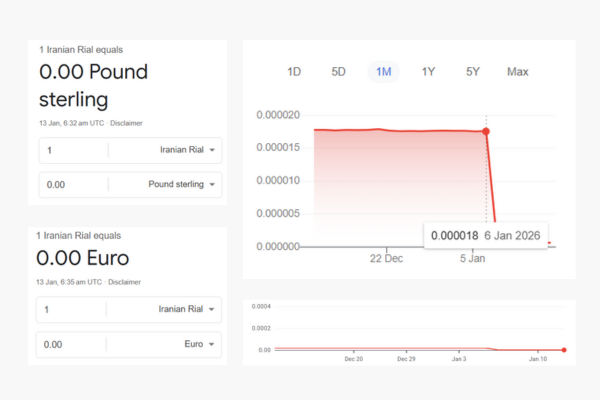
Interestingly, when you search for the exchange rate of 1 IRR on platforms like Google, it may appear as though 1 Iranian rial equals zero when converting to major currencies like EUR and GBP. This is because the rial’s value is so low that Google rounds it down to zero for easier display.
For example, 1 IRR might show as 0 EUR or 0 GBP, but when converted to currencies like the Japanese yen (JPY) or the Chinese yuan (CNY), you will see values like 0.00014 JPY or 0.00000 CNY for 1 IRR. While these values are still tiny, they demonstrate that the rial’s value is measurable, even if it is extremely low.
This rounding effect shows how little the rial is worth on the global market, and how functionally worthless it has become in real-world exchanges.
Risks of the Iran Currency Crash & Further Devaluation
The Iran currency crash has brought with it significant risks, some of which are likely to continue if the situation isn’t addressed.
1. Accelerating Inflation
With inflation already surpassing 40%, the situation is expected to worsen. As the rial continues to lose value, basic goods will become even more expensive. This erodes real household income and makes it increasingly difficult for Iranians to maintain a decent standard of living.
2. Increased Poverty
As inflation outpaces wages, poverty levels in Iran have risen. Many Iranians are now forced to turn to foreign currencies or gold to preserve their wealth. In extreme cases, individuals have converted their savings into real estate or property to protect against further devaluation. The middle class has been hardest hit, with many falling into poverty as the value of the rial continues to plummet.
3. Social Unrest and Protests
The economic turmoil driven by the Iran currency crash has sparked widespread protests. In late 2025, demonstrations erupted in major cities like Tehran, Shiraz, and Mashhad, primarily driven by currency losses and rising prices.
These protests have expanded into political grievances, with many citizens expressing frustration over economic mismanagement and government corruption. The protests are becoming increasingly violent, with authorities responding with crackdowns, adding to the already fragile economic environment. This growing social unrest only adds to the uncertainty, making it harder for the country to recover.
4. Geopolitical Instability
In addition to domestic unrest, the Iran currency crash has heightened geopolitical risks. Falling oil prices and sanctions have strained Iran’s relationships with major trading partners like China and the UAE. The economic instability in Iran could spill over into neighboring countries, increasing geopolitical tensions in the region.
What Is Being Done to Address the Crisis?
Iran has explored a few measures to mitigate the impact of the rial’s collapse. One of the most prominent attempts has been redenomination: removing zeros from the currency to make it seem more manageable.
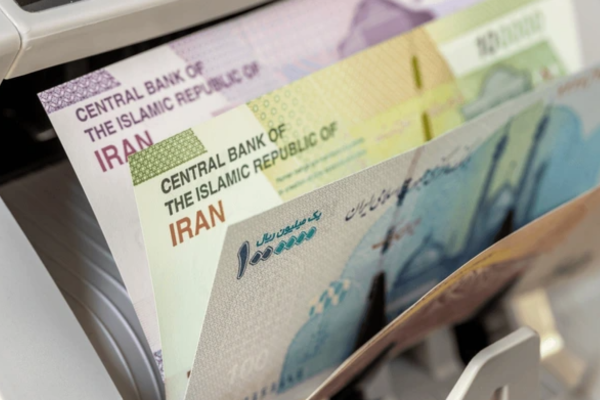
However, this move is largely symbolic, as it doesn’t restore the rial’s underlying value. A 1,000,000 rial note might be redenominated as a 1 new toman note, but the actual purchasing power of the currency doesn’t improve.
Unless Iran can secure substantial economic reforms, reduce its reliance on oil exports, and resolve its ongoing political isolation, the rial is unlikely to recover any time soon.
Is the Currency of Rial Worthless Now?
The Iran currency crash has effectively rendered the rial worthless for many practical purposes. With the rial’s value dropping to $0.0000010 USD, it has become nearly impossible for Iranians to use the currency for anything meaningful in daily life.
While the rial has not technically hit zero, its rapid decline and the ongoing economic turmoil have made it functionally worthless. Until Iran can implement significant economic and political reforms, the rial is unlikely to regain its former value. For now, the Iran currency crash stands as a stark reminder of the dangers of economic mismanagement, geopolitical isolation, and the erosion of public trust in a currency.
FAQ
Why has the Iranian rial lost so much value?
The rial has collapsed due to sanctions, inflation, and economic mismanagement, leading to a dramatic loss in purchasing power.
What is the current exchange rate of the Iranian rial?
As of early 2026, the rial is trading at approximately 1 USD = 1.4 million IRR, and the rial is often rounded to zero on digital platforms due to its extreme devaluation.
Is the Iranian rial officially worthless?
The rial has not technically hit zero, but its value has become so low that it is effectively worthless for most practical purposes.
Share Now
Disclaimer:This content is provided for informational purposes only and does not constitute, and should not be construed as, financial, investment, or other professional advice. No statement or opinion contained herein should be considered a recommendation by Ultima Markets or the author regarding any specific investment product, strategy, or transaction. Readers are advised not to rely solely on this material when making investment decisions and should seek independent advice where appropriate.
Thank you for visiting the Ultima Markets website. Please note that this website is intended for individuals residing in jurisdictions where access is permitted by law. Ultima and its affiliated entities do not operate in your home jurisdiction.
By clicking ‘Acknowledge’, you confirm that you are entering this website solely on your own initiative and not as a result of any specific marketing outreach. You wish to obtain information from this website based on reverse solicitation principles, in accordance with the applicable laws of your home jurisdiction.