
Ultima Markets App
Trade Anytime, Anywhere





Important Information
This website is managed by Ultima Markets’ international entities, and it’s important to emphasise that they are not subject to regulation by the FCA in the UK. Therefore, you must understand that you will not have the FCA’s protection when investing through this website – for example:
- You will not be guaranteed Negative Balance Protection
- You will not be protected by FCA’s leverage restrictions
- You will not have the right to settle disputes via the Financial Ombudsman Service (FOS)
- You will not be protected by Financial Services Compensation Scheme (FSCS)
- Any monies deposited will not be afforded the protection required under the FCA Client Assets Sourcebook. The level of protection for your funds will be determined by the regulations of the relevant local regulator.
Note: Ultima Markets is currently developing a dedicated website for UK clients and expects to onboard UK clients under FCA regulations in 2026.
If you would like to proceed and visit this website, you acknowledge and confirm the following:
- 1.The website is owned by Ultima Markets’ international entities and not by Ultima Markets UK Ltd, which is regulated by the FCA.
- 2.Ultima Markets Limited, or any of the Ultima Markets international entities, are neither based in the UK nor licensed by the FCA.
- 3.You are accessing the website at your own initiative and have not been solicited by Ultima Markets Limited in any way.
- 4.Investing through this website does not grant you the protections provided by the FCA.
- 5.Should you choose to invest through this website or with any of the international Ultima Markets entities, you will be subject to the rules and regulations of the relevant international regulatory authorities, not the FCA.
Ultima Markets wants to make it clear that we are duly licensed and authorised to offer the services and financial derivative products listed on our website. Individuals accessing this website and registering a trading account do so entirely of their own volition and without prior solicitation.
By confirming your decision to proceed with entering the website, you hereby affirm that this decision was solely initiated by you, and no solicitation has been made by any Ultima Markets entity.
I confirm my intention to proceed and enter this website Please direct me to the website operated by Ultima Markets , regulated by the FCA in the United Kingdom

Will China’s LandSpace Challenge SpaceX?
If you’re searching “landspace”, you might be wondering the bigger question behind the name.
Can China’s LandSpace really challenge Elon Musk’s SpaceX, or is it still years away from matching SpaceX’s reusable rocket playbook?
That’s exactly what this article unpacks. We’ll look at why LandSpace Technology Corporation, a Beijing based private rocket company, is being compared to SpaceX in the first place, and what it has actually proven so far.
What Does LandSpace Do?
LandSpace is one of the commercial space startups that emerged after China opened parts of its space sector to private capital in 2014. It aims to provide domestic launch services at a lower cost and higher frequency than traditional state led approaches, with reusability as the long term lever.
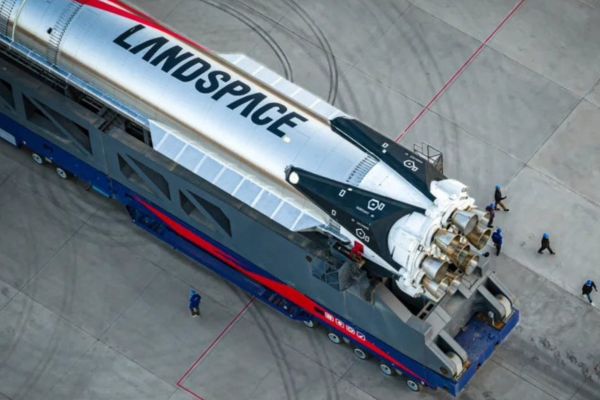
In practical terms, landspace is trying to build the kind of launch cadence that supports large scale satellite projects, where the cost per launch and the ability to fly often matter as much as raw performance. Reuters links that direction to China’s ambition to deploy massive satellite constellations in the coming decades.
Why Methane Matters In LandSpace’s Strategy
LandSpace’s rockets are strongly associated with methalox, meaning methane plus liquid oxygen. This choice is not just about novelty. Methane is widely seen as a strong fit for modern reusable rocket designs, partly because it supports cleaner operations and reuse friendly engineering choices.
LandSpace itself has framed methane engines as especially suited to reusable rockets, while acknowledging that harnessing them at orbital scale is technically difficult.
Zhuque 2 Put LandSpace On The Global Map
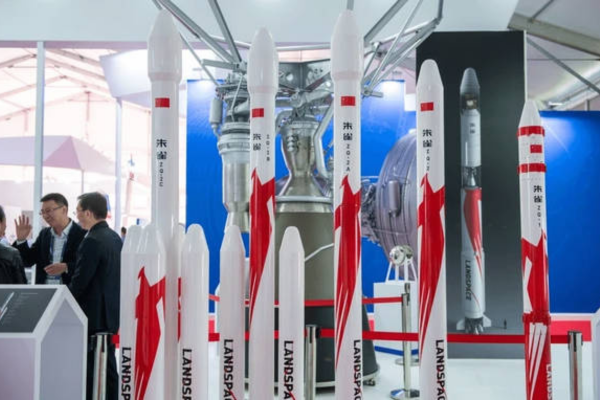
The milestone that put landspace on the world stage came in July 2023, when Zhuque 2 reached orbit and was widely described as the first successful orbital launch using methane and liquid oxygen.
That achievement mattered beyond the headline. It showed LandSpace could build and operate advanced cryogenic propulsion systems, which is the technical base you need before you can even start serious reusability testing.
Zhuque 2E Shows Iteration Not Just Headlines
LandSpace continued iterating. In May 2025 the improved Zhuque 2E deployed six satellites, and the report highlighted technical work such as using super chilled propellants to increase thrust.
Real credibility also comes from acknowledging setbacks. Public launch records and reporting indicate an August 2025 Zhuque 2E flight suffered an anomaly, which is a reminder that reliability is earned through repeated flights and lessons learned, not just a single milestone mission.
Zhuque 3 Is Where LandSpace Tests Reusability
If Zhuque 2 proved methane to orbit, Zhuque 3 is the attempt to prove something harder: a reusable first stage.
Reuters describes Zhuque 3 as a larger stainless steel rocket designed to carry roughly 20 to 25 tonnes to low Earth orbit and built with reusability in mind.
What Happened On December 3, 2025
In Zhuque 3’s maiden flight on December 3, 2025, LandSpace attempted a full recovery sequence. The mission did not end with a successful landing. Reuters reported the booster was not able to activate its planned landing burn about 3 km above the ground, and it crashed rather than completing a controlled landing.
This detail matters because it clarifies the gap LandSpace is trying to close. Reusability is not a single “yes or no” capability. It is a chain of events, and Zhuque 3 is now working through the hardest part of that chain.
A Culture Shift In How China Treats Failure
One of the most interesting parts of the LandSpace story is not just hardware, but mindset.
Many competitor pages skip this angle. LandSpace’s Zhuque 3 chief designer Dai Zheng described SpaceX’s ability to push to failure, identify limits, and iterate quickly, contrasting it with the more risk averse traditions of China’s state dominated space sector.
The fact that failed recovery attempts have been discussed more openly in Chinese coverage suggests the ecosystem is gradually getting more comfortable with trial, error, and rapid improvement.
Why LandSpace Keeps Getting Compared With SpaceX
LandSpace’s SpaceX comparison comes from two places.
First, it is the design logic. LandSpace has openly studied what works, especially the Falcon 9 style approach to a recoverable first stage, and framed it as learning rather than copying.
Second, it is the market logic. SpaceX proved that the biggest cost saver is not a slightly better engine, it is reuse and cadence. Reuters notes SpaceX’s Falcon 9 cadence is about 150 launches a year, while China’s entire rocket industry combined is around 100 launches in a year, highlighting how large the gap is in industrial ecosystem and operational tempo.
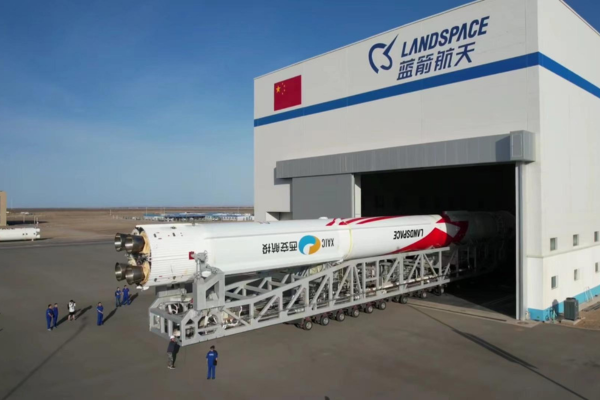
Elon Musk has also commented publicly on Zhuque 3’s design direction, recognising the blend of modern materials and methalox propulsion with a Falcon 9 style architecture, while also emphasising that SpaceX’s next generation system sits in another league. This is useful context because it frames landspace as a serious learner in the reusable era, without implying it is already on SpaceX’s level.
IPO And Policy Support
Reusable rocket development is expensive because it requires repeated test flights, rapid redesign, and accepting failures along the way. That is why LandSpace’s IPO planning and the broader policy push to help commercial space firms access capital markets have become part of the story.
In simple terms, reusability is not only an engineering challenge. It is also a funding challenge. The faster LandSpace can fund test cadence, the faster it can improve landing reliability and move from prototypes to repeatable operations.
What To Watch Next
If you want a simple checklist for 2026, here’s what to watch:
Mid 2026 Zhuque 3 follow up flight
A second test flight targeting a successful booster recovery and landing.
A reused booster milestone
If recovery succeeds, LandSpace has indicated it aims to fly a reused first stage on the fourth flight.
Launch cadence
LandSpace has outlined a plan for around 10 launches in 2026 across its models, which will be a key signal of production and operational maturity.
Conclusion
LandSpace has already proven it can do something that once seemed out of reach for a private Chinese startup: reach orbit with a methane fuelled rocket and iterate into improved variants. Now it is in the most difficult phase, where success is defined by a booster that comes back safely and can fly again.
If landspace achieves a controlled booster recovery in 2026 and follows it with a reused booster flight, the story stops being about comparisons and starts being about performance. That is the moment LandSpace moves from “promising” to “proven.”
Disclaimer: This content is provided for informational purposes only and does not constitute, and should not be construed as, financial, investment, or other professional advice. No statement or opinion contained here in should be considered a recommendation by Ultima Markets or the author regarding any specific investment product, strategy, or transaction. Readers are advised not to rely solely on this material when making investment decisions and should seek independent advice where appropriate.
Latest Articles


FOLLOW US






Ultima Markets is a member of The Financial Commission, an international independent body responsible for resolving disputes in the Forex and CFD markets.

All clients of Ultima Markets are protected under insurance coverage provided by Willis Towers Watson (WTW), a global insurance brokerage established in 1828, with claims eligibility up to US$1,000,000 per account.

Ultima Markets is the first United CFD broker to be part of the United Nations Global Compact.
FOLLOW US
TRADE WITH US
RISK DISCLOSURE
Risk Warning:
Trading leveraged financial products, including Contracts for Difference (CFDs), carries a high level of risk and may result in losses exceeding your initial investment. These products are not suitable for all investors and should only be traded with funds you can afford to lose. You do not own or have any rights to the underlying assets of these derivatives (e.g., entitlement to dividends). Please ensure you fully understand the associated risks. Before trading, consider your level of experience, investment objectives, and seek independent financial advice if necessary. Refer to our legal documents and disclosures before making any trading decisions.
General Advice Warning:
The information provided on this website is general in nature and does not take into account your personal objectives, financial situation, or needs. Before acting on any advice, you should assess its appropriateness in light of your individual circumstances and consult our legal documentation.
Regional Restrictions:
The information and services on this website are not intended for residents of certain jurisdictions, including but not limited to the United States, United Kingdom, Singapore, and any jurisdictions subject to international sanctions. For further information, please contact our customer support team.
Regulatory Information:
Ultima Markets is a trading name shared amongst multiple entities operating in various jurisdictions. These following entities are authorised to operate under the Ultima Markets brand and trademarks.
-
Ultima Markets UK Limited, reference number 470325, is authorised and regulated by the Financial Conduct Authority (FCA). Registered address: 1 Blossom Yard, Fourth Floor, London, E1 6RS, UNITED KINGDOM.
-
Ultima Markets Ltd is authorised and regulated by the Financial Services Commission (FSC) of Mauritius as a Full-Service Investment Dealer (excluding Underwriting), under licence number GB 23201593.
Registered address: 2nd Floor, The Catalyst, 40 Silicon Avenue, Ebene Cybercity, 72201, Mauritius.

Copyright © 2025 Ultima Markets Ltd. All rights reserved.
-

Messenger


Continue on Messenger
Take the conversation to your Messenger account. You can return anytime.
Scan the QR code and then send the message that appears in your Messenger.
Open Messenger on this device.
-

Instagram

Continue on Instagram
Take the conversation to your Instagram account. You can return anytime.
Scan the QR code to open Instagram. Follow @ultima_markets to send a DM.
Open Instagram on this device.
-

Live Chat
-

