This website is managed by Ultima Markets’ international entities, and it’s important to emphasise that they are not subject to regulation by the FCA in the UK. Therefore, you must understand that you will not have the FCA’s protection when investing through this website – for example:
You will not be guaranteed Negative Balance Protection
You will not be protected by FCA’s leverage restrictions
You will not have the right to settle disputes via the Financial Ombudsman Service (FOS)
You will not be protected by Financial Services Compensation Scheme (FSCS)
Any monies deposited will not be afforded the protection required under the FCA Client Assets Sourcebook. The level of protection for your funds will be determined by the regulations of the relevant local regulator.
Note: UK clients are kindly invited to visit https://www.ultima-markets.co.uk/. Ultima Markets UK expects to begin onboarding UK clients in accordance with FCA regulatory requirements in 2026.
If you would like to proceed and visit this website, you acknowledge and confirm the following:
1.The website is owned by Ultima Markets’ international entities and not by Ultima Markets UK Ltd, which is regulated by the FCA.
2.Ultima Markets Limited, or any of the Ultima Markets international entities, are neither based in the UK nor licensed by the FCA.
3.You are accessing the website at your own initiative and have not been solicited by Ultima Markets Limited in any way.
4.Investing through this website does not grant you the protections provided by the FCA.
5.Should you choose to invest through this website or with any of the international Ultima Markets entities, you will be subject to the rules and regulations of the relevant international regulatory authorities, not the FCA.
Ultima Markets wants to make it clear that we are duly licensed and authorised to offer the services and financial derivative products listed on our website. Individuals accessing this website and registering a trading account do so entirely of their own volition and without prior solicitation.
By confirming your decision to proceed with entering the website, you hereby affirm that this decision was solely initiated by you, and no solicitation has been made by any Ultima Markets entity.
Learn the Turtle Trading Strategy, a mechanical trend-following system that enters on breakouts, helping traders capture trends while managing risk.
Turtle Trading Strategy Made Simple
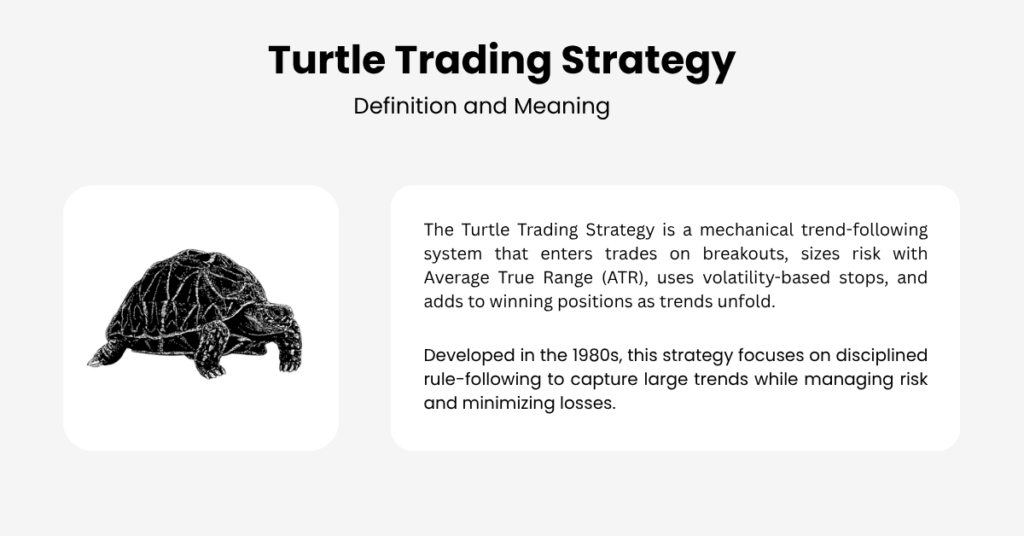
Ever heard about the turtle trading strategy? The turtle trading strategy is described as a simple trend approach that enters on breakouts, sizes risk with ATR, uses 2N stops, and only adds to positions that already work. It helps beginners capture the middle of big moves while keeping losses small.
If you are new and tired of guessing tops and bottoms, you can try this strategy instead. Let price do the talking. Buy strength, cut weakness, risk a tiny fixed slice, and let the occasional big trend pay for a lot of small scratches. That is the turtle trading strategy in one line.
Why This Strategy Became Famous
In the 1980s a successful trader, Richard Dennis, taught a group of newcomers one mechanical system and funded them. The lesson was not that anyone can get rich overnight. The lesson was that clear rules plus strict risk control can beat constant prediction. That story turned “turtle trading” into a lasting reference point for beginners who want a repeatable plan.
What Is The Turtle Trading Strategy?
Turtle trading is a rules based trend following method. It waits for price to break from a multi week range, enters in the direction of the break, uses volatility based stops, and exits only on an opposite break or trailing rule. You do not predict. You execute the plan.
Start with daily charts. Intraday noise can overwhelm the edge and raise costs.
Turtle Trading Rules
Here is the full ruleset in one place so you can see the whole plan before we talk about risk sizing and portfolio control.
Entries
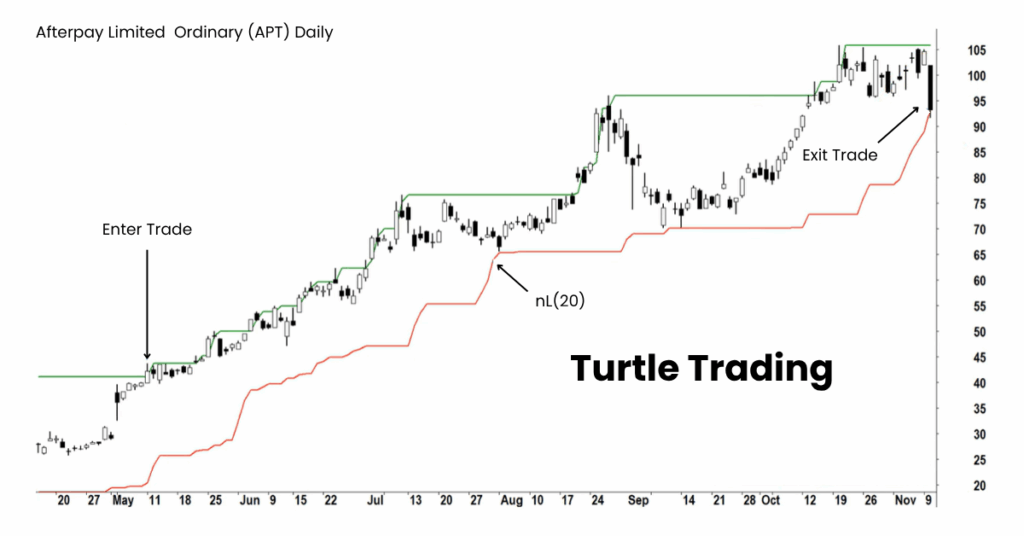
System One Long on a new 20 day high Short on a new 20 day low If the previous 20 day breakout was profitable, skip the next 20 day signal
System Two Long on a new 55 day high Short on a new 55 day low Always take System Two as the catch all
Stops And Exits
Initial stop at 2N from entry
System One exit on a 10 day opposite breakout
System Two exit on a 20 day opposite breakout
Pyramiding
Add one new unit every 0.5N of open profit
Keep units equal size
Cap at four units per market
Portfolio Heat
Up to six units in closely related markets
Up to ten units in loosely related markets
Up to twelve units total in one direction across the whole portfolio
Position Sizing With N
Before you can apply the turtle trading rules in real trades, you need to know how much to trade. The entry and exit rules tell you when to act, but without proper sizing, even a good signal can hurt your account.
That’s why position sizing is the backbone of the turtle trading strategy. Richard Dennis built it around a volatility measure called N, so every trade carries a controlled and consistent level of risk, no matter how wild or quiet the market is.
What N Means N represents the Average True Range over 20 periods. It measures typical daily movement and turns volatility into a simple number you can use for risk management.
In practice
High volatility with large N means smaller position size
Low volatility with small N means slightly larger position size
Each trade risks a similar fraction of capital rather than a fixed number of lots or contracts.
Why It Helps Beginners Using N automatically adapts your size to market conditions. It keeps risk per trade consistent and your emotions in check, even when markets get choppy.
How To Size One Unit
Choose account risk per trade such as 0.5 to 1 percent of equity
Calculate N as ATR over 20 periods
Convert N to money using pip value or contract value
Position size equals Account Risk divided by Dollar Volatility at 2N
Each unit is your standard building block. You add new units only when the trade moves in your favour. Keep this sizing process identical on every trade so your results stay consistent and objective.
Stops And Exits That Keep You Objective
This ties directly to the rules and explains how they work together. Think in layers. Your initial stop is 2N from entry. Your trailing exit is the opposite breakout window. Whichever triggers first closes the trade. Do not widen stops and do not move targets after entry.
Adding To Winners Without Averaging Down
This complements the entry rule with a growth rule that rewards proof. Add only when the market proves you right.
Add one equal unit every 0.5N of open profit
Stop after four units in the same market
Keep the stop aligned so an exit closes the full stack together This lets winning trends carry more weight while initial risk stays small.
Portfolio Caps And Simple Drawdown Rules
After you size a single trade, protect the whole account. These controls stop one theme from dominating risk and help you stay consistent during cold streaks.
Treat gold and silver as closely related
Treat Brent and WTI as closely related
Treat major equity indices from different regions as loosely related
Respect the six, ten, and twelve unit caps above
Drawdown step down Reduce new position sizes by about twenty percent after each ten percent drawdown. Restore only after recovery. This protects both capital and confidence during cold streaks.
What Still Works Today
Kept short and practical so beginners can apply the rules now.
Daily first. The edge shows better on daily swings than intraday noise
Diversify smartly. Mix FX majors, metals, energies, agricultural futures, and broad equity indices
Costs matter. Include spreads, commissions, and slippage in testing so your plan matches live execution
Strengths And Limitations
We will take a careful look at the strengths and limitations so you know what to expect before you start.
Aspect
Strengths
Limitations
Psychology
Clear rules reduce second guessing
Many small losses can test patience
Risk
ATR sizing keeps per trade risk consistent
Equity swings are normal during ranges
Returns Profile
Outlier trends can drive long term results
You give back some profit to catch big moves
Execution
Easy to log, audit, and automate
Requires discipline to take every qualified signal
Portfolio
Caps prevent one theme from dominating
Poor diversification can still concentrate risk
Timeframe
Works well on daily swing setups
Intraday use often dilutes the edge and raises costs
Conclusion
The turtle trading strategy gives beginners a practical way to follow trends without prediction. Enter on breakouts, size by volatility, add to strength, and protect capital with exits and portfolio caps. Keep risk tiny, stay consistent through the dull periods, and give yourself a real chance to catch the next major move.
Share Now
Disclaimer:This content is provided for informational purposes only and does not constitute, and should not be construed as, financial, investment, or other professional advice. No statement or opinion contained herein should be considered a recommendation by Ultima Markets or the author regarding any specific investment product, strategy, or transaction. Readers are advised not to rely solely on this material when making investment decisions and should seek independent advice where appropriate.
Thank you for visiting the Ultima Markets website. Please note that this website is intended for individuals residing in jurisdictions where access is permitted by law. Ultima and its affiliated entities do not operate in your home jurisdiction.
By clicking ‘Acknowledge’, you confirm that you are entering this website solely on your own initiative and not as a result of any specific marketing outreach. You wish to obtain information from this website based on reverse solicitation principles, in accordance with the applicable laws of your home jurisdiction.