This website is managed by Ultima Markets’ international entities, and it’s important to emphasise that they are not subject to regulation by the FCA in the UK. Therefore, you must understand that you will not have the FCA’s protection when investing through this website – for example:
You will not be guaranteed Negative Balance Protection
You will not be protected by FCA’s leverage restrictions
You will not have the right to settle disputes via the Financial Ombudsman Service (FOS)
You will not be protected by Financial Services Compensation Scheme (FSCS)
Any monies deposited will not be afforded the protection required under the FCA Client Assets Sourcebook. The level of protection for your funds will be determined by the regulations of the relevant local regulator.
Note: UK clients are kindly invited to visit https://www.ultima-markets.co.uk/. Ultima Markets UK expects to begin onboarding UK clients in accordance with FCA regulatory requirements in 2026.
If you would like to proceed and visit this website, you acknowledge and confirm the following:
1.The website is owned by Ultima Markets’ international entities and not by Ultima Markets UK Ltd, which is regulated by the FCA.
2.Ultima Markets Limited, or any of the Ultima Markets international entities, are neither based in the UK nor licensed by the FCA.
3.You are accessing the website at your own initiative and have not been solicited by Ultima Markets Limited in any way.
4.Investing through this website does not grant you the protections provided by the FCA.
5.Should you choose to invest through this website or with any of the international Ultima Markets entities, you will be subject to the rules and regulations of the relevant international regulatory authorities, not the FCA.
Ultima Markets wants to make it clear that we are duly licensed and authorised to offer the services and financial derivative products listed on our website. Individuals accessing this website and registering a trading account do so entirely of their own volition and without prior solicitation.
By confirming your decision to proceed with entering the website, you hereby affirm that this decision was solely initiated by you, and no solicitation has been made by any Ultima Markets entity.
Wondering what is preferred stock? Identify its key features, types, and see how it compares to common stock and bonds. Learn why companies issue it.
What is Preferred Stock?
Preferred stock is a type of equity that pays fixed dividends and has priority over common stock in dividend payments and liquidation. It combines features of stocks and bonds, offering investors steady income and higher security than common shares, but usually without voting rights or significant growth potential.
Unlike common shares, preferred stockholders often don’t have voting rights, but they benefit from steadier income and a more predictable payout structure. This balance between equity ownership and bond-like income is why preferred shares appeal to investors seeking stability without giving up all growth potential.
Key Features of Preferred Stock
Preferred stock sits between equity and debt, giving investors a unique balance of stability and ownership. The following features define how it works:
Fixed Dividend Payments
Preferred shareholders typically receive regular, fixed dividends—similar to bond coupon payments. For example, a preferred share might pay a 6% annual dividend regardless of company profits, unless suspended.
Dividend Priority
Before common shareholders can be paid, preferred dividends must be distributed. This priority makes preferred shares attractive to income-focused investors seeking predictability.
Liquidation Preference
If a company faces bankruptcy, preferred shareholders are ahead of common stockholders in the payout order. While bondholders are still first in line, preferred investors have better protection than common equity holders.
Limited or No Voting Rights
Most preferred shares don’t carry voting rights, meaning investors trade governance influence for financial stability.
Callable Shares
Issuers can “call” or redeem preferred stock at a set price after a certain date. This benefits the company if interest rates fall but creates call risk for investors, as shares may be redeemed just as they become more valuable.
Convertibility
Some preferred shares come with a conversion option, allowing investors to swap them into common stock. This feature provides a pathway to participate in upside growth if the company performs well.
Perpetual Nature
Unlike bonds, many preferred shares have no maturity date. They can provide long-term dividend income indefinitely, unless redeemed by the issuer.
Types of Preferred Stock
Companies issue different classes of preferred shares to meet investor demand and financing needs. The main types of preferred stock include:
Cumulative Preferred Stock
If the company misses a dividend payment, it accumulates. Before common shareholders can be paid, all unpaid dividends must first go to cumulative preferred holders. This feature offers stronger income protection.
Non-Cumulative Preferred Stock
Unlike cumulative shares, missed dividends are not carried forward. If the company skips a payment, investors lose it permanently. These are riskier but may offer higher yields.
Participating Preferred Stock
Participating preferred stock provides both a fixed dividend and the chance to earn extra payouts if company profits exceed certain thresholds. This allows investors to share in upside gains, unlike standard preferred shares.
Convertible Preferred Stock
Convertible shares allow holders to exchange preferred stock for common stock at a predetermined ratio. This feature lets investors benefit from steady income initially and growth potential later if the company performs well.
Perpetual Preferred Stock
These shares have no maturity date, meaning they can pay dividends indefinitely. They act like a long-term source of fixed income, but investors face interest rate risk if yields rise in the market.
Callable Preferred Stock
Callable shares can be redeemed by the issuer after a certain date at a set price. This gives companies flexibility, but creates call risk for investors, since shares may be redeemed when interest rates fall.
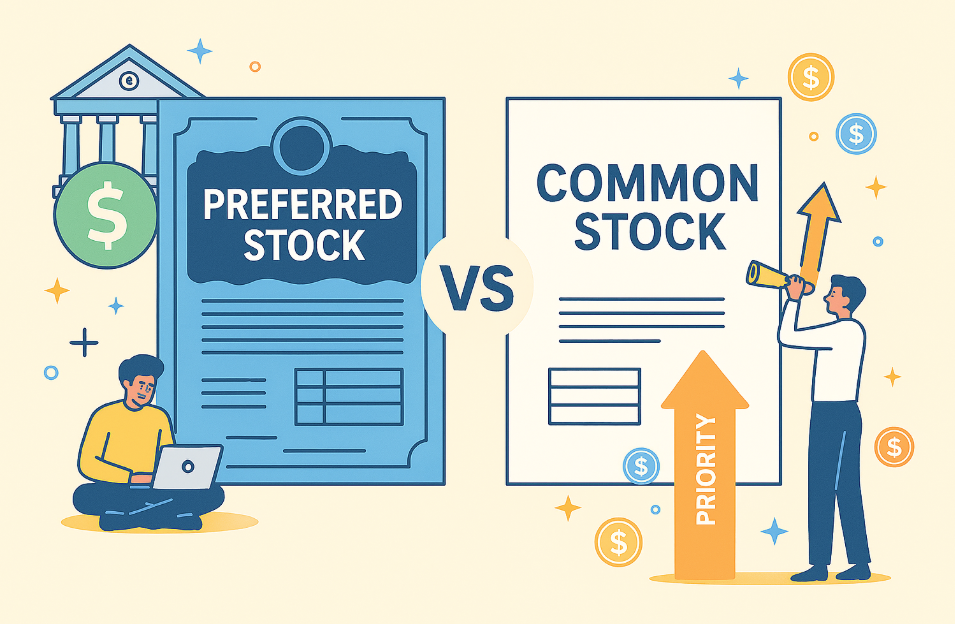
Preferred Stock vs Common Stock
Both preferred and common stock represent ownership in a company, but they serve different purposes for investors. The main difference lies in income stability, risk level, and shareholder rights.
Key Differences Explained
Dividends: Preferred shares usually pay fixed dividends on a regular schedule, while common stock dividends are variable and not guaranteed. Many growth companies skip common dividends altogether.
Payment Priority: Preferred shareholders are paid first in both dividend distribution and liquidation. Common shareholders are last in line, which increases risk but also allows for higher upside potential.
Voting Rights: Common stockholders generally have the right to vote on corporate decisions like electing directors or approving mergers. Preferred shareholders often give up voting rights in exchange for income priority.
Growth Potential: Common stock offers more capital appreciation if the company grows. Preferred stock focuses on steady income but has limited price upside.
Risk Profile: Preferred stock is less volatile and safer in downturns, while common stock carries more risk but also greater potential returns.
Feature
Preferred Stock
Common Stock
Dividends
Fixed, paid before common stock
Variable, may be skipped
Payment Priority
Higher (before common stock)
Lowest (last in liquidation)
Voting Rights
Usually none
Full voting rights
Growth Potential
Limited, focuses on income
Higher long-term upside
Risk Level
Moderate, safer than common, riskier than bonds
Higher volatility and downside risk
Preferred stock is ideal for those who want predictable income and downside protection, while common stock suits investors seeking long-term growth and voting influence. Many portfolios hold a mix of both to balance risk and reward.
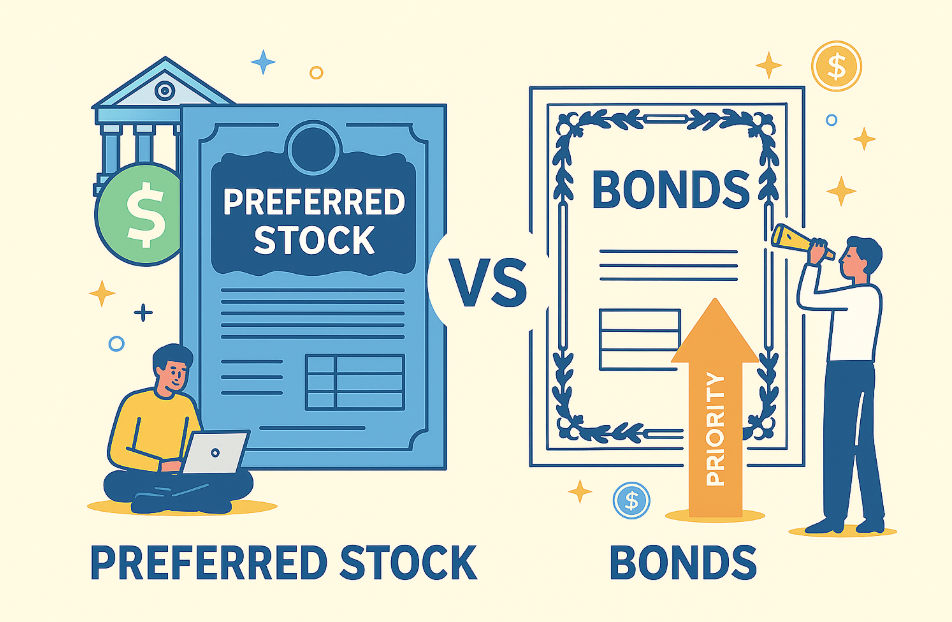
Preferred Stock vs Bonds
Preferred stock and corporate bonds share similarities both provide steady income and are sensitive to interest rates but they differ in ownership rights, risk, and payment obligations. Investors often compare the two to decide whether they want the security of debt or the flexibility of equity.
Key Differences:
Ownership vs Debt: Bonds represent a loan to the company, making bondholders creditors. Preferred stock represents equity ownership, giving investors a stake in the company.
Payment Obligation: Companies are legally required to pay bond interest, while preferred dividends can be deferred or suspended in tough times without triggering default.
Priority in Liquidation: Bondholders are paid first if a company goes bankrupt. Preferred shareholders come next, ahead of common stockholders but behind debt.
Maturity: Bonds usually have a fixed maturity date when the principal is repaid. Preferred stock is often perpetual, meaning there is no set maturity.
Return Potential: Preferred stock may offer higher dividend yields than bond interest, and some preferred shares are convertible into common stock for growth exposure. Bonds, however, are usually safer but capped in returns.
Tax Treatment: In some jurisdictions, preferred dividends may be taxed at lower rates compared to bond interest, making them more efficient for certain investors.
Feature
Preferred Stock
Bonds
Instrument Type
Equity ownership
Debt obligation
Income Source
Fixed dividends (not guaranteed)
Fixed interest payments (guaranteed)
Payment Priority
After bonds, before common stock
First priority in liquidation
Maturity
Usually perpetual
Fixed maturity date
Risk Level
Moderate, safer than common stock, riskier than bonds
Lower but exposed to default risk
Growth Potential
Limited, but may convert to common stock
None, capped at interest payments
Why Companies Issue Preferred Stock
Companies issue preferred stock as a way to raise capital while balancing the advantages of equity and debt financing. Unlike bonds, preferred stock does not create a strict repayment obligation, and unlike common stock, it does not dilute voting power.
Here are the main reasons corporations use preferred stock:
Raise Capital Without Debt Burden Preferred shares allow companies to secure funding without increasing their debt ratios. Since dividends can be suspended in difficult times, this provides more financial flexibility than bonds.
Preserve Control Issuing common stock dilutes voting rights. Preferred shares typically carry no voting rights, letting companies raise money while keeping decision-making power in the hands of existing owners.
Attract Income-Focused Investors Preferred stock is designed to appeal to investors who want steady dividend income with more security than common stock. This broadens the company’s investor base.
Tax Efficiency In some regions, dividends on preferred shares may receive more favorable tax treatment for both issuers and investors compared to bond interest.
Flexible Financing Tool Preferred stock can be structured with features such as convertibility, callability, or participation, giving companies multiple options for tailoring securities to market conditions.
Companies issue preferred stock because it offers capital without heavy debt risk, avoids dilution of control, and attracts stable-income investors. It’s a strategic tool that sits between traditional equity and debt financing.
Risks of Preferred Stock
Despite its advantages, preferred stock comes with risks that investors should consider:
Interest Rate Sensitivity: Rising rates often reduce the value of preferred shares, similar to bonds.
Credit Risk: If the issuer faces financial trouble, dividend payments may be suspended.
Limited Upside: Price appreciation is typically capped compared to common stock.
Call Risk: Issuers may redeem shares early, limiting long-term gains.
Understanding these risks helps investors decide where preferred shares fit into their portfolio.
Conclusion
Preferred stock plays a unique role in investing, combining the income stability of bonds with the ownership benefits of equity. It offers priority in dividends, greater security than common stock, and flexible structures like convertibility and callability. At the same time, it carries risks such as interest rate sensitivity, limited growth, and potential dividend suspension.
For investors, understanding the features, types, and comparisons with bonds and common stock is essential to deciding whether preferred stock fits into their portfolio. It’s best used as part of a diversified investment strategy that balances income, stability, and growth.
At Ultima Markets, we believe in empowering traders and investors with transparent education and reliable insights. As a multi-regulated broker, including FCA oversight, our mission is to help you navigate financial markets with confidence. Whether you are exploring stocks, bonds, or hybrid securities like preferred shares, Ultima Markets provides the tools and knowledge to make informed trading decisions.
FAQs
What is preferred stock?
Preferred stock is a type of equity that combines features of both common stock and bonds. It typically pays fixed dividends and has priority over common stock in dividend payments and liquidation, but usually comes with limited or no voting rights.
Is preferred stock safer than common stock?
Preferred stock is generally considered less volatile than common stock because it offers fixed dividend payments and higher priority in liquidation. However, it still carries risk and does not have the same capital appreciation potential as common stock.
Does preferred stock pay dividends?
Yes, preferred stock usually pays dividends at a fixed rate. These dividends are often paid before any dividends are distributed to common shareholders, making preferred stock attractive to income-focused investors.
Share Now
Disclaimer:This content is provided for informational purposes only and does not constitute, and should not be construed as, financial, investment, or other professional advice. No statement or opinion contained herein should be considered a recommendation by Ultima Markets or the author regarding any specific investment product, strategy, or transaction. Readers are advised not to rely solely on this material when making investment decisions and should seek independent advice where appropriate.
Thank you for visiting the Ultima Markets website. Please note that this website is intended for individuals residing in jurisdictions where access is permitted by law. Ultima and its affiliated entities do not operate in your home jurisdiction.
By clicking ‘Acknowledge’, you confirm that you are entering this website solely on your own initiative and not as a result of any specific marketing outreach. You wish to obtain information from this website based on reverse solicitation principles, in accordance with the applicable laws of your home jurisdiction.