This website is managed by Ultima Markets’ international entities, and it’s important to emphasise that they are not subject to regulation by the FCA in the UK. Therefore, you must understand that you will not have the FCA’s protection when investing through this website – for example:
You will not be guaranteed Negative Balance Protection
You will not be protected by FCA’s leverage restrictions
You will not have the right to settle disputes via the Financial Ombudsman Service (FOS)
You will not be protected by Financial Services Compensation Scheme (FSCS)
Any monies deposited will not be afforded the protection required under the FCA Client Assets Sourcebook. The level of protection for your funds will be determined by the regulations of the relevant local regulator.
Note: UK clients are kindly invited to visit https://www.ultima-markets.co.uk/. Ultima Markets UK expects to begin onboarding UK clients in accordance with FCA regulatory requirements in 2026.
If you would like to proceed and visit this website, you acknowledge and confirm the following:
1.The website is owned by Ultima Markets’ international entities and not by Ultima Markets UK Ltd, which is regulated by the FCA.
2.Ultima Markets Limited, or any of the Ultima Markets international entities, are neither based in the UK nor licensed by the FCA.
3.You are accessing the website at your own initiative and have not been solicited by Ultima Markets Limited in any way.
4.Investing through this website does not grant you the protections provided by the FCA.
5.Should you choose to invest through this website or with any of the international Ultima Markets entities, you will be subject to the rules and regulations of the relevant international regulatory authorities, not the FCA.
Ultima Markets wants to make it clear that we are duly licensed and authorised to offer the services and financial derivative products listed on our website. Individuals accessing this website and registering a trading account do so entirely of their own volition and without prior solicitation.
By confirming your decision to proceed with entering the website, you hereby affirm that this decision was solely initiated by you, and no solicitation has been made by any Ultima Markets entity.
Understand what is a stock symbol and see why it matters. Learn about global formats and share classes. Read step by step tips to identify stock tickers.
What is A Stock Symbol? How to Find It?
If you have ever watched the markets or read a finance headline, you have seen short letter codes like AAPL or TSLA. These are stock symbols. They are the simple identifiers that tell traders and investors exactly which company they are looking at. Once you understand them, everything you read on prices, charts, and news becomes clearer and faster to use.
Definition of a Stock Symbol
A stock symbol, also known as a ticker, is a unique set of letters or numbers assigned to a listed security. If someone asks you what is a stock symbol, the answer is straightforward: it’s the shorthand identifier for a company on an exchange. Without symbols, navigating the markets would be slow and confusing. One symbol maps to one listing on one venue. For example, this clarity keeps Apple separate from any other firm with a similar name and it makes data easy to find.
Why Ticker Symbols Matter
Understanding what is a stock symbol is essential because:
They remove guesswork when company names look alike
They speed up searches, orders, and research
They keep news, price moves, and filings tied to the right listing
How Stock Symbols Are Formed
When looking at what is a stock symbol in practice, different exchanges follow different patterns. In the United States, the NYSE and Nasdaq usually use letters. Many non US markets use letters with an exchange suffix or even numbers.
NYSE and Nasdaq often use one to four letters, sometimes five on Nasdaq
Some markets add a dot and a suffix to show the venue, for example .L for London and .HK for Hong Kong
Some markets use numbers for the core code, common in parts of Asia
Companies can have more than one class of share, which shows up as a variation of the symbol
Quick Decoder
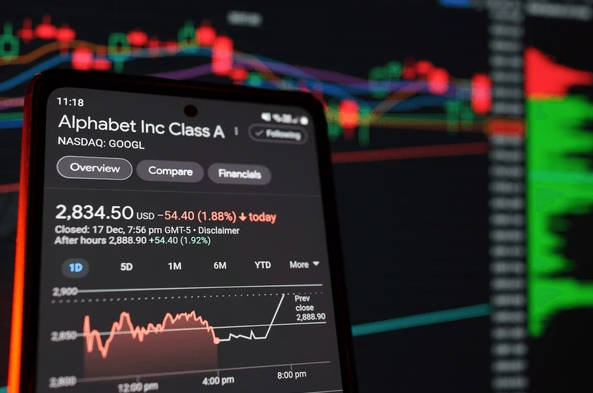
Some companies issue more than one class of shares, and the symbol reflects that difference. Alphabet trades as GOOGL and GOOG for its Class A and Class C shares, while Berkshire Hathaway uses BRK.A and BRK.B for its Class A and Class B shares. The extra letter or suffix helps you see voting rights and price levels at a glance, so you always know which class you are looking at.
Exchanges outside the United States often add a suffix to show the trading venue. Tencent appears as 0700.HK on the Hong Kong Stock Exchange, BMW shows as BMW.DE on the Frankfurt exchange, and Toyota trades as 7203.T on the Tokyo Stock Exchange. Reading the code together with the suffix tells you where the shares are listed, which avoids mix ups between look alike tickers on different markets.
Several markets, especially in Asia, use numbers as the core of the code rather than letters. That is why you will frequently see four digit formats in Tokyo and Hong Kong. The idea is the same as in the United States. A compact code points to one specific listing on one specific exchange, making it faster to find prices, read news, and place accurate orders.
Famous Stock Symbols
Below are a few familiar tickers that illustrate what we covered above, starting with standard U.S. symbols, then share class pairs, and finally those with exchange suffixes.
Symbol(s)
Company
Exchange / Market
Notes
AAPL
Apple
Nasdaq
Standard U.S. ticker
MSFT
Microsoft
Nasdaq
Standard U.S. ticker
AMZN
Amazon
Nasdaq
Standard U.S. ticker
TSLA
Tesla
Nasdaq
Standard U.S. ticker
NVDA
Nvidia
Nasdaq
Standard U.S. ticker
META
Meta Platforms
Nasdaq
Standard U.S. ticker
GOOGL / GOOG
Alphabet
Nasdaq
Class A and Class C shares
BRK.A / BRK.B
Berkshire Hathaway
NYSE
Class A and Class B shares
0700.HK
Tencent
Hong Kong
Exchange suffix format
7203.T
Toyota
Tokyo
Number format with exchange suffix
BMW.DE
BMW
Frankfurt
Exchange suffix format
How to Find the Correct Symbol
This is the single most useful habit for new traders. Follow the same order every time.
Start with the company investor relations page and note the exchange and symbol
Check the listing on the exchange website to confirm the venue
Cross check on a regulator database such as EDGAR in the United States and match the legal name and filings
Read the latest company description to ensure the business matches what you expect
If the name looks right but the exchange or business overview looks wrong, stop and recheck before placing an order.
Common Mistakes and How to Avoid Them
Mistakes usually happen when people chase headlines or social posts and do not verify the issuer.
The Zoom mix up
Many buyers once purchased shares of Zoom Technologies with the symbol ZOOM by mistake when they meant Zoom Video Communications with the symbol ZM. The names looked similar and the wrong stock moved for the wrong reasons. The fix is simple. Always pair the symbol with its exchange and read the company description before you trade.
The Signal confusion
After a well known tweet told people to use Signal, some traders bought Signal Advance with the symbol SIGL. It was a tiny and unrelated company. The price spiked and then fell as reality returned. The lesson is the same. Verify the issuer, the sector, and the filings. If you cannot explain what the company sells or makes, you probably have the wrong one.
Look alike names and tickers
Many names sound similar. NIO and tickers that begin with N or NI can confuse fast moving traders. Nest related hype once pushed an unrelated symbol with NEST. Slow down and confirm the full company name, country, and exchange.
A 3 Step Safety Check before Any Order
Confirm company name and exchange symbol together, for example ZM on Nasdaq
Open one recent filing or announcement to ensure the business matches your intent
Check the price history and market value to see if it fits the size of the company you think you are buying
Frequently Asked Questions
Are stock symbols universal No. They are unique on an exchange, not worldwide. That is why suffixes and venue names matter.
Why did a symbol change Mergers, name changes, corporate actions, and delistings can trigger a new code. When a company changes its name, broker platforms usually show an alert and map your holdings automatically.
Can two companies share one symbol Not on the same exchange. Across different exchanges the same letters can appear, which is why you should always link the code with the venue.
What is a Stock Symbol?
So what is a stock symbol exactly? To sum it up, stock symbols do more than label company shares. The same compact codes also identify other exchange listed instruments, including exchange traded funds, some bonds, and derivatives such as options and futures where extra letters or numbers indicate contract details.
Read every symbol together with its exchange or suffix, confirm the issuer on an official source, and check the business description before you trade. With that habit, you can move quickly and avoid wrong ticker mistakes while keeping your research clean and consistent.
Share Now
Disclaimer:This content is provided for informational purposes only and does not constitute, and should not be construed as, financial, investment, or other professional advice. No statement or opinion contained herein should be considered a recommendation by Ultima Markets or the author regarding any specific investment product, strategy, or transaction. Readers are advised not to rely solely on this material when making investment decisions and should seek independent advice where appropriate.
Thank you for visiting the Ultima Markets website. Please note that this website is intended for individuals residing in jurisdictions where access is permitted by law. Ultima and its affiliated entities do not operate in your home jurisdiction.
By clicking ‘Acknowledge’, you confirm that you are entering this website solely on your own initiative and not as a result of any specific marketing outreach. You wish to obtain information from this website based on reverse solicitation principles, in accordance with the applicable laws of your home jurisdiction.