On August 12, 2025, the Reserve Bank of Australia lowered the official cash rate by 25 basis points, bringing it down to 3.60%–the third rate cut this year and the lowest level since April 2023.
The decision, reached unanimously by the Board, reflects confidence that inflation is steadily moving back within target, but also caution amid persistent global and domestic uncertainties.
RBA Policy Outlook
Inflation Moderating, but Risks Remain
The RBA noted that inflation has fallen substantially since its 2022 peak, with trimmed mean inflation easing to 2.7% in Q2, broadly in line with its May forecasts. Headline CPI slowed to 2.1%, partly due to temporary cost-of-living relief measures. Updated staff forecasts see underlying inflation drifting toward the midpoint of the 2–3% range, assuming a gradual pace of monetary easing.
Governor Michele Bullock said, “With underlying inflation continuing to decline and labour market conditions easing slightly, a further easing of policy was appropriate.” However, she stressed the Board remains “attentive to the data and evolving risks”, particularly those related to trade policy shifts, global growth, and domestic consumption trends.
Labour Market and Growth Outlook
The RBA also highlighted that the unemployment rate rose to 4.3% in June but remains historically low, while labour underutilisation rates are still tight. Wage growth has eased from its peak, though productivity growth remains weak, keeping unit labour costs elevated. Private demand is gradually recovering, supported by rising real household incomes and some easing in financial conditions.
The bank’s forecasts assume household consumption will recover as incomes rise, but it warned that demand could be weaker than expected if households maintain higher savings or if global trade disruptions deepen. Conversely, stronger-than-expected labour market outcomes could prompt higher consumption.
Global and Domestic Uncertainty
Internationally, the RBA noted that risks from U.S. tariffs and other countries’ policy responses have become clearer, reducing the chance of extreme scenarios. Still, trade tensions are expected to weigh on global activity and inflation in Australia for some time.
RBA Policy Stance
The RBA stated it remains well positioned to respond to any significant shifts in global or domestic conditions. While the latest rate cut forms part of a gradual easing strategy, the Board stressed that policy will remain data-dependent, with a continued focus on maintaining price stability and full employment.
The central bank’s tone was cautiously balanced rather than overtly dovish, though further easing remains possible should inflation continue to moderate.
The Australian dollar softened modestly against major peers following the announcement, but overall held within recent ranges.
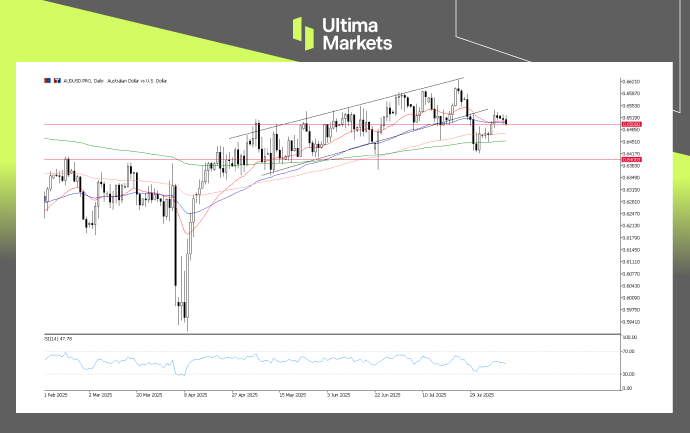
Market Reaction: AUD/USD Hold Steady at 0.6500
The AUD/USD extended its recent range-bound trading on Tuesday, holding near the 0.6500 level. The pair has been confined to a narrow two-cent range for nearly two months, reflecting a period of muted directional momentum.
AUD/USD, Day-Chart Analysis | Source: Ultima Market MT5
Technically, the pair has recently broken out of its tight consolidation uptrend channel but remains anchored at the 0.6500 handle.
“A decisive break below 0.6500 could open the door to further downside, particularly if the U.S. dollar strengthens,” said Shawn Lee, Senior Market Analyst at Ultima.
Disclaimer
Comments, news, research, analysis, price, and all information contained in the article only serve as general information for readers and do not suggest any advice. Ultima Markets has taken reasonable measures to provide up-to-date information, but cannot guarantee accuracy, and may modify without notice. Ultima Markets will not be responsible for any loss incurred due to the application of the information provided.