This website is managed by Ultima Markets’ international entities, and it’s important to emphasise that they are not subject to regulation by the FCA in the UK. Therefore, you must understand that you will not have the FCA’s protection when investing through this website – for example:
You will not be guaranteed Negative Balance Protection
You will not be protected by FCA’s leverage restrictions
You will not have the right to settle disputes via the Financial Ombudsman Service (FOS)
You will not be protected by Financial Services Compensation Scheme (FSCS)
Any monies deposited will not be afforded the protection required under the FCA Client Assets Sourcebook. The level of protection for your funds will be determined by the regulations of the relevant local regulator.
Note: UK clients are kindly invited to visit https://www.ultima-markets.co.uk/. Ultima Markets UK expects to begin onboarding UK clients in accordance with FCA regulatory requirements in 2026.
If you would like to proceed and visit this website, you acknowledge and confirm the following:
1.The website is owned by Ultima Markets’ international entities and not by Ultima Markets UK Ltd, which is regulated by the FCA.
2.Ultima Markets Limited, or any of the Ultima Markets international entities, are neither based in the UK nor licensed by the FCA.
3.You are accessing the website at your own initiative and have not been solicited by Ultima Markets Limited in any way.
4.Investing through this website does not grant you the protections provided by the FCA.
5.Should you choose to invest through this website or with any of the international Ultima Markets entities, you will be subject to the rules and regulations of the relevant international regulatory authorities, not the FCA.
Ultima Markets wants to make it clear that we are duly licensed and authorised to offer the services and financial derivative products listed on our website. Individuals accessing this website and registering a trading account do so entirely of their own volition and without prior solicitation.
By confirming your decision to proceed with entering the website, you hereby affirm that this decision was solely initiated by you, and no solicitation has been made by any Ultima Markets entity.
How does CPI affect the stock market? Learn about how inflation data influences forex, Fed policies, interest rates, stock prices and market reactions.
Every month, investors and traders closely watch the Consumer Price Index (CPI) because it can influence expectations for interest rates, Federal Reserve policy and stock market performance.
But how does CPI affect the stock market? The answer depends on how inflation data changes expectations about the future. A higher-than-expected CPI report may increase concerns about higher interest rates, while a lower-than-expected reading can improve market sentiment and support risk assets.
For traders, CPI is more than just an economic indicator. It is a key market-moving event that can create volatility across stocks, currencies, bonds and commodities.
CPI vs Inflation: What Is the Difference?
Although CPI and inflation are often discussed together, they are not exactly the same.
Inflation refers to the overall increase in prices of goods and services across an economy over time.
CPI is one of the main measurements used to track inflation by monitoring changes in the prices consumers pay for a basket of goods and services.
In simple terms:
Inflation = the economic condition of rising prices
CPI = a measurement used to track changes in consumer prices
For example, if CPI shows that the average cost of housing, food and transportation has increased compared with the previous year, it suggests that inflation remains elevated.
Investors pay close attention to CPI because persistent inflation can influence central bank decisions, particularly interest rate policies.
What Is CPI in Trading?
For traders, CPI is an important economic data release that provides clues about future market conditions.
The main reason CPI matters in trading is its influence on expectations for central bank policy.
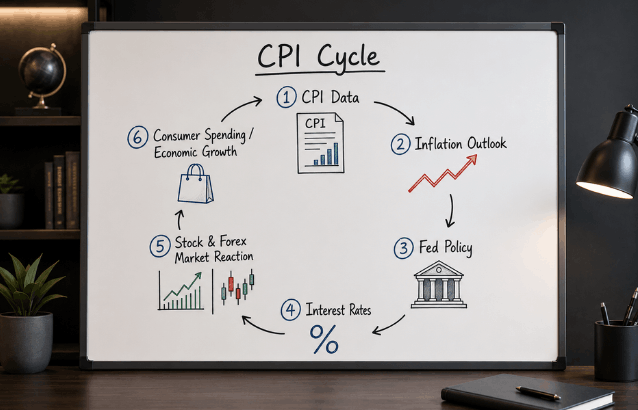
A typical market reaction follows this cycle:
CPI data → Inflation outlook → Federal Reserve expectations → Interest rates → Market movements
When CPI comes in higher than expected, traders may anticipate that the Federal Reserve will keep interest rates higher for longer. This can increase volatility in financial markets.
When CPI is lower than expected, traders may expect a more supportive monetary policy environment, which can benefit risk assets.
Markets commonly watch CPI alongside:
Stock indices such as the S&P 500 and Nasdaq
US Treasury yields
The US dollar
Gold prices
How Does CPI Affect the Stock Market?
The CPI effect on the stock market mainly comes through interest rates and company valuations.
Higher CPI Can Pressure Stock Prices
A stronger CPI reading may signal that inflation remains difficult to control.
This can lead to:
Expectations of higher interest rates
Increased borrowing costs for businesses
Lower valuations for growth companies
Reduced investor appetite for risk
Technology stocks are often more sensitive because their valuations depend heavily on future earnings growth. When interest rates rise, those future earnings become less valuable in present terms.
Lower CPI Can Support Stock Markets
A weaker CPI reading may suggest that inflation is slowing.
This can increase expectations for:
Future interest rate cuts
Lower bond yields
Improved economic conditions
As a result, investors may become more willing to allocate capital towards stocks, especially growth-oriented sectors.
However, a lower CPI does not automatically guarantee a stock market rally. The reaction depends on whether the data matches or exceeds investor expectations.
Is High CPI Good or Bad for the Stock Market?
The answer is usually: high CPI is generally negative for the stock market, but the impact depends on the reason behind the inflation and market expectations.
High CPI can be negative because:
The Federal Reserve may keep interest rates higher
Companies may face higher costs
Consumers may reduce spending power
Stock valuations may decline
However, high CPI does not affect every sector equally.
Some industries may benefit from inflationary conditions.
Examples:
Energy companies
Higher commodity prices can increase revenues for energy producers.
Companies with pricing power
Businesses that can pass higher costs to customers may maintain profitability.
Certain financial companies
Higher interest rates can sometimes support bank lending margins.
Therefore, investors usually focus on whether inflation is rising too quickly and whether it forces tighter monetary policy.
Why CPI Expectations Matter More Than the Actual Number
One of the most important concepts in understanding CPI and the stock market is that markets react to surprises.
For example:
Expected CPI: 3.5% Actual CPI: 3.2%
Although inflation remains elevated, investors may view the result positively because inflation is cooling faster than expected.
Another example:
Expected CPI: 3.0% Actual CPI: 3.2%
Even though the difference is small, markets may react negatively because inflation is proving more persistent.
This is why stocks can sometimes rise after a high CPI reading or fall after a lower CPI report.
How Different Stock Sectors React to CPI
Sector
Typical Reaction to Higher CPI
Technology
Often pressured due to higher rates affecting valuations
Consumer Staples
Usually more defensive due to stable demand
Energy
May benefit from higher commodity prices
Financials
Mixed, depending on lending conditions
Real Estate
Often pressured by higher borrowing costs
CPI and Federal Reserve Interest Rate Decisions
The Federal Reserve uses inflation data, including CPI, when determining monetary policy.
If inflation remains above its target, the Fed may maintain restrictive policies to slow price growth.
If inflation continues to decline, policymakers may have more flexibility to reduce interest rates.
Because interest rates directly affect borrowing costs and investment decisions, CPI has become one of the most closely watched indicators in financial markets.
How Traders Prepare for CPI Releases
CPI days often bring increased market volatility.
Before the release, traders usually monitor:
Inflation expectations
Bond market movements
Federal Reserve commentary
Market positioning
After the release, traders analyse whether the data changes expectations for:
Interest rates
Stock valuations
Currency strength
Commodity prices
A surprising CPI result can quickly move multiple asset classes at the same time.
Conclusion
So, how does CPI affect the stock market?
CPI influences stocks mainly through its impact on inflation expectations, Federal Reserve policy and interest rates. While high CPI is generally viewed as negative because it can lead to tighter monetary policy, the actual market reaction depends on whether the data is better or worse than expected.
Understanding the relationship between CPI, inflation and interest rates allows investors and traders to better interpret why markets react strongly to economic data releases.
FAQs
Does high CPI always make stocks fall?
No. Markets react to whether CPI is above or below expectations and how investors interpret future interest rate decisions.
Is CPI the same as inflation?
No. Inflation describes rising prices across the economy, while CPI is one measurement used to track inflation.
Why is CPI important for traders?
CPI can influence expectations for interest rates, making it a major market-moving event for stocks, currencies and commodities.
Share Now
Disclaimer:This content is provided for informational purposes only and does not constitute, and should not be construed as, financial, investment, or other professional advice. No statement or opinion contained herein should be considered a recommendation by Ultima Markets or the author regarding any specific investment product, strategy, or transaction. Readers are advised not to rely solely on this material when making investment decisions and should seek independent advice where appropriate.
Thank you for visiting the Ultima Markets website. Please note that this website is intended for individuals residing in jurisdictions where access is permitted by law. Ultima and its affiliated entities do not operate in your home jurisdiction.
By clicking ‘Acknowledge’, you confirm that you are entering this website solely on your own initiative and not as a result of any specific marketing outreach. You wish to obtain information from this website based on reverse solicitation principles, in accordance with the applicable laws of your home jurisdiction.