This website is managed by Ultima Markets’ international entities, and it’s important to emphasise that they are not subject to regulation by the FCA in the UK. Therefore, you must understand that you will not have the FCA’s protection when investing through this website – for example:
You will not be guaranteed Negative Balance Protection
You will not be protected by FCA’s leverage restrictions
You will not have the right to settle disputes via the Financial Ombudsman Service (FOS)
You will not be protected by Financial Services Compensation Scheme (FSCS)
Any monies deposited will not be afforded the protection required under the FCA Client Assets Sourcebook. The level of protection for your funds will be determined by the regulations of the relevant local regulator.
Note: UK clients are kindly invited to visit https://www.ultima-markets.co.uk/. Ultima Markets UK expects to begin onboarding UK clients in accordance with FCA regulatory requirements in 2026.
If you would like to proceed and visit this website, you acknowledge and confirm the following:
1.The website is owned by Ultima Markets’ international entities and not by Ultima Markets UK Ltd, which is regulated by the FCA.
2.Ultima Markets Limited, or any of the Ultima Markets international entities, are neither based in the UK nor licensed by the FCA.
3.You are accessing the website at your own initiative and have not been solicited by Ultima Markets Limited in any way.
4.Investing through this website does not grant you the protections provided by the FCA.
5.Should you choose to invest through this website or with any of the international Ultima Markets entities, you will be subject to the rules and regulations of the relevant international regulatory authorities, not the FCA.
Ultima Markets wants to make it clear that we are duly licensed and authorised to offer the services and financial derivative products listed on our website. Individuals accessing this website and registering a trading account do so entirely of their own volition and without prior solicitation.
By confirming your decision to proceed with entering the website, you hereby affirm that this decision was solely initiated by you, and no solicitation has been made by any Ultima Markets entity.
Ultima Markets does not have an establishment in Singapore and does not operate from Singapore.
Ultima Markets does not provide products or services to citizens or residents of Singapore, and account applications from Singapore citizens or residents will not be accepted.
If you are a citizen or resident of Singapore, please do not open an account or use Ultima Markets’ products or services.
By selecting “Acknowledge and Continue Browsing”, you confirm that you are accessing this website on your own initiative and that your access is not the result of any direct marketing, targeted advertising, solicitation, or promotional activity by Ultima Markets.
Nothing on this website constitutes an offer, solicitation, or promotion of products or services in any jurisdiction where such activity is prohibited. You are responsible for ensuring that your access to and use of this website complies with applicable local laws and regulations.
Why is the yen so weak? Discover how Japan’s ultra-loose monetary policy and U.S. rate hikes are pushing the yen to historic lows and what’s next.
Why is The Yen So Weak
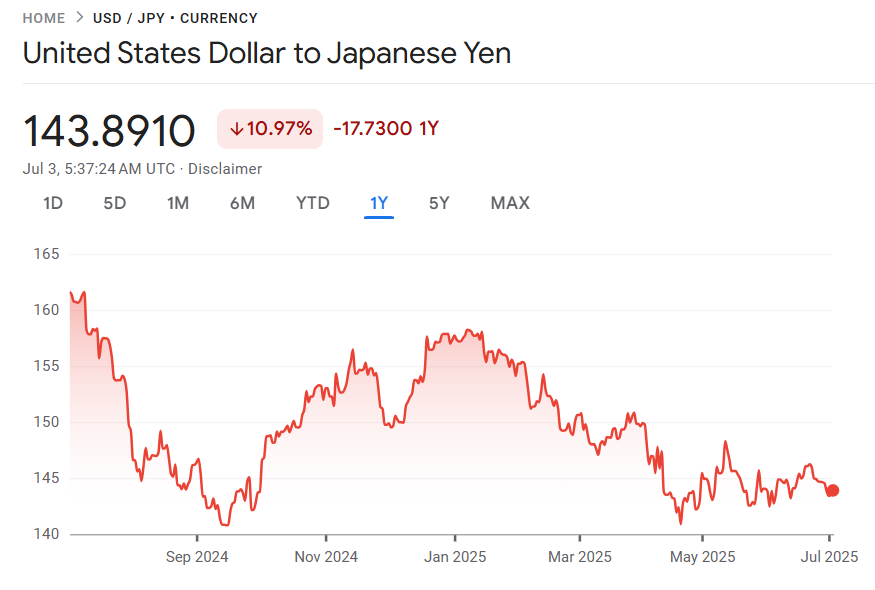
In April 2024, the yen dropped to around ¥160/USD, its weakest level since 1990. This dramatic decline reflects a perfect storm of structural and policy factors. Japan’s ultra-loose monetary policy, an aging economy, and a massive interest rate gap with the U.S. are driving the yen’s prolonged weakness.
Understanding why the yen is so weak requires looking at the complex interplay between interest rates, monetary policy, and Japan’s unique position in the global economy.
Key Takeaways
The Japanese yen fell to around 160 per U.S. dollar in April 2024, its lowest level since 1990
Massive interest rate gap between Japan (0.5%) and the U.S. (5.25–5.50%) makes the yen less attractive
Ultra-loose monetary policy over decades contributed to persistent yen underperformance
Weaker yen helps exports and tourism but hurts households via more expensive imports
Japan spent around $60 billion in interventions across 2022 and 2024 with limited success
Most analysts expect the yen to stay weak for 6–12 months unless interest rate gaps narrow
The Primary Drivers Behind the Yen’s Weakness
Japan’s weak currency stems from long-term policy responses to past economic challenges. After the asset bubble burst in the 1990s, the country entered a prolonged period of stagnation and deflation known as the “Lost Decades.” To counteract this, the Bank of Japan (BOJ) implemented ultra-loose monetary policy, including negative interest rates from 2016 to March 2024.
Even after exiting negative rates, Japan’s benchmark interest rate remains low at 0.5%, while the U.S. rate stands much higher at 5.25–5.50%. This wide interest rate gap encourages investors to move capital out of yen and into higher-yielding U.S. assets, putting continuous downward pressure on the yen.
Despite recent rate hikes, the BOJ remains cautious due to Japan’s structural issues—like low wage growth, weak domestic consumption, and an aging population—which make aggressive tightening difficult.
Economic Impact of the Weak Yen
While the weak yen benefits Japan’s exports and tourism, it creates real pain for consumers through rising import costs and worsens inflation without boosting domestic demand. This creates a tough balancing act for policymakers.
Benefits:
Exporters profit: Companies like Toyota and Sony benefit as overseas earnings convert to more yen
Tourism boost: Japan becomes a cheaper destination, driving record tourist inflows
Manufacturing edge: Lower prices improve competitiveness of Japanese products abroad
Downsides:
Import inflation: Households pay more for imported energy, food, and goods
Rising living costs: Average Japanese families spend ~¥90,000 (about $590) more annually due to the weaker yen
Bad inflation: Higher prices come from import costs, not domestic demand—hurting consumers
Government and Central Bank Response
The Ministry of Finance and the BOJ have intervened multiple times, spending billions to support the yen. In both 2022 and 2024, Japan spent around $60 billion on FX interventions. These actions provided short-term relief but failed to reverse the downward trend, as the core issue—interest rate differentials—remains.
The BOJ raised rates cautiously to 0.5% by January 2025, the first time in 17 years. Governor Kazuo Ueda signaled willingness to hike further if sustainable inflation and wage growth emerge. However, the BOJ remains cautious, wary of derailing Japan’s fragile recovery. Their gradual pace reflects past experiences and the country’s deep-rooted economic issues.
Future Outlook for the Yen
The yen is likely to stay weak in the near term. Traders should monitor interest rate spreads and central bank signals closely. Volatility will create tactical trading opportunities, especially through yen-based carry trades and options.
6–12 months weakness expected unless the Fed cuts rates or Japan hikes faster
U.S. policy pivotal: Persistent U.S. inflation could keep rates high, pressuring the yen
BOJ rate hikes possible if wage growth strengthens, but timing remains uncertain
Risk-on volatility: Carry trade reversals and geopolitical shocks could create yen rallies
Trader Insights:
Carry trades: Traders borrow yen to invest in higher-yield currencies, boosting USD/JPY
Hedging necessary: Japanese corporates and multinationals must actively manage FX exposure
Options strategies: Yen volatility creates tactical opportunities for short-term traders
Safe-haven moments: During global uncertainty, the yen can strengthen briefly on risk-off sentiment
Global Market Impact
The yen’s prolonged decline has far-reaching effects on global trade, investment flows, and market sentiment:
Asian FX under pressure: Cheaper yen creates competitive pressure on other Asian exporters
Corporate FX risk: Global firms must adjust hedging to counter yen volatility
Global trade shifts: Japanese exports surge, while imports decline due to higher costs
Central bank reserves: Prolonged weakness may lead to reduced yen weighting in global FX reserves
Overall, the weak yen amplifies price competition in global trade and may alter monetary policy responses in other countries due to imported inflation or shifting capital flows.
Conclusion
The yen’s continued weakness reflects Japan’s long-standing policy divergence from other major economies, particularly the United States. While exporters and tourists benefit, Japanese consumers face rising costs and shrinking real wages. For traders, yen volatility presents both risks and opportunities.
At Ultima Markets, we help traders stay informed on currency movements, central bank actions, and global macro shifts. Whether you’re trading forex pairs or managing FX exposure, our tools and insights help you navigate market volatility with precision. Trade smarter—trade with confidence at Ultima Markets.
FAQ
When Was the Yen Last This Weak?
The yen was last this weak in 1998, when it fell to a 24-year low against the U.S. dollar during the Asian financial crisis.
Why Is the Yen So Weak?
The yen is weak due to Japan’s low interest rates, inflation control measures, and aggressive monetary easing by the Bank of Japan. Additionally, global factors like the strong U.S. dollar and economic challenges have contributed.
What Is Japan’s Current Interest Rate?
As of now, Japan’s interest rate is -0.10%, reflecting the Bank of Japan’s policy to maintain low rates to stimulate economic growth.
How Much Has Japan Spent on Currency Support?
Japan has spent billions of dollars on currency interventions to stabilize the yen in recent months, although specific figures fluctuate based on intervention strategies.
How Does a Weak Yen Impact Consumers?
A weak yen makes imports more expensive, raising the cost of foreign goods and services. This can lead to higher prices for consumers in Japan, especially for energy, food, and technology imports. However, it also benefits exporters by making Japanese products cheaper abroad.
Share Now
Disclaimer:This content is provided for informational purposes only and does not constitute, and should not be construed as, financial, investment, or other professional advice. No statement or opinion contained herein should be considered a recommendation by Ultima Markets or the author regarding any specific investment product, strategy, or transaction. Readers are advised not to rely solely on this material when making investment decisions and should seek independent advice where appropriate.
Thank you for visiting the Ultima Markets website. Please note that this website is intended for individuals residing in jurisdictions where access is permitted by law. Ultima and its affiliated entities do not operate in your home jurisdiction.
By clicking ‘Acknowledge’, you confirm that you are entering this website solely on your own initiative and not as a result of any specific marketing outreach. You wish to obtain information from this website based on reverse solicitation principles, in accordance with the applicable laws of your home jurisdiction.