Brazilian Equities Surge to All-Time High as Interest Rates Decline
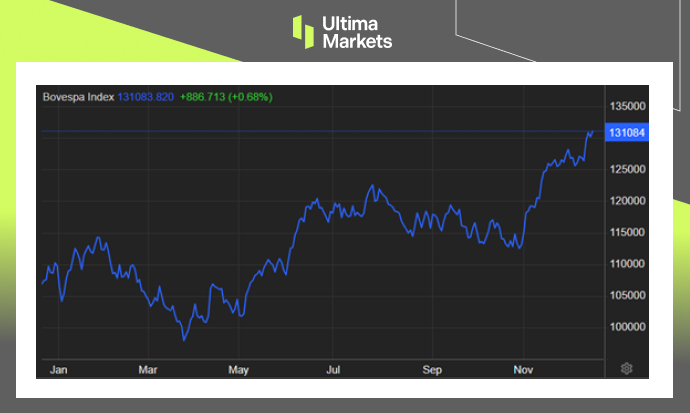
The Brazilian stock market, led by the Ibovespa index, achieved a remarkable 0.68% gain on Monday, reaching a historic high of 131,084 points. This surge not only erased previous session losses but also showcased the resilience of the market in the face of various economic factors.
(IBovespa Index One-year Chart)
Let’s delve into the key drivers and notable performers shaping the Brazilian equities landscape.
1. Petrobras and the Influence of Crude Oil Prices
The surge in international crude oil prices, driven by repeated attacks on oil tankers in the Red Sea, played a pivotal role in boosting the Ibovespa. Petrobras, the state-run oil giant, emerged as one of the top performers with a 1.2% increase in its stock price. The impact of geopolitical events on oil routes led to shipping diversions, contributing to a more than 3% rise in global oil prices.
2. Iron Ore Boosts Vale’s Performance
Another significant player in the market, Vale, the iron ore miner, experienced a 1.6% rise in its stock price. This surge can be attributed to sustained near one-and-a-half-year high prices for iron ore. The favorable market conditions for iron ore further contributed to the positive momentum of Brazilian equities.
3. Alpargatas and Casas Bahia: Divergent Paths
In the realm of consumer goods, Alpargatas emerged as a standout performer, posting a substantial stock gain of 6.3%. On the flip side, Casas Bahia, a prominent retailer, recorded a notable decline of 6.9%. These contrasting performances underscore the diverse dynamics within the Brazilian stock market.
4. Economic Outlook and Central Bank Projections
The latest projections from Brazil’s central bank, as outlined in the Focus Bulletin, revealed slightly reduced inflation forecasts and steady GDP growth expectations. This reinforces the anticipation that the central bank will persist in cutting the benchmark Selic interest rate to stimulate economic growth.
Investors are buoyed by optimism regarding Brazil’s economic recovery, a sentiment reflected in the record highs of the stock market.
5. Potential Risks: Political Uncertainties and Global Trade
Despite the positive trajectory, analysts caution against overlooking potential risks. Ongoing domestic political uncertainties and the looming specter of fallout from the US-China trade war could introduce volatility to the market in the coming days. It’s crucial for investors to stay vigilant and navigate the evolving landscape with foresight.
Frequently Asked Questions
Q1: What is the Ibovespa index?
The Ibovespa index is the main performance indicator of stocks traded on the B3, representing major companies in the Brazilian capital market. Established in 1968, it serves as a crucial barometer for the overall health of the Brazilian stock market.
Q2: How does geopolitical turmoil impact Brazilian stocks?
Geopolitical events, such as the recent attacks on oil tankers, can significantly influence Brazilian stocks. As witnessed with Petrobras, disruptions in global oil routes can lead to price surges, benefiting related industries and contributing to overall market gains.
Q3: What role does the Selic interest rate play in Brazil’s economic strategy?
The benchmark Selic interest rate is a key tool in Brazil’s economic strategy. The central bank’s decision to cut the rate, as indicated by the latest Focus Bulletin, reflects an effort to stimulate economic growth by making borrowing more affordable.
Bottom Line
Unlock the full potential of the Brazilian stock market with insights from the Ibovespa index, key performers like Petrobras and Vale, and a nuanced understanding of economic projections. Stay informed and navigate potential risks with confidence.