Important Information

This website is managed by Ultima Markets’ international entities, and it’s important to emphasise that they are not subject to regulation by the FCA in the UK. Therefore, you must understand that you will not have the FCA’s protection when investing through this website – for example:

  • You will not be guaranteed Negative Balance Protection
  • You will not be protected by FCA’s leverage restrictions
  • You will not have the right to settle disputes via the Financial Ombudsman Service (FOS)
  • You will not be protected by Financial Services Compensation Scheme (FSCS)
  • Any monies deposited will not be afforded the protection required under the FCA Client Assets Sourcebook. The level of protection for your funds will be determined by the regulations of the relevant local regulator.

Note: UK clients are kindly invited to visit https://www.ultima-markets.co.uk/. Ultima Markets UK expects to begin onboarding UK clients in accordance with FCA regulatory requirements in 2026.

If you would like to proceed and visit this website, you acknowledge and confirm the following:

  • 1.The website is owned by Ultima Markets’ international entities and not by Ultima Markets UK Ltd, which is regulated by the FCA.
  • 2.Ultima Markets Limited, or any of the Ultima Markets international entities, are neither based in the UK nor licensed by the FCA.
  • 3.You are accessing the website at your own initiative and have not been solicited by Ultima Markets Limited in any way.
  • 4.Investing through this website does not grant you the protections provided by the FCA.
  • 5.Should you choose to invest through this website or with any of the international Ultima Markets entities, you will be subject to the rules and regulations of the relevant international regulatory authorities, not the FCA.

Ultima Markets wants to make it clear that we are duly licensed and authorised to offer the services and financial derivative products listed on our website. Individuals accessing this website and registering a trading account do so entirely of their own volition and without prior solicitation.

By confirming your decision to proceed with entering the website, you hereby affirm that this decision was solely initiated by you, and no solicitation has been made by any Ultima Markets entity.

I confirm my intention to proceed and enter this website Please direct me to the website operated by Ultima Markets , regulated by the FCA in the United Kingdom
Roll Arrow

Decoding the ASX 200 Index Plunge: A Hierarchical Analysis


Main Point: ASX 200 Index’s Recent Decline

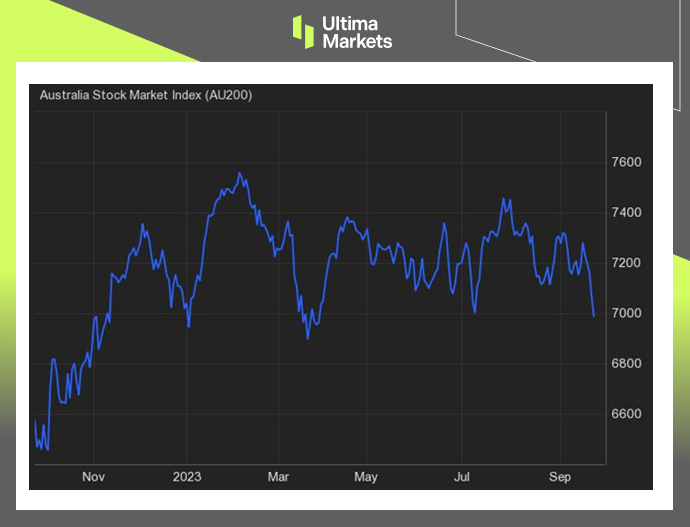
The ASX 200 Index tumbled 1.3% to below 7,000 on Sep. 22, hitting its lowest levels in six months and tracking losses on Wall Street overnight as the US Federal Reserve’s hawkish pause continued to weigh on investor sentiment.

The benchmark index is also on track to lose nearly 5% this week for its second consecutive weekly decline. Domestically, investors digested data showing Australia’s manufacturing activity contracted further in September, while services activity turned expansionary.


Impact on Key Sectors

Commodity-linked stocks led the decline with sharp losses from BHP Group (-2%), Rio Tinto (-2.3%), Fortescue Metals (-2.2%), Woodside Energy (-0.9%) and Newcrest Mining (-0.9%). Heavyweight financial, technology, and consumer-related firms slumped as well. 

(ASX 200 Index daily chart) 


The Judo Bank Flash Australia Manufacturing PMI

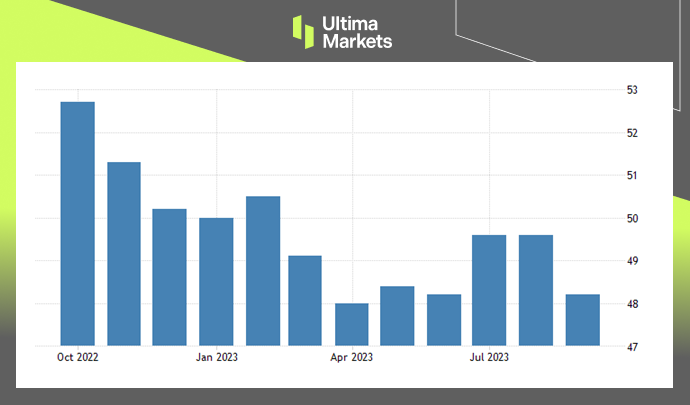
The Judo Bank Flash Australia Manufacturing PMI fell to 48.2 in September 2023, from 49.6 in the previous month, flash estimates showed. It pointed to the lowest reading in 4 months, indicating continued deteriorating business conditions across the sector.


Inflation and Pricing Strategies

A sharper fall in new orders led to manufacturing output shrinking for a tenth straight month in September. Consequently, firms reduced their purchasing activity and inventory holdings.

That said, employment levels rose with some manufacturers still facing a shortage of labor to support ongoing operations. Staffing constraints also led to a marginal lengthening of lead times.

Input cost inflation eased amid the drop in purchasing activity, while firms also raised their own selling prices at a slower rate. 

(Judo Bank Australia Manufacturing PMI, S&P Global) 


Implications and Conclusion

In conclusion, the ASX 200 Index’s recent nosedive results from a complex interplay of domestic and international factors.

The US Federal Reserve’s hawkish stance, along with domestic issues, especially the manufacturing sector’s contraction, has deepened economic uncertainties.

While challenges persist, businesses have demonstrated resilience in adapting to the evolving landscape.

In this volatile market, comprehending the intricacies of the ASX 200 Index’s journey is vital for investors and analysts alike.


Disclaimer  

Comments, news, research, analysis, price, and all information contained in the article only serve as general information for readers and do not suggest any advice. Ultima Markets has taken reasonable measures to provide up-to-date information, but cannot guarantee accuracy, and may modify without notice. Ultima Markets will not be responsible for any loss incurred due to the application of the information provided. 

Chia sẻ ngay

  • Article Details
  • Article Details
  • Article Details

Thank you for visiting the Ultima Markets website. Please note that this website is intended for individuals residing in jurisdictions where accessing is permitted by law. Ultima and its affiliated entities do not operate in your home jurisdictions.

By clicking on ''Acknowledge'', you confirm that you are entering this website solely based on your initiative and not as a result of any specific marketing outreach. You wish to obtain information from this website based on reverse solicitation principles, in accordance with the applicable laws of your home jurisdiction.