
Ultima Markets App
Trade Anytime, Anywhere





Important Information
This website is managed by Ultima Markets’ international entities, and it’s important to emphasise that they are not subject to regulation by the FCA in the UK. Therefore, you must understand that you will not have the FCA’s protection when investing through this website – for example:
- You will not be guaranteed Negative Balance Protection
- You will not be protected by FCA’s leverage restrictions
- You will not have the right to settle disputes via the Financial Ombudsman Service (FOS)
- You will not be protected by Financial Services Compensation Scheme (FSCS)
- Any monies deposited will not be afforded the protection required under the FCA Client Assets Sourcebook. The level of protection for your funds will be determined by the regulations of the relevant local regulator.
Note: Ultima Markets is currently developing a dedicated website for UK clients and expects to onboard UK clients under FCA regulations in 2026.
If you would like to proceed and visit this website, you acknowledge and confirm the following:
- 1.The website is owned by Ultima Markets’ international entities and not by Ultima Markets UK Ltd, which is regulated by the FCA.
- 2.Ultima Markets Limited, or any of the Ultima Markets international entities, are neither based in the UK nor licensed by the FCA.
- 3.You are accessing the website at your own initiative and have not been solicited by Ultima Markets Limited in any way.
- 4.Investing through this website does not grant you the protections provided by the FCA.
- 5.Should you choose to invest through this website or with any of the international Ultima Markets entities, you will be subject to the rules and regulations of the relevant international regulatory authorities, not the FCA.
Ultima Markets wants to make it clear that we are duly licensed and authorised to offer the services and financial derivative products listed on our website. Individuals accessing this website and registering a trading account do so entirely of their own volition and without prior solicitation.
By confirming your decision to proceed with entering the website, you hereby affirm that this decision was solely initiated by you, and no solicitation has been made by any Ultima Markets entity.
I confirm my intention to proceed and enter this website Please direct me to the website operated by Ultima Markets , regulated by the FCA in the United Kingdom

Copper powers EVs, modern grids, data centers and the wiring in your home. If you’re deciding how to invest in copper, you have three practical routes: track the metal’s price through a copper ETF, buy companies that mine it, or use exchange-traded futures. This guide explains each approach, the costs and risks, and how to choose what fits your goals.
Why Copper Now
This year, copper has been volatile for reasons that go beyond the usual “global growth” story. Tariff headlines and logistics reshaped where metal sits and how it’s priced: U.S. prices at times traded at a large premium to global benchmarks, pulling metal into American warehouses and draining LME stocks, which pushed the LME to tighten position rules to reduce stress in the system. In July, when refined copper was unexpectedly exempted from a planned U.S. tariff, COMEX prices saw a historic intraday plunge as traders unwound stockpiles. The takeaway for investors: policy and inventory dynamics can move copper just as much as traditional demand.
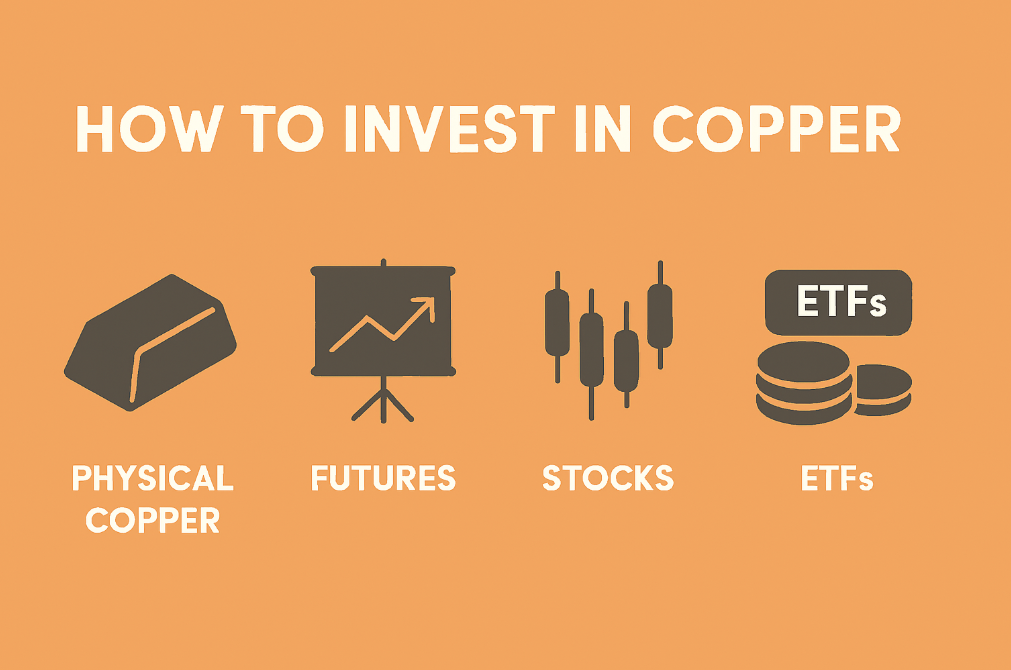
3 Main Ways to Invest in Copper
When you’re deciding how to invest in copper, you’ll usually choose between tracking the metal’s price, owning the businesses that produce it, or using derivatives for precision.
Track the Metal’s Price with a Copper ETF
If your goal is exposure to the commodity itself, a copper ETF (or ETN) that references copper futures is the most straightforward, listed route. You’re not betting on a management team or a mine; you’re trying to mirror copper’s price trend.
What to know in practice: futures-based funds “roll” from one contract to the next. That roll can add or subtract from returns depending on the curve (contango vs backwardation). Before you buy, check three basics on the fund page: the expense ratio, average bid–ask spread (liquidity), and the index or methodology that governs how and when it rolls. Then decide how you’ll implement: many long-term investors dollar-cost average a small allocation, rebalance quarterly, and avoid trading around headlines.
This is suitable for investors who want clean commodity exposure inside a diversified portfolio, prefer simple tickers, and don’t want single-company risk.
Futures-based copper ETFs/ETNs (pure price exposure):
- United States Copper Index Fund (CPER): Seeks to reflect the SummerHaven Copper Index Total Return (SCITR), a rules-based basket of COMEX copper futures. Understand roll methodology and tax treatment before you buy
- iPath Series B Bloomberg Copper Subindex ETN (JJC): Tracks a Bloomberg copper futures index in ETN form, easy access but adds issuer credit risk (unsecured note). Expense ratio ~0.45% (check before trading).
Own the Producers: Copper Mining Stocks (or a Miners ETF)
Buying miners gives you operational leverage to copper. When copper prices rise faster than costs, cash flow can ramp quickly; when prices fall or costs jump, the reverse happens. That’s why miners can outperform the metal in good cycles and underperform in drawdowns.
What to evaluate if you pick stocks: cost position (cash costs/AISC), grade and reserve life, jurisdiction and permitting risk, balance-sheet strength, hedging policy, and pipeline (expansions or new projects). If you don’t want to research individual names, a copper miners ETF spreads risk across multiple producers and developers while keeping daily liquidity. A miners ETF like COPX reduces single-company risk.
This is suitable for investors who comfortable with equity volatility who want potential upside torque, dividends from mature producers, and the possibility of value creation from new projects.
Use Futures (and Options) for Precision and Hedging
Futures are the direct market for copper. They’re capital-efficient and let you size exposure precisely, including with smaller “micro” contracts. They also introduce leverage, margin calls, and the need to manage contract expiries and rolls, tools best handled with a written plan.
How to implement well: start with education and a practice plan, then graduate to small positions. Define the maximum loss per trade and per day, pre-set your invalidation level, and schedule your roll into the next active contract before liquidity thins. Options on futures can cap downside or express views on volatility, but they add another layer of complexity.
Active traders and hedgers use COMEX futures:
- Standard Copper (HG): 25,000 lb contract; minimum tick $0.0005/lb = $12.50 per tick.
CME Group - Micro Copper (MHG): 2,500 lb (1/10th size) for finer sizing; tick $1.25. Useful for learning curve and risk control.
This is suitable for experienced traders and industrial users who need hedging or tactical exposure and are comfortable with leverage and disciplined risk controls.

Step-by-Step: How to Invest in Copper Safely
Define your thesis and time horizon
Are you expressing a multi-year electrification view or a tactical trade around inventories, tariffs and PMIs? In 2025, policy and logistics shifted regional pricing and exchange stocks so be explicit about your holding period and risk limits.
Pick the right vehicle
- I want the metal: Start with a futures-based copper ETF (e.g., CPER) or an ETN (JJC) if you accept issuer risk.
- I want equity torque and potential dividends: Use a miners ETF (COPX) or a curated basket of quality producers.
- I need precision or hedging: Consider HG/MHG futures once you have a written plan.
Understand costs and structures
- Expense ratios & spreads: Check the fund page on the day you trade (COPX ~0.65%; JJC ~0.45% historically; CPER ~0.97% listed by third-party screeners, verify live)
- Roll yield: Futures-based products may diverge from spot due to contango/backwardation. Read each fund’s roll rules (e.g., SCITR for CPER).
- ETN vs ETF: ETNs are unsecured notes; ETFs hold underlying assets/derivatives in a trust.
Position sizing and risk control
Copper’s 2025 swings around tariff headlines and inventory shifts show why you start small, diversify, and use stop-losses.
What to monitor
Keep an eye on the full copper ecosystem: supply dynamics such as mine outages, labour strikes, and smelting capacity constraints, demand signals from EV adoption rates, grid and renewable capex plans, and global PMI prints and inventories and spreads, including how LME and CME warehouse stocks and premia evolve. Layer on policy risk like tariff proposals, sanctions, and logistics bottlenecks at ports which can quickly reshape trade flows.
In 2025, the interaction of these forces produced unusual price and basis divergences between COMEX and LME and even prompted temporary rule tweaks at the LME, a reminder that monitoring fundamentals, inventories, and policy together is essential when deciding how to invest in copper or allocate via a copper ETF.
Pros and Cons
Copper ETFs / ETNs
- Pros: Easiest way to get copper exposure with a simple ticker. You follow the metal’s price without picking individual companies.
- Cons: Returns can drift from spot because funds roll futures. ETNs also carry issuer credit risk.
Copper Miners (stocks or a miners ETF)
- Pros: When copper rises and costs are under control, miners can climb faster than the metal. Some pay dividends. A miners ETF spreads the risk across many companies.
- Cons: You’re exposed to stock-market swings, higher costs, and country or policy issues. It won’t match copper’s price move exactly.
Futures / Options
- Pros: Powerful tools: small “micro” contracts let you size positions precisely, and futures track copper closely. Good for hedging or short-term views.
- Cons: Leverage cuts both ways. You must manage margin, contract rollovers, and a steeper learning curve. Start small and use a clear risk plan.
Conclusion
Commodities trading works best when you keep it simple, manage risk, and stay disciplined. Copper can play a clear role in a diversified portfolio because it links to long term trends in electrification and infrastructure. If your goal is pure metal exposure, a copper ETF can be a straightforward way to express the view. If you want potential equity upside, miners add torque but also company and country risk. If you need precision or hedging, futures offer direct access but demand a written plan, strict sizing, and respect for leverage.
Whichever path you choose, anchor your process to the basics of commodities trading. Define your thesis and time horizon, size positions small, and use limit orders. Check liquidity, fees, and how your product gains exposure. Monitor supply headlines, warehouse stocks, policy shifts, and demand indicators such as EV adoption and grid investment. Rebalance on a schedule and avoid reacting to single data points. That is how to invest in copper with clarity and keep it a well governed part of your broader strategy rather than a headline driven bet.
Disclaimer: This content is provided for informational purposes only and does not constitute, and should not be construed as, financial, investment, or other professional advice. No statement or opinion contained here in should be considered a recommendation by Ultima Markets or the author regarding any specific investment product, strategy, or transaction. Readers are advised not to rely solely on this material when making investment decisions and should seek independent advice where appropriate.
Latest Articles


FOLLOW US






Ultima Markets is a member of The Financial Commission, an international independent body responsible for resolving disputes in the Forex and CFD markets.

All clients of Ultima Markets are protected under insurance coverage provided by Willis Towers Watson (WTW), a global insurance brokerage established in 1828, with claims eligibility up to US$1,000,000 per account.

Ultima Markets is the first United CFD broker to be part of the United Nations Global Compact.
FOLLOW US
TRADE WITH US
RISK DISCLOSURE
Risk Warning:
Trading leveraged financial products, including Contracts for Difference (CFDs), carries a high level of risk and may result in losses exceeding your initial investment. These products are not suitable for all investors and should only be traded with funds you can afford to lose. You do not own or have any rights to the underlying assets of these derivatives (e.g., entitlement to dividends). Please ensure you fully understand the associated risks. Before trading, consider your level of experience, investment objectives, and seek independent financial advice if necessary. Refer to our legal documents and disclosures before making any trading decisions.
General Advice Warning:
The information provided on this website is general in nature and does not take into account your personal objectives, financial situation, or needs. Before acting on any advice, you should assess its appropriateness in light of your individual circumstances and consult our legal documentation.
Regional Restrictions:
The information and services on this website are not intended for residents of certain jurisdictions, including but not limited to the United States, United Kingdom, Singapore, and any jurisdictions subject to international sanctions. For further information, please contact our customer support team.
Regulatory Information:
Ultima Markets is a trading name shared amongst multiple entities operating in various jurisdictions. These following entities are authorised to operate under the Ultima Markets brand and trademarks.
-
Ultima Markets UK Limited, reference number 470325, is authorised and regulated by the Financial Conduct Authority (FCA). Registered address: 1 Blossom Yard, Fourth Floor, London, E1 6RS, UNITED KINGDOM.
-
Ultima Markets Ltd is authorised and regulated by the Financial Services Commission (FSC) of Mauritius as a Full-Service Investment Dealer (excluding Underwriting), under licence number GB 23201593.
Registered address: 2nd Floor, The Catalyst, 40 Silicon Avenue, Ebene Cybercity, 72201, Mauritius.

Copyright © 2025 Ultima Markets Ltd. All rights reserved.
-

Messenger


Continue on Messenger
Take the conversation to your Messenger account. You can return anytime.
Scan the QR code and then send the message that appears in your Messenger.
Open Messenger on this device.
-

Instagram

Continue on Instagram
Take the conversation to your Instagram account. You can return anytime.
Scan the QR code to open Instagram. Follow @ultima_markets to send a DM.
Open Instagram on this device.
-

Live Chat
-

